
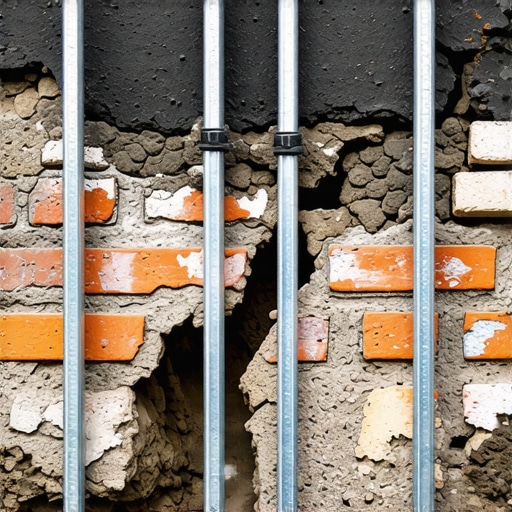
I was called to a textile mill near the riverbank three days after the floodwaters receded. The owner pointed at a vertical fracture running from the grade to the eaves and told me it was just a bit of ‘settlement’ from the rain. I didn’t say a word. I pulled my high-resolution boroscope from my kit and fed it into a weep hole. What I saw wasn’t settlement; it was a ghost. The lateral force of the saturated silt—weighing nearly 120 pounds per cubic foot—had pushed the backup wythe so hard that the galvanized wall ties had snapped like dry twigs. The brick veneer was standing by habit alone, a 40-foot curtain of clay waiting for a stiff breeze to become a pile of debris. This is the reality of masonry forensics after a geological event. When the earth moves or the water rises, the ‘tooth’ of your mortar and the integrity of your substrate are pushed to their absolute physical limits.
The Physics of Hydrostatic Failure and Lateral Loading
Most brick walls are designed to handle vertical loads—the weight of the roof and the floors above. They are remarkably poor at handling lateral loads, which is exactly what a landslide or a flood provides. When soil becomes saturated, it loses its internal friction and begins to behave like a fluid. This fluid pressure, or hydrostatic pressure, exerts a constant, outward force against foundation walls and masonry skins. If you don’t have a robust foundation waterproofing system in place, that water doesn’t just sit there; it migrates into the microscopic pores of the brick through capillary suction.
“Water penetration is the single greatest threat to masonry durability, particularly when external pressures exceed the resistive capacity of the wall assembly.” – BIA Technical Note 7
In a landslide scenario, the impact is even more violent. The kinetic energy of moving earth can shear a brick lintel or cause a sudden cold joint failure where the mortar meets the stone. This is why a masonry damage assessment is the first and most critical step. We aren’t just looking for cracks; we are looking for ‘bowing’ and ‘leaning,’ signs that the wall has detached from its structural frame.
The Digital Eye: AI Masonry Assessment and Subsurface Inspection
Modern forensic work has moved beyond the simple hammer-tap. We now utilize AI masonry assessment tools that can analyze thermal imaging and ground-penetrating radar to find ‘honeycombing’ or voids behind the facade that the human eye would miss. This is particularly vital in commercial smokestack repair, where the height and wind load make any internal structural compromise a potential catastrophe. These AI systems compare the current density of the wall against known standards, flagging areas where the commercial masonry maintenance has failed over decades, leaving the structure vulnerable to the sudden shock of a flood. If the internal steel is rusted to the point of ‘expansion’—a process where rust occupies up to ten times the volume of the original steel—it will blow the brick faces off from the inside out, a process known as spalling.
The Cure: Strengthening and Stabilization Techniques
Once we’ve mapped the damage, the ‘Band-Aid’ approach of slapping some mud in a crack won’t cut it. Strengthening a compromised wall requires a multi-pronged attack. For foundations that have tilted, we often look at self-leveling masonry lifts and helical piers to find stable strata. On the facade, brick lintel replacement is often necessary if the soil shift has dropped the support over windows or loading docks. When we repoint, we don’t just use any bag of pre-mix from the big-box store. We use mortar matching services to ensure the new ‘mud’ has a similar compressive strength and vapor permeability as the original. If you put a hard, high-portland Type S mortar into a wall built with soft 19th-century lime, the new mortar will literally crush the old bricks as the building breathes.
“Mortar should always be weaker than the masonry units it binds, acting as a sacrificial element that allows for thermal and moisture movement without fracturing the units themselves.” – ASTM C270 Standards
For those looking for modern resilience, metallic masonry finishes can provide a protective, non-porous barrier, but they must be applied only after the wall’s ‘breathability’ is accounted for through proper venting.
The Vertical Threat: Chimneys and Smokestacks
In the aftermath of a landslide, chimneys are often the first to show distress. Because they are heavy, isolated towers, any shift in the earth causes them to list. A chimney flashing repair might seem like a minor cosmetic fix, but if the lead or copper flashing has pulled away, it’s a sign that the entire stack has shifted. In commercial settings, commercial smokestack repair involves internal lining and often the installation of carbon fiber wraps to provide the tensile strength that masonry naturally lacks. You have to ‘butter’ your joints perfectly here; any ‘voids’ in the bed joints will collect acidic condensate, which, when mixed with flood moisture, turns into a corrosive slurry that eats the mortar from the inside. Do it once, do it right, or get out of the way when the stack decides it’s time to come down. This isn’t just about aesthetics; it’s about the cold, hard physics of survival in a changing landscape. If your mason doesn’t talk about ‘hydrostatic relief’ or ‘shear capacity,’ he’s not a mason; he’s a handyman with a trowel. And in a post-flood world, a handyman is the last thing your structural integrity needs.