
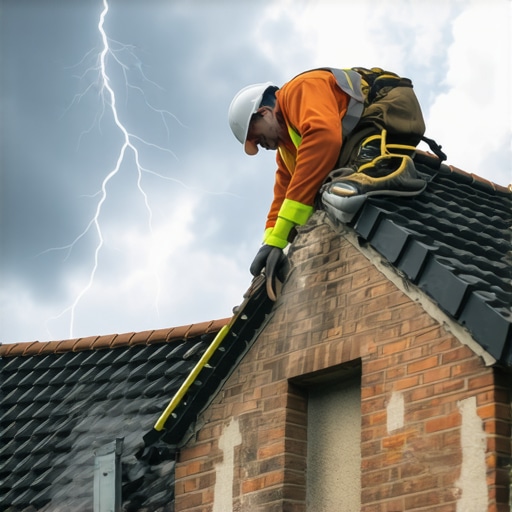
The property manager thought it was just a hairline crack. But when I put my scope inside that commercial parapet wall repair job, I saw the structural steel was rusted to dust. The brickwork was literally hanging by a thread of historical memory. I stood on that swaying scaffold, thirty feet up, looking at a wall that was weeping lime like a salted slug. This wasn’t just a cosmetic issue; it was a forensic scene where the killer was water, and the weapon was a failed masonry joint. In my three decades of laying mud and inspecting the failures of ‘handyman specials,’ I have seen this tragedy play out a thousand times. Homeowners see a small void in their brickwork and reach for a tube of silicone, but they don’t understand the complex thermodynamics of a masonry wall. Masonry is not a solid, static object; it is a breathing, porous system that requires a specific chemical balance to survive the brutal freeze-thaw cycles of the north. When you talk about high-performance tuckpointing weatherproofing, you aren’t just talking about aesthetic beauty; you are talking about the structural survival of the building envelope.
“Water penetration is the single greatest threat to masonry durability. Proper mortar joint finishing and maintenance are the primary defenses against moisture infiltration.” – BIA Technical Note 7
To understand why joints fail, we have to micro-zoom into the hydration of the mud. Modern contractors often commit the cardinal sin of using a high-PSI Portland cement on old, soft bricks. This is a death sentence. Old bricks are often softer than the mortar they were originally set in. When you introduce a rigid, non-breathable ‘hard’ mortar, you destroy the sacrificial principle. The mortar should always be slightly softer and more permeable than the brick itself. If the mortar is too hard, the water cannot escape through the joint; instead, it gets trapped behind the face of the brick. When that temperature drops and the water expands by 9% in its transition to ice, it exerts thousands of pounds of hydraulic pressure. The result? Spalling—where the face of the brick literally pops off, leaving the soft core exposed to the elements. This is why we use Type N or even Type O mortars for historic restoration, often incorporating fiber-reinforced mortars to add tensile strength without sacrificing the necessary vapor permeability. [IMAGE_PLACEHOLDER] When we begin the process of tuckpointing curved walls or straight soldier courses, we don’t just ‘butter’ over the old cracks. We use a vacuum-shrouded grinder to clear out the old, failing mud to a depth of at least one inch, or 2.5 times the width of the joint. Anything less is just a ‘band-aid’ that will peel off within two seasons. We look for the ‘tooth’ of the brick—that clean, roughened surface that allows the new mortar to form a mechanical bond.
Commercial parapet wall repair requires even more precision. These walls are exposed to the elements on both sides and suffer from extreme thermal expansion. Without proper relief joints and a high-quality brickwork sealants application, the parapet becomes a giant sponge. We often find that the original masons failed to install a proper capillary break. When we perform a retaining wall capstone replacement, we aren’t just swapping stones; we are ensuring the new capstone has a proper drip edge to shed water away from the face of the wall. If water is allowed to run down the vertical surface, it will eventually find its way into the core of the wall, leading to the dreaded efflorescence—those white, salty stains that are essentially the ‘corpse’ of a dying wall, the minerals being leached out of the masonry by constant moisture flow.
“Mortar joints shall be struck to a dense, weather-resistant surface. The choice of joint profile significantly impacts the wall’s ability to resist water penetration.” – ASTM C270 Standards
Sometimes the failure isn’t just in the joints; it’s in the earth itself. I’ve been called to sites where a brick column repair turned into a full-scale foundation helical pier installation because the soil had heaved so violently it snapped the masonry’s back. When a wall settles, it creates stair-step cracks that follow the path of least resistance through the mortar joints. If you see these, don’t just point them up. You need to stabilize the foundation first. Similarly, a brick paver driveway repair often fails because the ‘base’—the 8 inches of compacted gravel—was neglected. If the base isn’t solid, the pavers will sink and weave, creating ‘ponds’ that accelerate the degradation of the joints. For those looking at more modern solutions, 3D printed masonry repairs are beginning to emerge for restoring intricate, ornate details that would be too costly to hand-carve, but the fundamental physics remains: you must manage the water. Whether you are doing an outdoor fireplace rebuild or a simple tuckpointing job, you have to respect the ‘suction’ of the brick. If the brick is too dry, it will suck the moisture out of your mortar too fast, causing it to ‘flash set’ and crumble. You have to ‘slick’ the joint at the exact right moment of thumb-print hardness to create a dense, weather-resistant skin that will stand up to the coming storms.