
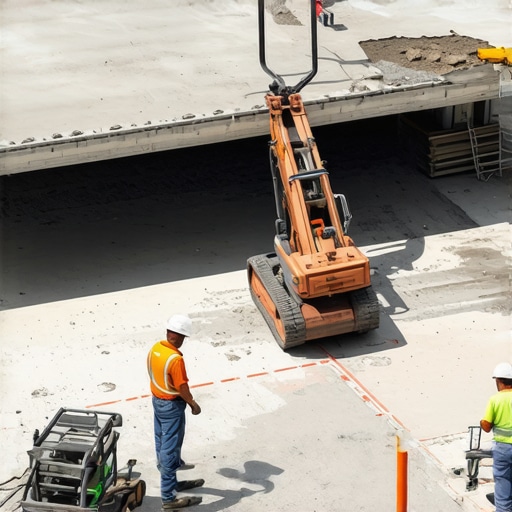
The Forensic Reality of the Sun Belt Slab
I was called to a commercial distribution center in the blistering heat of the Mojave. The owner pointed to a thin fissure running through the loading dock. To the untrained eye, it looked like a standard shrinkage crack from a hot pour. But when I dropped a laser level on the slab, the floor was four inches out of plumb over twenty feet. I took a core sample, and instead of finding a compacted sub-base, my drill dropped into an eighteen-inch void where the water table had scoured the earth out from under the concrete. That hairline wasn’t a surface blemish; it was the last scream of a dying foundation. In these high-heat environments, the physics of masonry and concrete are governed by the brutal reality of thermal expansion and flash setting. When a slab begins to ‘walk’ or settle, it isn’t just the concrete moving; it is the entire structural assembly, from the structural brick ties replacement needs to the chimney leak detection alerts on the roofline.
“Differential settlement of the foundation is the primary cause of cracking and distress in masonry veneers.” – BIA Technical Note 18A
The Physics of the Void: Why Slabs Shift
To understand how self-leveling lifts work, you have to understand the ‘tooth’ of the soil and the chemistry of the substrate. Most shifting happens because of the moisture-driven volumetric changes in expansive clays, particularly montmorillonite. When the clay drinks, it heaves; when it dries, it shrinks, leaving a gap. This gap creates a ‘cold joint’ of air where there should be stone. When a multi-ton commercial load rolls over that slab, the concrete flexes. Concrete is phenomenal in compression but garbage in tension. Without the support of the earth, it snaps. This is where commercial masonry facade maintenance becomes a forensic exercise. We aren’t just looking at the floor; we are looking at how that floor is pulling the brick veneer detachment repair schedule forward because the wall is literally hanging off the frame. The ‘suction’ of the dry soil beneath a hot slab can also pull moisture out of a fresh pour too quickly, leading to a brittle matrix that lacks the necessary C-S-H (Calcium Silicate Hydrate) gel density to resist cracking.
Self-Leveling Lifts: The Surgical Solution
We don’t use a sledgehammer where a scalpel is needed. Self-leveling lifting systems utilize a series of hydraulic manifolds that inject high-density structural polymers or high-performance mortar mixes directly into the void. This isn’t your grandfather’s mudjacking. We are talking about a controlled ‘buttering’ of the underside of the slab. As the material enters the void, it undergoes a phase change from a liquid to a rigid solid, expanding with enough force to overcome the ‘stiction’ of the slab against the surrounding soil. This process requires a slicker touch than laying a soldier course on a decorative arch. We monitor the lift in real-time using sub-millimeter laser sensors. If you lift too fast, you blow out the tuckpointing curved walls nearby. If you lift too slow, the ‘mud’ sets in the hose.
The Material Science of Stabilization
The chemistry of the lift material is critical. In historic contexts where we might be dealing with historic pointing styles and soft, hand-molded bricks, we cannot use a material that is harder than the original masonry. This is the ‘sacrificial’ principle. However, for a modern slab, we want a high-performance mix that offers low shrinkage and high early strength. This often involves brick efflorescence removal protocols after the lift, as the moisture introduced during the stabilization can push mineral salts to the surface of the adjacent masonry. We look for a mix that manages the ‘vapor drive’—the movement of moisture through the capillary network of the concrete. If the stabilization material blocks this drive entirely, you end up with chimney leak detection issues as moisture is forced upward into the wall cavities, rotting out the structural brick ties replacement points before you even realize there’s a problem.
“The selection of mortar should be based on the properties of the masonry units and the exposure conditions.” – ASTM C270 Standard Specification for Mortar for Unit Masonry
Restoring the Facade: Beyond the Slab
Once the slab is level, the work moves to the vertical. A shifting slab always leaves a trail of destruction in the masonry above. You’ll see it in the brick veneer detachment repair needs where the wall has bowed outward because the foundation ‘toed’ in. We have to go back in and perform tuckpointing curved walls or replace retaining wall block replacement units that have been crushed by the shift. For driveways, brick paver driveway repair involves pulling up the units, re-leveling the sand bed with the same precision as the main slab, and re-setting the ‘tooth’ of the pavers. If you don’t address the brick efflorescence removal at this stage, the salt crystals will continue to grow in the pores of the brick, a process called subflorescence, which can pop the face of a brick off just as surely as a freeze-thaw cycle in the north.
The Master Mason’s Verdict
Don’t trust a handyman with a bag of ready-mix and a hydraulic jack. Structural stabilization is a symphony of geotechnical engineering and forensic masonry. Whether it’s commercial masonry facade maintenance or a simple brick paver driveway repair, the goal is the same: restore the structural integrity without creating new stress points. A real pro knows that the ‘mud’ on his hawk is only as good as the soil it’s sitting on. When we finish a lift, the slab should ‘ring’ when you strike it—a solid, deep thud that tells you the void is gone and the building is once again at rest. Do it once, or do it twice; the choice is usually found in the thickness of your high-performance mortar mixes and the patience of your mason.