
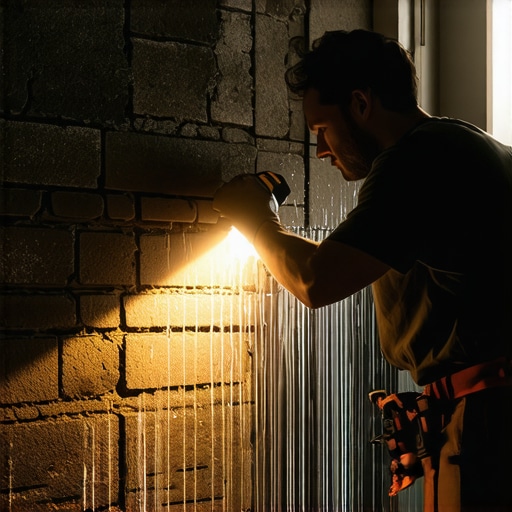
The Forensic Reality of Water Seepage
The homeowner thought it was just a hairline crack, a minor aesthetic blemish on the face of a century-old facade. But when I put my scope inside that fissure, the reality was much grimmer: the structural steel was rusted to dust. For three generations, my family has been reading the language of stone and clay, and if there is one thing I have learned, it is that water never sleeps. It is a patient predator, searching for any microscopic opening to begin the slow process of deconstruction. Most people see a wall as a solid object; I see it as a porous membrane under constant hydraulic siege.
The Physics of the Porous Membrane
To understand why your chimney rebuild services or stone veneer repair are failing, you have to understand the micro-zoomed physics of masonry. We are dealing with capillary action. Masonry materials like brick and stone have a natural ‘suction’ or ‘tooth’ that pulls moisture deep into their core through a network of microscopic pores. When rain hits a wall, it doesn’t just run off; it is absorbed. In a healthy wall, this moisture evaporates back out once the sun shines. However, when we introduce modern ‘lick-and-stick’ veneers or non-breathable sealants, we create a trap. This is where masonry staining often begins—not as an external pollutant, but as internal minerals being pushed to the surface by trapped water.
“Water penetration is the single greatest threat to masonry durability. Moisture can cause efflorescence, spalling of the masonry units, and corrosion of embedded metals.” – BIA Technical Note 7
The Tragedy of the Wrong ‘Mud’
One of the biggest crimes in historic masonry preservation is the use of modern Portland cement on old, soft bricks. I have walked onto countless jobs where a ‘handyman’ applied a hard Type S mortar to a 1920s bungalow. Because the new mortar is harder than the old brick, it doesn’t allow for thermal expansion. Instead of the mortar joint acting as a ‘cushion,’ it acts as a hammer. When the temperature shifts, the brick face pops off—a process we call spalling. For historic brickwork repointing, you must use a ‘sacrificial’ mortar, typically a lime-rich Type N or Type O, which is softer than the brick itself. This ensures that the mortar fails before the brick does, making future mortar repointing services a simple maintenance task rather than a structural disaster.
The Anatomy of a Leak: From Chimneys to Parapets
If you are looking for the source of seepage, you start at the top. Commercial parapet wall repair is often ignored until the ceiling inside starts to sag. These walls are exposed to the elements on three sides, making them prime candidates for water infiltration. When structural brick ties replacement is neglected, the outer wythe of the wall can actually peel away from the backup, creating massive voids for water to pool. This often manifests as honeycombing in the backup material or a cold joint where new and old concrete failed to bond. Similarly, a chimney is essentially a vertical straw for water. Without proper flush pointing services and a solid crown, water travels down the flue, rotting the structure from the inside out.
“Mortars for masonry construction shall be specified by either the property or proportion specifications of ASTM C270.” – ASTM International Standards
The Master’s Process: Grinding and Buttering
When we perform historic brickwork repointing, we don’t just slap new mud over the old. We grind out the joints to a depth of at least twice the width of the joint, ensuring the new material has enough ‘grab.’ We use a hawk to hold the mortar and a slicker or jointer tool to compress the mud into the gap. This compression is vital; it forces the mortar against the ‘tooth’ of the brick, creating a watertight seal. We call this ‘buttering’ the joint. If the mortar is too wet, it shrinks and cracks; if it is too dry, it won’t bond. It’s a balance of chemistry and tactile feel that a machine simply cannot replicate. For those looking for a tuckpointing cost estimation, remember that you are paying for this precision, not just the raw materials.
Structural Integrity and the Invisible Enemy
In many forensic cases, the leak isn’t the primary problem—it’s a symptom of structural brick ties replacement needs. When the steel ties that hold your brick veneer to the studs rust away, the wall begins to ‘bow.’ This creates internal pressure that cracks the mortar, allowing even more water in. It is a vicious cycle of decay. Professional stone veneer repair must address these hidden structural failures before the cosmetic work begins. Otherwise, you are just putting a fresh coat of paint on a sinking ship. Do it once, or do it twice—the choice is always yours in the world of masonry.