
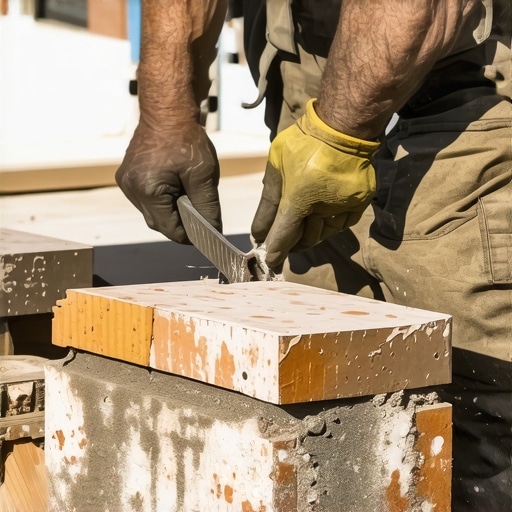
The Grit and Geometry of the Perfect Birdsmouth Cut
I remember the first time I saw a rookie try to execute a birdsmouth cut on a 120-year-old chimney. He approached the scaffold with a shiny 12-inch diamond blade and a look of unearned confidence. Ten minutes later, he had shattered a piece of rare, oversized Victorian face brick that had survived a century of North Atlantic winters. He didn’t understand the ‘heart’ of the brick. My old mentor, a man who had more lime under his fingernails than blood in his veins, used to say that a brick doesn’t just sit in a wall; it breathes, it expands, and it demands a seat that respects gravity. If you don’t ‘ring’ the brick before you cut it, you’re just guessing. A birdsmouth cut—that V-shaped notch used to marry a brick to a corner or a structural transition—is where masonry stops being a trade and starts being forensic engineering.
“Water penetration is the single greatest threat to masonry durability. Proper detailing of joints and units is the primary defense against systemic failure.” – BIA Technical Note 7
The Physics of the Notch: Why Precision Matters
When we talk about historic masonry preservation, we aren’t just talking about aesthetics. We are talking about the management of load and the mitigation of moisture. A birdsmouth cut is often required in outdoor masonry fountain restoration or when navigating the complex geometry of a commercial smokestack repair. The ‘V’ must be precise to ensure that the mud (mortar) has a consistent thickness. If your cut is jagged, you create ‘pressure points.’ Over a decade of freeze-thaw cycles, those pressure points become the epicenter of a structural crack. In the North, where water expands 9% upon freezing, a poorly executed birdsmouth acts like a wedge, slowly prying the facade away from the backup wythe.
The Tools of the Forensic Mason
Forget the high-speed grinders for a moment. If you’re working with historic brick salvage, a high-RPM blade can glaze the internal pores of the clay, destroying the ‘tooth’ of the material. Without that tooth, your mortar won’t achieve the necessary suction. I prefer a scutch hammer or a sharp tungsten carbide chisel for the final ‘honing’ of the notch. This leaves the surface slightly raw, allowing the advanced masonry adhesives or traditional lime mortars to bond at a molecular level. When you butter a birdsmouth, you aren’t just slapping mud on; you are creating a hydraulic seal.
The Restoration Reality: Why ‘Hard’ is the Enemy of ‘Old’
One of the biggest sins in historic brickwork repointing is the use of modern Portland cement on soft, pre-1940s units. I’ve been called to dozens of sites for chimney repair services where the homeowner thought they were ‘strengthening’ the stack by using Type S mortar. Instead, they guaranteed its destruction. The mortar must be the sacrificial lamb of the wall. It must be softer than the brick. When you’re executing a birdsmouth in a historic tuckpointing project, you must use a Lime-based mix—Type O or even a pure Lime Putty. This allows for autogenous healing, where the lime actually migrates into hairline cracks to reseal them over time.
“The modulus of elasticity in masonry mortar must be lower than that of the masonry units to ensure that stress is distributed and not concentrated.” – ASTM C270 Standard Specification
Mastering the Cut: A Step-by-Step Approach
First, identify the angle. In a retaining wall drainage upgrade, you might use birdsmouth cuts to create elegant soldier course transitions that hide retaining wall weep hole cleaning access points. Mark your brick with a carpenter’s pencil—never a wax crayon, which kills the suction. Use a hawk to hold your mortar ready, and ensure the brick is ‘Saturated Surface Dry’ (SSD). If the brick is too dry, it will suck the water out of the mud too fast, leading to ‘flash setting’ and a weak bond. If it’s too wet, it will float, and your birdsmouth will slip out of alignment.
The Science of Hydration and Carbonation
Micro-zooming into the mortar: when we mix our mud, we are initiating a complex chemical dance. In traditional restoration, we rely on carbonation—the absorption of CO2 from the atmosphere to turn lime back into limestone. This is a slow process that can take years to fully complete, but it results in a flexible, breathable structure. Modern ‘lick-and-stick’ contractors don’t understand this. They want it to get hard in an hour. But in commercial smokestack repair, that rigidity is a death sentence. The stack needs to sway and expand. A birdsmouth cut provides the geometric relief for that movement, provided the mortar allows it.
Beyond the Brick: Drainage and Longevity
No matter how perfect your birdsmouth is, if you haven’t addressed retaining wall drainage upgrade needs, the wall will fail. Hydrostatic pressure is a silent killer. I’ve seen 24-inch thick stone walls bowed out like a sail because the weep holes were clogged or nonexistent. When laying your notched bricks, always consider where the water is going. In outdoor masonry fountain restoration, the birdsmouth is often the point of highest saturation. Using advanced masonry adhesives in conjunction with traditional mortars can provide the extra insurance needed in high-moisture environments, but they must be vapor-permeable.
The Final Strike: Finishing the Joint
Once the brick is set, the job isn’t done. You have to ‘strike’ the joint. Using a slicker or a jointer tool, you compress the mortar into the birdsmouth notch. This compaction is vital. It pushes the binder to the surface and creates a ‘weather-struck’ profile that sheds water. If you leave the joint ‘shaggy,’ you’re just inviting moss and ice to take up residence. This is especially critical in historic tuckpointing, where the illusion of a razor-thin joint is maintained by a contrasting bead of lime put into a hidden birdsmouth groove.
In the end, masonry is about legacy. It’s about building something that your grandkids will have to point at and say, ‘He did that right.’ Whether you are performing retaining wall weep hole cleaning or a complex chimney repair services job, the birdsmouth cut remains the litmus test of a true master. It requires the eye of an architect and the hands of a laborer. Don’t rush it. Don’t use cheap mud. And for heaven’s sake, don’t use a grinder where a chisel belongs.