
The Forensic Reality of Architectural Heights
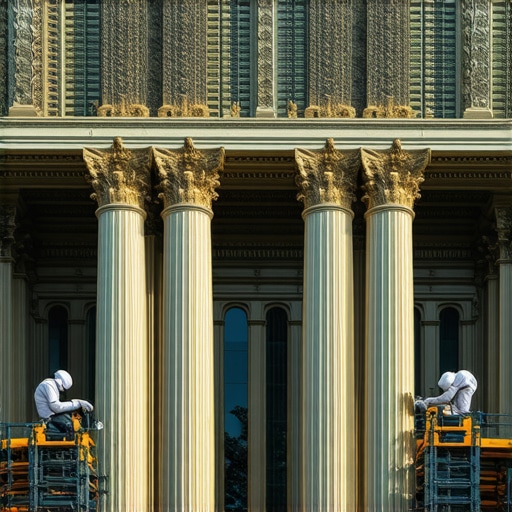
The street level hides a thousand sins, but eighty feet up on a boom lift, the truth of a century-old building is written in the cracks. I was recently inspecting a Victorian-era facade where the homeowner thought they just had a bit of peeling paint on the upper decorative elements. When I put my fiber-optic scope inside a hairline fracture in the stone, I saw ‘the ghost’—the structural iron tie-backs had oxidized into a brittle red powder. Five tons of carved limestone were essentially balancing on a prayer. This is the world of high-stakes masonry forensics, where a failure to understand the physics of gravity and moisture leads to catastrophic structural collapse.
The Geometry of Survival: Masonry Birdsmouth Cuts
When we talk about the longevity of a cornice or a stone balustrade restoration project, we aren’t just talking about aesthetics; we are talking about water management. The masonry birdsmouth cuts—those precise V-shaped notches designed to seat one stone into another—are the primary defense against the elements. If these are cut with even a two-degree variance from the original design, you create a pocket where water sits. In a northern climate, that water is a ticking time bomb.
“Water penetration is the single greatest threat to masonry durability, leading to efflorescence, spalling, and the eventual disintegration of the structural matrix.” – BIA Technical Note 7
During freeze-thaw damage restoration, we often find that the original craftsman’s birdsmouth was perfect, but a later ‘handyman’ filled the gap with modern brickwork sealants application. This is a death sentence for the stone. High-performance sealants often trap internal moisture, preventing the stone from ‘breathing.’ When that trapped water hits 32 degrees Fahrenheit, it expands by 9%. This internal pressure is greater than the tensile strength of the limestone, causing the face of the cornice to pop off in a process called spalling.
The Digital Stone Cutter: 3D Scans and Robotic Precision
Modern restoration doesn’t mean abandoning the old ways; it means giving the old ways a digital brain. Using LIDAR 3D scans, we can capture the ‘sugar-fretting’ and profile of a weathered cornice with sub-millimeter accuracy. This point cloud is then fed into a 6-axis robotic milling arm. This isn’t ‘cheating’—it’s sustainable block cutting. The robot can rough out the complex geometry of a replacement stone in hours, a task that would take a mason weeks of heavy lifting. However, the ‘tooth’ of the stone—the final texture that allows the mud to bond—must still be finished by hand with a chisel and a hawk. We use these robotic tools to ensure that the replacement stone perfectly matches the expansion coefficient of the surviving original elements. Without this precision, the new stone and the old stone will fight each other during thermal cycles, leading to emergency masonry repair within a decade.
The Chemistry of the ‘Mud’: Why Portland is the Enemy
One of the biggest scams in the industry is the use of modern Portland cement on historic structures. Old stones and bricks are soft; they are meant to move. If you use a hard, brittle mortar (Type S or M) on a restoration project, you are creating a ‘cold joint’ that will eventually crush the original material. We advocate for sustainable masonry materials, specifically hydraulic lime mortars. The mortar must be the sacrificial element of the wall. It is designed to be softer than the stone so that the inevitable stresses of the building shifting are absorbed by the mortar joints, not the irreplaceable carved stone.
“The use of mortar that is harder than the surrounding masonry units is a primary cause of irreversible masonry decay in historic structures.” – ASTM C270 Standards
When we are buttering a new stone for a cornice, we ensure the suction of the stone is managed by pre-wetting. If the stone is too dry, it sucks the moisture out of the lime putty too fast—what we call ‘burning’ the mud—and the bond never truly crystallizes.
Restoring the Flow: From Fountains to Balustrades
The same physics apply to outdoor masonry fountain restoration and spalled concrete steps repair. In these high-moisture environments, mortarless masonry systems are sometimes preferred for their ability to allow rapid drainage. For a stone balustrade restoration, each spindle must be anchored not with rigid iron, but with stainless steel or bronze pins set in lead or soft lime to prevent the ‘rust-jacking’ I saw on that Victorian cornice. If you see honeycombing in the concrete or stone of a fountain, it’s a sign that the aggregate was poorly graded or the mix was vibrating too much during the set. We fix this by injecting micro-fine lime grouts that find their way into the capillaries of the stone, re-consolidating the matrix without changing the outward appearance. Do not trust a contractor who suggests a simple ‘slicker’ coat of cement to hide the damage; they are just burying the problem for the next generation to find. Real masonry work isn’t about the finish; it’s about the physics of what’s underneath.