
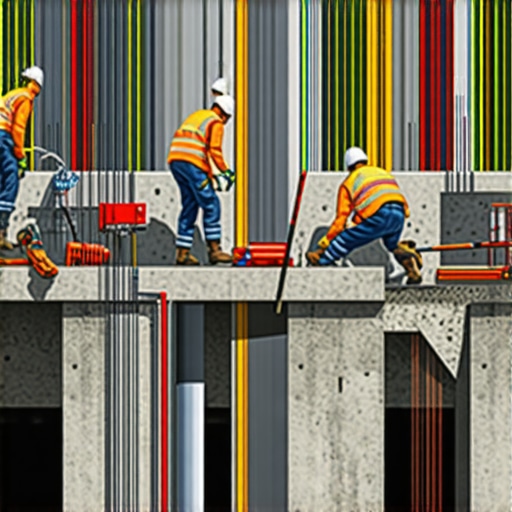
The Ghost in the Concrete: A Forensic Scene
The facility manager thought it was just a hairline crack, a minor nuisance in a forty-thousand-square-foot commercial basement. But when I slid my borescope into the core of those Concrete Masonry Units (CMU), the reality was grimmer. I saw the structural steel was rusted to dust, a victim of decades of neglected hydrostatic pressure and poor drainage. The air in that basement didn’t just smell like damp earth; it smelled like the slow decay of a massive investment. In this trade, you learn that the wall doesn’t lie, but the people who built it often do. I’ve spent forty years listening to what the stone tells me, and most of the time, it’s screaming for help. This isn’t about slapping some paint on a wall; it’s about understanding the physics of load-bearing assemblies and the chemistry of the mud that holds them together.
The Anatomy of CMU Failure
A standard 8x8x16 CMU block is an engineering marvel of voids and webs, but it’s also a sponge. In commercial applications, these foundations are often subjected to lateral earth pressures that exceed their design capacity. When we perform a masonry damage assessment, we aren’t just looking at the surface. We are looking for the ‘bow.’ A horizontal crack at the third or fourth course is a textbook sign of hydrostatic pressure. Water weight in the surrounding soil is pushing against the hollow cores of the block. If those cores weren’t properly grouted or if the rebar was placed by a ‘handyman’ who didn’t know a hawk from a handsaw, the wall starts to shear. This is where foundation underpinning becomes the only language that matters. You have to transfer that load to a deeper, more stable stratum before the entire assembly buckles under the weight of the structure above.
“Water penetration is the single greatest threat to masonry durability.” – BIA Technical Note 7
In the North, we deal with the brutal reality of the freeze-thaw cycle. Water expands 9% when it turns to ice. If your CMU walls are saturated because the exterior parging has failed, that expansion happens inside the block. It pops the faces off in a process we call spalling. I’ve seen brick veneer detachment repair jobs where the entire facade was literally hanging by a thread because the wall ties had rusted through from the inside out. You can’t just ‘butter’ the edges and hope for the best. You need to understand the suction. A dry, thirsty brick will suck the life out of your mortar before it has a chance to hydrate. That’s how you get a cold joint—a bond so weak you could kick it over with a steel-toe boot.
The Physics of the Fix: Underpinning and Jacking
When the slab starts to dip, people start panicking. They look at foundation slab jacking as a miracle cure. And it can be, if the physics are respected. We’re talking about injecting high-density polyurethane or a cementitious slurry under the slab to lift it back to its original grade. But if the underlying cause—usually poor soil compaction or a broken storm line—isn’t addressed, you’re just throwing money into a hole. It’s the same with foundation underpinning using helical piers. You have to torque those piers into the load-bearing soil. I’ve watched ‘pros’ stop as soon as they hit a little resistance, only to have the building settle another two inches six months later. It makes my blood boil. You do it once, or you do it twice. There is no in-between in masonry.
Tuckpointing and the Myth of Hard Mortar
I see it every day: some ‘specialist’ takes a diamond blade grinder to a 100-year-old wall and packs it with high-strength Portland cement. That is a death sentence for the building. Old bricks are soft. They breathe. The mortar must be the sacrificial lamb in the equation. It needs to be softer than the brick so that when the wall moves—and it will move—the mortar cracks, not the unit. We use tuckpointing brick walls as a restorative art, often employing flush pointing services to ensure water sheds away from the joint. If you use a mortar that’s too hard, the moisture gets trapped, freezes, and the brick face explodes. That’s the ‘lick-and-stick’ mentality that is ruining our architectural heritage.
“Cracks in masonry are the result of internal or external forces exceeding the strength of the material.” – ASTM C1197
We’ve also started seeing a trend in metallic masonry finishes and self-healing concrete foundations. While the chemistry of a self-healing slab—using bacteria to precipitate calcite and seal micro-cracks—is fascinating, it’s not a substitute for proper drainage. And those metallic finishes? They often act as a vapor barrier. In a commercial basement, you need the wall to breathe. If you seal it with a non-permeable coating, you’re just trapping the water. The result? Brick efflorescence removal becomes a weekly chore as the salts are pushed to the surface by the trapped moisture, leaving a white, chalky ghost on your expensive finish.
Modern Tools: Drones and Scopes
A drone chimney inspections might seem like overkill for a basement job, but it’s part of a holistic forensic approach. A leaking chimney crown three stories up can send water straight down the interior wall cavity, pooling at the foundation. My grandfather used to climb a ladder with a hammer and a prayer; I use 4K thermal imaging. We look for the thermal signature of wet insulation and saturated masonry. It’s about finding the source, not just treating the symptom. When I see honeycombing in a concrete pour, I know the vibration wasn’t handled right. That’s a structural weak point that will eventually lead to a blowout. In this business, if you don’t respect the ‘mud,’ the ‘mud’ will eventually bury you. Whether it’s brick veneer detachment repair or stabilizing a massive CMU warehouse foundation, the rules of physics don’t change because you’re in a hurry. You respect the tooth of the stone, you manage the water, and you never, ever trust a ‘handyman special.'”, “image”: {“imagePrompt”: “A gritty, high-detail photograph of a master mason inspecting a horizontal crack in a commercial CMU foundation wall in a dimly lit basement. The mason is using a borescope, and the texture of the damp, salt-stained concrete blocks is highly visible. Tools like a hawk and trowel are visible in a bucket nearby.”, “imageTitle”: “Forensic Masonry Inspection of CMU Foundation”, “imageAlt”: “Master mason performing a forensic inspection on a cracked commercial basement wall.”}, “categoryId”: 0, “postTime”: “”}