
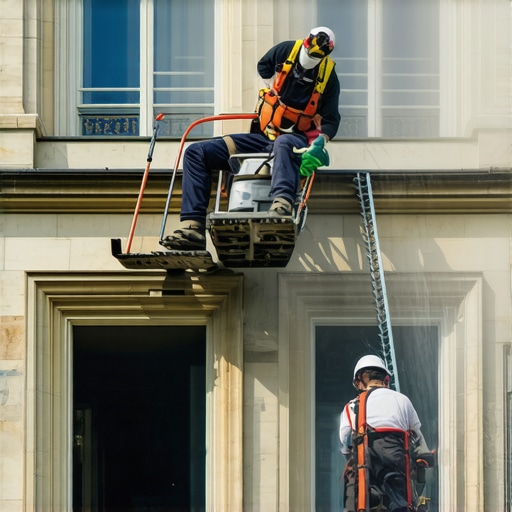
The Black Crust: More Than Just Grime
When I walk up to a limestone building that has been sitting in an urban corridor for eighty years, I don’t just see a dirty wall. I see a slow-motion chemical war. That black, soot-like skin clinging to the protected areas of the cornices and window headers isn’t just ‘pollution.’ It’s a gypsum crust—a cancerous transformation of the stone’s own calcium carbonate into calcium sulfate. If you approach this with a pressure washer set to 3000 PSI, you aren’t cleaning the building; you are skinning it alive. I’ve spent thirty years watching ‘restoration’ crews blow the face off historic masonry, leaving behind a porous, weeping mess that will crumble within a decade.
The Old Master’s Rule: The Calcite Skin
My Uncle Sal, who could lay a soldier course blindfolded in a Nor’easter, used to tell me that a piece of limestone has a ‘soul’ that lives in its first eighth of an inch. He’d rub his thumb over a freshly quarried block and talk about the ‘quarry sap’—the moisture that evaporates and leaves behind a hard, protective calcite skin. ‘Once you break that skin, boy,’ he’d say, ‘the stone starts its funeral.’ This is why we don’t use sandblasting. This is why we don’t use harsh acids. If you strip that natural hardening, the soft interior of the stone is exposed to the elements, and it will soak up water like a sponge. When the freeze-thaw cycle hits, that trapped water expands by 9%, and you’ll find your facade lying on the sidewalk in flakes.
“Water penetration is the single greatest threat to masonry durability.” – BIA Technical Note 7
The Chemistry of Decay: Why Limestone Suffocates
Limestone is a sedimentary rock, primarily calcium carbonate. In an urban environment, sulfur dioxide from vehicle exhaust and industrial processes mixes with moisture to form weak sulfuric acid. When this acid hits the stone, it reacts with the calcium carbonate. The result? Gypsum. Unlike the original stone, gypsum is water-soluble. On parts of the building that get hit by rain, the gypsum simply washes away, a process called ‘surface recession.’ But in the shadows—under the arches of a brick arch restoration project or tucked into the deep recesses of a chimney repair services job—the gypsum accumulates. It traps soot, fly ash, and carbon, forming a hard, black, impermeable shell. This shell prevents the stone from ‘breathing.’ Moisture gets trapped behind the crust, salts build up (efflorescence), and eventually, the pressure of those salt crystals (subflorescence) pops the face of the stone off in a process called spalling.
Forensic Cleaning: The Nebulous Spray Approach
The safest way to clean limestone is through patience, not power. We use what’s called ‘nebulous water pressure.’ This involves setting up a misting system that creates a fog around the stone for 24 to 72 hours. This slowly softens the gypsum crust without saturating the core of the masonry. We aren’t looking for a ‘cold joint’ where water stops and starts; we want a gentle, uniform soak. After the crust is softened, we use natural bristle brushes—never wire—to gently agitate the mud and rinse it away. It’s tactile, it’s slow, and it’s the only way to ensure you don’t destroy the tuckpointing brick walls or the delicate limestone ornaments. For areas with severe staining, we might use a poultice—a clay-based paste that draws the contaminants out of the stone’s pores through capillary action. It’s like a detox for the building.
Beyond the Surface: Structural Integrity and Foundation
Cleaning a facade often reveals the skeletons in the closet. Once the grime is gone, you might see the ‘stair-step’ cracks that indicate a settlement issue. This is where cracked brick wall repair meets geotechnical engineering. If the limestone blocks are shifting, no amount of cleaning will save the building. We look at the dirt. Is the soil heaving? Is hydrostatic pressure pushing against the basement? In many historic restorations, we find that the original footings are failing. This requires foundation underpinning or the installation of foundation helical pier installation to transfer the building’s load down to stable load-bearing strata. Without a stable base, your beautifully cleaned limestone will simply crack again as the structure continues its slow lean into the earth.
“The use of harsh chemicals or high-pressure water can cause irreversible damage to the surface of historic masonry.” – ASTM C1496
Modern Tech Meets Old World Craft: Digital Twins and 3D Printing
We aren’t just using trowels and hawks anymore. On high-stakes digital twin masonry projects, we use LiDAR to map the facade to a millimeter’s accuracy. This allows us to track cracks over time and identify where retaining wall capstone replacement is needed before the wall actually fails. If a specific limestone gargoyle or scroll has been dissolved by acid rain beyond repair, we can now utilize 3D printed masonry repairs. We scan the remaining fragment, mirror it digitally, and print a replacement using a stone-dust composite that matches the original density and porosity. It’s a marriage of the digital and the physical that my grandfather wouldn’t have believed, but it saves the ‘tooth’ of the architecture for another century.
The Maintenance Loop: Chimneys and Caps
A facade is only as good as its roof. If your chimney sweep and repair specialist isn’t looking at the flashing where the limestone meets the brick, you’re in trouble. Water that enters at the top of a chimney or through a failed retaining wall capstone replacement will travel down the interior of the wall. By the time it reaches the limestone facade, it’s carrying dissolved salts that will burst through the stone. You have to seal the top to save the bottom. This is the holistic nature of forensic masonry. You don’t just ‘butter’ a joint and walk away. You look at the drainage, the soil, and the chemistry of the ‘mud’ you’re using to ensure it’s softer than the stone itself. If you use a high-strength Portland cement on soft limestone, the stone will be the one to break. We always specify a Type N or even a Type O lime-based mortar for these historic jobs—it’s the sacrificial lamb that allows the stone to survive.
Final Inspection: Do It Once, Do It Right
The goal of cleaning limestone isn’t to make it look brand new; it’s to make it healthy. A building should show its age, but it shouldn’t show its neglect. When you see a crew out there with ‘leftover material’ and a pressure washer, run the other way. Real masonry restoration is about understanding the physics of the wall—how it breathes, how it moves, and how it handles the inevitable attack of the elements. Whether you’re dealing with a simple cracked brick wall repair or a full-scale facade restoration, remember that you are a steward of history. Don’t let a ‘handyman special’ turn a hundred-year-old masterpiece into a pile of rubble. Use the right chemistry, respect the calcite skin, and for heaven’s sake, keep the pressure washer in the truck.