
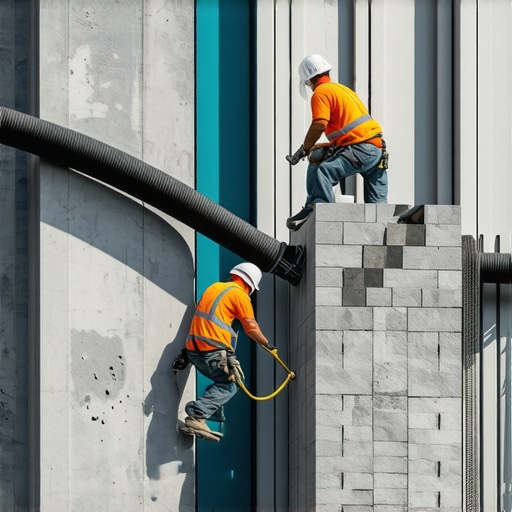
The Anatomy of the Lift: Why Gravity is Your Greatest Adversary
The vibration in the line tells you everything you need to know before the mud even hits the hopper. If it’s a rhythmic, dull thud, the mix has the right viscosity; if it’s a sharp, metallic clank, your aggregate is segregating and you’re seconds away from a plugged line or a cold joint that will haunt the structure for fifty years. In my thirty years of forensic masonry, I have seen the same story repeated on high-end stone facade restoration projects and massive industrial chimneys: the assumption that concrete is a static fluid. It isn’t. It is a violent, heavy chemical reaction that exerts massive hydrostatic pressure the moment you start a vertical lift.
I remember a scene on a blustery November morning near the Great Lakes. The contractor was attempting a chimney flue liner installation with a high-lift grout pour. He thought he could fill twenty feet in a single shot. I stood by with my borescope as the pump hammered away. Suddenly, a hairline fissure appeared in the soldier course at the base. Within seconds, the internal pressure—compounded by the 9% expansion of water during the inevitable freeze-thaw cycles of the region—threatened to turn that chimney into a vertical clay bomb. When I looked inside, the grout hadn’t flowed; it had bridged, leaving a honeycombing disaster that looked more like a sponge than a structural fill. This is the reality of failing to respect the physics of the lift.
“Grout for reinforced masonry must have sufficient fluidity to flow into the small spaces between the masonry units and the reinforcement, but must also maintain its aggregate-to-cement ratio to ensure bond strength.” – ASTM C476-20 Standard Specification for Grout for Masonry
The Physics of Vertical Pressure and High-Lift Grouting
When pumping concrete for masonry, specifically for emergency masonry repair or structural stabilization, you are dealing with two competing forces: the fluid pressure of the wet mix and the absorption rate of the masonry units. In the trade, we talk about the ‘suction’ of the brick. If you are working with an older, high-suction clay brick, it will pull the water out of your mud so fast it will ‘flash set’ against the interior face, creating a shell that prevents the rest of the pour from consolidating. This is where digital twin masonry projects become invaluable. By creating a digital replica of the internal cavity, we can calculate the exact volume and identify potential ‘bottlenecks’ where a masonry birdsmouth cut is required to ensure mechanical keys between the new grout and the existing wall.
Vertical lifts must be managed in ‘stages’ or ‘pours.’ For a standard reinforced masonry wall, the limit is often four to five feet. Any more, and the weight of the wet column exceeds the ‘green strength’ of the mortar joints. If you’re performing mortar repointing services simultaneously, you must ensure the re-pointing services are fully cured. Otherwise, the hydrostatic pressure will blow your fresh slicker-finished joints right out of the wall. We use a hawk and trowel to test the density of the mud; if it doesn’t hang on the tool, it won’t stay in the wall.
Micro-Zooming into the Chemistry: Hydration vs. Desiccation
The failure point in most vertical lifts happens at the molecular level. Portland cement requires water for hydration—the chemical process where silicate crystals grow and interlock. If the masonry unit absorbs that water too quickly, the hydration stops, and you’re left with a dusty, brittle mass that has zero shear strength. In cold climates, the risk is double-edged. Water trapped in crumbling mortar joint repair zones will expand when it freezes, popping the face off your stone facade restoration like a bottle cap. We mitigate this by using air-entrained grout and ensuring the masonry units are ‘pre-wetted’ to a state of Saturated Surface Dry (SSD). This prevents the brick from acting like a thirsty sponge and robbing the grout of its lifeblood.
“Water penetration is the single greatest threat to masonry durability, and the integrity of the grout-to-unit bond is the primary defense against internal moisture accumulation.” – BIA Technical Note 7: Water Resistance of Brick Masonry
For an outdoor kitchen masonry build or a chimney crown repair, the lift might be smaller, but the precision is higher. A chimney crown acts as the roof of the entire masonry system. If the concrete is pumped too thin, it will shrink and crack, allowing water to bypass the chimney flue liner installation and rot the interior of the stack. I always look for a ‘ring’ when I tap a cured lift. If it sounds hollow, you have a void. If it sounds like a bell, you have a monolithic structure.
The Forensic Evidence of Poor Pumping
When I’m called in for a forensic inspection, I look for ‘bleeding’ at the base of the lift. If I see clear water weeping through the joints, the mix was over-watered to make it easier to pump. This is a cardinal sin. Excess water leaves behind microscopic pores once it evaporates, creating a highway for salt-laden water to enter and cause efflorescence or subflorescence. In stone facade restoration, this is lethal. The stone doesn’t breathe, the water gets trapped, and the entire veneer delaminates. We use specific ‘slump’ tests on-site. For masonry grout, you want a slump of 8 to 11 inches—it should look like a thick milkshake, not a soup. If a contractor tries to butter the joints with standard Type S mortar to hide a poor grout pour, the slicker marks will always reveal the truth under a thermal imaging camera. Real craftsmanship can’t be faked with a handyman special approach.
Final Structural Considerations
Managing vertical lifts is about timing and temperature. In the heat of the South, you have minutes before the mud begins to stiffen in the hose. In the North, you have the looming threat of the first frost. Whether you are performing re-pointing services on a historic cathedral or building a reinforced foundation, the principle is the same: the masonry must be a single, cohesive unit. You don’t just pour concrete; you place it. You respect the aggregate, you monitor the pressure, and you never, ever trust a pump operator who says ‘just add more water.’ Done right, a structural masonry wall is a monument that will stand for a century. Done wrong, it’s just an expensive pile of rubble waiting for the first hard freeze.