
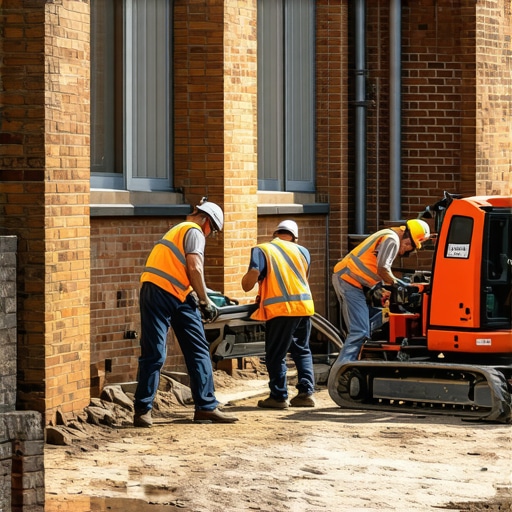
The Ghost in the Wall: Why Traditional Restoration is Failing
I remember a job in a historic district where a young contractor had just finished ‘fixing’ a 1910 brownstone. From thirty feet away, it looked clean. But as I got closer, I could hear the building screaming. He had used a high-speed diamond blade without a depth stop, slicing deep into the soldier course and scarring the faces of bricks that had survived a century of storms. He used a high-strength Portland cement—the kind of ‘mud’ you’d use for a skyscraper foundation—to repoint soft, sand-struck clay. My old mentor used to say, ‘A wall is a living lung; if you choke it with plastic and stone-hard mortar, it will suffocate and spit its teeth out.’ This is the tragedy of modern masonry: the loss of the sacrificial joint. When the mortar is harder than the brick, the natural expansion and contraction of the building forces the stress into the clay. The brick faces spall off, turning a hundred-year-old facade into a pile of red dust. This is why the shift toward precision tuckpointing and machine-assisted services isn’t just about speed; it is about forensic accuracy and the survival of our architectural history.
“Water penetration is the single greatest threat to masonry durability. The selection of mortar must prioritize compatibility with the existing masonry units to ensure moisture can escape the system.” – BIA Technical Note 7
The Physics of the Sacrificial Joint
To understand why tuckpointing weatherproofing is failing across modern cities, we have to look at the chemistry of the hydration process. Historic bricks were fired in kilns that didn’t always reach uniform temperatures, resulting in a ‘soft’ core. These bricks are highly permeable. They take in water and they let it go. When we talk about masonry waterproofing solutions, many inexperienced ‘pros’ want to slap a silicone sealer over the whole thing. That is a death sentence. It traps liquid water behind the surface. When the temperature drops, that water expands by 9% as it turns to ice. This hydraulic pressure is what blows the face off a brick. Precision tuckpointing using machine-assisted dust extraction and depth-controlled grinders ensures that we remove only the failed mortar without ‘burning’ the edges of the brick. By using self-leveling masonry lifts, we can maintain a consistent strike height even on buildings that have settled or shifted over the decades, ensuring the new joints handle the load-bearing stress evenly across the hawk and trowel work.
The Evolution of the Tool: From Hand-Chisel to AI Masonry Assessment
We are entering an era where AI masonry assessment is no longer science fiction. By using high-resolution photogrammetry, we can map the exact crack patterns of a facade before a single chisel touches the wall. This allows us to identify retaining wall batter correction needs or structural shifts that the naked eye might miss. When we move to the actual repair, the machine services come into play. Old-school grinding created clouds of silica dust that would coat a neighborhood. Today, we use vacuum-shrouded precision tuckpointing tools that capture 99% of particulates. This isn’t just for health; it’s for the masonry. Dust left in a joint acts as a bond-breaker. If the joint isn’t clinically clean, the new ‘mud’ won’t have the ‘tooth’ it needs to grab the sides of the brick. We also look at masonry birdsmouth cuts at the base of walls to ensure that any moisture that does find its way into the cavity has a clear, geometric path to exit. This is masonry waterproofing that works with physics, not against it.
“The joints of the masonry should be made with great care, for it is through them that the ruin of the building usually begins.” – Vitruvius, De Architectura
Chimneys and the Art of Interior Parging
The most neglected part of any historic home is the chimney. Most homeowners call for chimney repair services only when they see a brick fall onto their lawn. By then, the internal structure is usually a mess of honeycombing and cold joints. We use chimney interior parging—specifically a lime-based smooth coat—to seal the interior flue. This prevents acidic combustion byproducts from eating the mortar from the inside out. On the exterior, a proper chimney crown repair is more than just a smear of concrete. It requires a drip edge and a thermal break. Without it, water runs down the side of the stack, saturating the brick and leading to masonry staining and efflorescence—that white, salty crust that tells me the wall is essentially ‘bleeding’ its minerals. Using precision tuckpointing on a chimney stack requires a delicate touch; you are working on the most exposed part of the building, where wind-driven rain hits with the most force.
Color Matching and Masonry Staining: The Final Forensic Touch
One of the biggest ‘sins’ in the trade is a patch job that looks like a checkerboard. Because historic mortars were often made with local sands, the color varies block by block. Masonry staining is the surgical answer to this problem. Instead of trying to mix the perfect color mud—which will change hue as it cures—we use mineral stains that chemically bond with the masonry. This allows the brick to remain ‘breathable’ while achieving a visual match that is indistinguishable from the original. This is particularly vital when dealing with retaining wall batter correction, where new structural blocks might be integrated with old stone. We want the building to look like it has one soul, not a series of botched surgeries. When we combine this with tuckpointing weatherproofing, we aren’t just making it look pretty; we are creating a monolithic barrier against the elements that still allows the internal ‘breath’ of the structure to regulate its own humidity.
Why Machine Services Win the Long Game
People ask me why I embrace self-leveling masonry lifts and machine grinding when I grew up with a hammer and a slicker. The answer is consistency. A man gets tired on the fourth hour of a hot afternoon. He starts to butter the joints too thin. He misses a spot of honeycombing. A machine doesn’t get tired. Precision tuckpointing machines ensure that every single linear inch of a joint is cut to the exact same depth—usually 3/4 of an inch—providing a uniform pocket for the new mortar. This uniformity is what prevents the ‘point-loading’ that causes structural cracks. It turns a repair into a restoration. Whether it is chimney repair services or a full-scale facade overhaul, the goal is always the same: do it once, or do it twice. And in this business, doing it twice usually means the building didn’t survive the first mistake.