
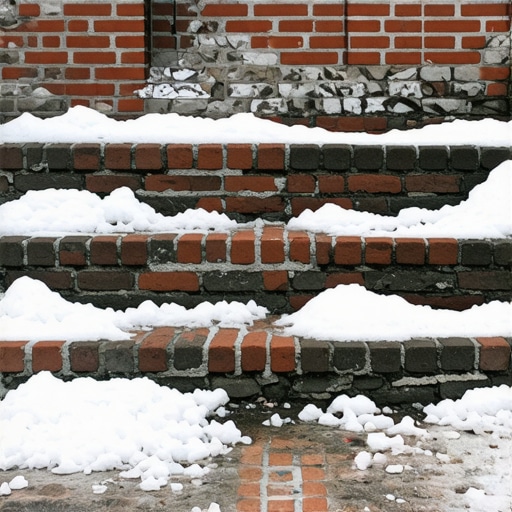
The Gritty Reality of the Winter Grind
I remember a call I took back in the late 90s, middle of a brutal February thaw. A homeowner had spent the weekend dumping forty-pound bags of rock salt on his front steps like he was seasoning a giant steak. By the time I got there, the nosing of those treads was turning into red dust. I touched the brick, and it didn’t just crumble; it dissolved under my thumb. That is the reality of the ‘salt trap.’ Most people think they are just melting ice, but they are actually inviting a chemical wrecking crew into the pore structure of their masonry. When we talk about freeze-thaw damage restoration, we aren’t just talking about aesthetic fixes; we are talking about saving the structural integrity of the home’s entrance before the steps become a liability. You see, brick is a sponge. It has a ‘tooth’ that bites into the mortar, but that same porosity is its Achilles’ heel when chlorides get involved.
“Water penetration is the single greatest threat to masonry durability, and when combined with de-icing salts, the rate of deterioration increases exponentially through sub-fluorescence.” – BIA Technical Note 1
To understand why your stairs are falling apart, we have to micro-zoom into the capillary action of the clay itself. A standard extruded brick has millions of microscopic voids. When you throw down salt, it dissolves into a brine. This brine is thinner than pure water, allowing it to penetrate deeper into the brick’s heart. Once the sun goes down and the temperature drops, that brine freezes. Now, basic physics tells us water expands by about 9% when it turns to ice. But when that ice is packed with salt crystals, it creates osmotic pressure. The salt draws more water toward it, increasing the internal PSI until the face of the brick literally explodes. This is what we call spalling. If you see white, crusty powder on your steps, that’s efflorescence—the salt’s calling card. If that salt stays trapped inside, it’s sub-efflorescence, and that’s the silent killer that necessitates historic brickwork repointing.
The Chemistry of the ‘Mud’ and the Salt Conflict
In the trade, we call mortar ‘mud,’ but there is nothing simple about it. If you are dealing with a pre-war home, your stairs were likely laid with a lime-heavy mix. Modern ‘handymen’ love to come in with a bag of high-strength Portland cement to ‘fix’ things. This is a death sentence. High-strength cement is too hard and non-breathable. When salt gets into the system, the moisture needs a way out. If the mortar is harder than the brick, the moisture (and the salt) stays trapped in the brick. The brick then becomes the ‘sacrificial’ element, shattering while the hard cement joints stay perfectly intact. This is why flush pointing services are so critical; the profile of the joint must be handled correctly to shed water, rather than trap it against the brick edge. I’ve seen commercial tuckpointing jobs where they used the wrong mix, and within two winters, the entire facade looked like a moth-eaten sweater.
“Mortar should always be weaker than the masonry units it binds to ensure that stresses from thermal expansion and moisture migration do not cause irreversible damage to the units themselves.” – ASTM C270 Standard Specification
We also have to look at the ‘lick-and-stick’ veneer problems. Often, what looks like solid brick stairs are actually thin slices of brick glued to a concrete core. Salt is exceptionally good at finding the gap between the veneer and the substrate. Once it gets back there, it eats the metal ties and the adhesive. This leads to brick veneer detachment repair projects that could have been avoided if the retaining wall capstone replacement had been handled with a proper drip edge to begin with. Without a ‘slicker’ to properly profile the joints and a hawk to catch the excess mud, you’re just begging for water to sit on those ledges and rot the assembly from the inside out.
Advanced Restoration and Preventative Physics
When the damage is done, we move into freeze-thaw damage restoration. This isn’t just about slapping some new mud in the holes. It involves a surgical removal of the salt-laden material. Sometimes, we have to look at the chimney as well. People forget that chimney flue liner installation is part of the moisture management system of a house. If a flue is cracked, moisture migrates through the brickwork, meeting the salt on the exterior stairs and creating a ‘wicking’ effect that pulls minerals to the surface, causing deep masonry staining. For those looking for a modern edge, some try metallic masonry finishes or sealants, but be warned: if you seal salt inside a brick, you are essentially building a small bomb. The pressure will build until the sealant peels off, taking the face of the brick with it. Instead, we often look at mortarless masonry systems for secondary areas or flush pointing with highly breathable lime putty to allow the structure to ‘breathe’ out the chlorides.
If you are looking at a crumbling soldier course or a sagging tread, the fix starts with drainage. You need to ensure that the salt-heavy runoff from your driveway isn’t pooling at the base of your stairs. We use retaining wall capstone replacement techniques to create a slight pitch—just a fraction of an inch—to keep the brine moving. Remember, a mason’s best tool isn’t his trowel; it’s his understanding of where the water wants to go. Do not trust a ‘quick fix’ in the dead of winter. You cannot ‘butter’ a joint in freezing temps and expect it to hold. You wait for the thaw, you wash out the salts with low-pressure deionized water, and you rebuild with the respect the stone deserves. Do it once, or do it twice—the choice is yours, but the salt doesn’t sleep.