The Sound of a Thousand-Pound Catastrophe
I stood looking at a $50,000 retaining wall that lay in a pile of rubble because the contractor forgot one thing: drainage. It wasn’t the blocks that failed; the units themselves were manufactured to a compressive strength of 5,000 PSI, more than enough to hold the weight of a small house. The failure was invisible, occurring six feet behind the face of the wall in the dark, wet heart of the backfill. It was a 100-year storm, the kind that turns a backyard into a swamp in forty-five minutes. Without a proper retaining wall drainage upgrade, that wall became a dam. And dams that aren’t designed to be dams eventually break. I remember the homeowner, a man who had spent his life savings on a ‘landscaper special,’ asking me if we could just ‘glue it back together.’ I had to tell him that when the physics of hydrostatic pressure takes hold, advanced masonry adhesives are about as useful as a screen door on a submarine.
The Hydrology of Failure: Why Walls Bow
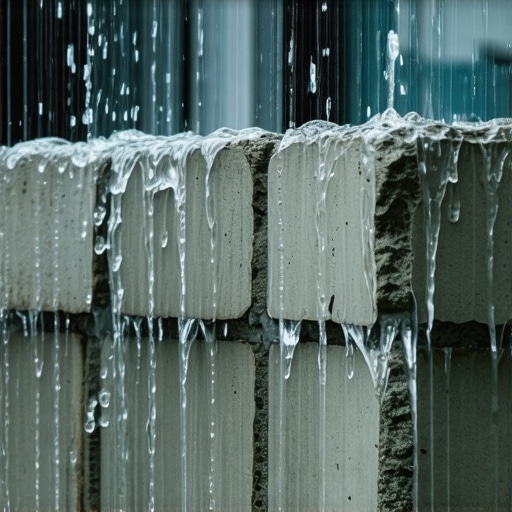
To understand why a modular wall fails during heavy rainfall, you have to look at the ‘angle of repose’ and the ‘active soil pressure.’ When soil gets wet, its internal friction drops. Think of it like this: dry sand stays in a pile; wet sand flows like sludge. In the trade, we talk about the ‘tooth’ of the stone, but in the geotechnical world, it’s all about the pore water pressure. As water fills the voids between soil particles, it exerts an outward force in every direction. If that water has nowhere to go, it pushes against the back of your wall blocks with thousands of pounds of lateral force.
“Hydrostatic pressure is the most common cause of retaining wall failure, often exceeding the structural capacity of the masonry units by a factor of four.” – National Concrete Masonry Association (NCMA) Design Manual
The Anatomy of a Pro-Grade Drainage System
A wall is only as good as its ‘mud’ and its ‘stone,’ but a modular wall doesn’t use traditional mortar—it uses gravity and friction. When I perform a forensic inspection, the first thing I look for isn’t the block; it’s the retaining wall drainage upgrade components. You need a 12-inch chimney of clean, 3/4-inch angular stone (often called #57 stone) directly behind the units. This isn’t just ‘gravel.’ It’s a dedicated hydraulic pathway. If you see ‘honeycombing’ in the soil or if the contractor used ‘bank-run’ dirt, you’re looking at a future failure. The water must drop straight down to a perforated toe-drain that is ‘daylighted’ or tied into a storm sewer. Without this, the ‘self-leveling masonry lifts’ you might try to use later to fix a sagging course will just be a waste of money.
The Micro-Physics of Compaction and Saturation
When we talk about retaining wall reinforcement, we aren’t just talking about bigger blocks. We are talking about geogrid—a high-tenacity polyester mesh that locks the soil together. During heavy rain, geogrid acts like a series of anchors, pulling the weight of the soil back into itself rather than letting it lean on the wall face. If the soil isn’t compacted to 95% of its ‘Proctor density,’ the geogrid won’t engage until the wall has already shifted. I’ve seen patio stone realignment projects where the entire terrace had moved three inches toward the neighbor’s yard because the base wasn’t vibrated in two-inch ‘lifts.’ You can’t just throw eight inches of stone down and hit it with a plate compactor; you have to build it in thin, dense layers. It’s tedious, it’s back-breaking, and it’s the only way to sleep when the rain starts thumping on the roof.
Modern Tech: From 3D Printing to Advanced Polymers
We are entering a strange new era of masonry. I’ve recently been involved in 3D printed masonry repairs, where we use a scan of a weathered, historic block to print a custom replacement that fits into a modular system perfectly. It sounds like science fiction, but when you’re dealing with a ‘soldier course’ on a curved radius that no longer exists in a catalog, it’s a lifesaver. Furthermore, advanced masonry adhesives have replaced the old ‘pave-bond’ junk. Modern polyurethane adhesives create a chemical weld that is actually stronger than the concrete itself. However, even the best ‘mud’ won’t save you if you have structural brick ties replacement needs on a veneer wall that’s being pushed by saturated masonry. The ties must be stainless steel or hot-dipped galvanized to survive the constant moisture of a poorly drained system.
Waterproofing and the Invisible Shield
Many contractors ignore masonry waterproofing solutions on the ‘blind side’ of the wall. I always advocate for a heavy-duty bituminous coating or a dimpled drainage membrane applied to the back of the blocks. This prevents the ‘efflorescence’—that white, salty crust—from leaching through the face of your stone. It also keeps the units from absorbing water, which is critical in Northern climates where the freeze-thaw cycle will ‘spall’ the face off a block like an onion skin. Remember: water expands 9% when it turns to ice. If that water is trapped inside the pores of your modular block, the block wins… for about three winters. Then it crumbles.
“The selection of backfill material and the management of groundwater are more critical than the masonry unit itself in gravity wall design.” – ASTM D6638 Standard Test Method
The Forensic Audit: Checking Your Chimneys and Foundations
Heavy rain doesn’t just affect walls. It’s the ultimate stress test for your entire property. I often tell clients that if their retaining wall is leaning, they better check their chimney sweep and repair needs too. Why? Because the same hydrostatic pressure and soil heaving that tilts a wall can crack a chimney crown or shift a hearth. A full forensic audit should include looking for ‘stair-step’ cracks in the mortar joints. If you see those, you don’t just need a ‘slicker’ and some fresh ‘mud’; you need to look at full repointing services to restore the structural integrity of the masonry envelope. Don’t let a handyman ‘butter’ over a structural crack with some cheap caulk; that’s like putting a band-aid on a broken leg.
The Hard Truth About Longevity
In the end, masonry is a battle against gravity and time, and water is the weapon they use against us. Whether you are looking at self-leveling masonry lifts to correct a minor tilt or a complete retaining wall reinforcement overhaul, do not cut corners on the things you can’t see. The geogrid, the #57 stone, the non-woven geotextile fabric—these are the components that actually hold the earth back. Everything else is just a pretty face. Do it right once, or prepare to pay me twice to come out and tell you why it fell down. The ‘Old World’ way wasn’t about fancy tools; it was about respecting the physics of the earth and the power of the rain. Stay dry, keep your weep holes clear, and never trust a contractor who doesn’t own a transit level.{“@context”:”https://schema.org”,”@type”:”HowTo”,”name”:”How to Stabilize a Modular Wall Against Heavy Rain”,”step”:[{“@type”:”HowToStep”,”text”:”Excavate a 12-inch trench behind the wall for clean angular stone backfill.”},{“@type”:”HowToStep”,”text”:”Install a perforated 4-inch drain pipe at the base, sloped to daylight.”},{“@type”:”HowToStep”,”text”:”Apply a masonry waterproofing membrane to the back of the modular units.”},{“@type”:”HowToStep”,”text”:”Layer geogrid reinforcement every two courses for walls over three feet high.”},{“@type”:”HowToStep”,”text”:”Compact soil backfill in 4-inch lifts to 95% Proctor density.”}]}