
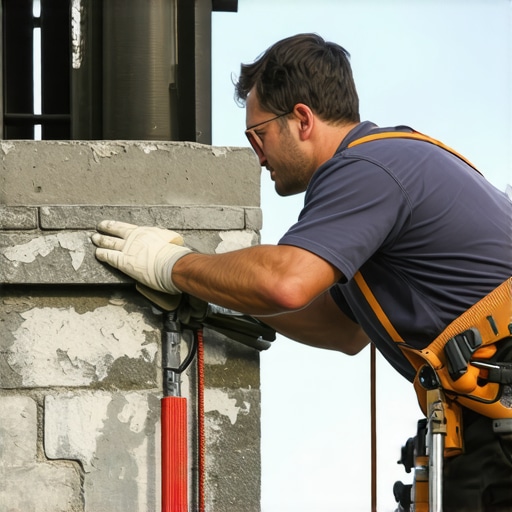
The Forensic Scene: When a Hairline Crack Becomes a Skeleton
I remember standing on a steep pitch in the biting November wind, staring at what the homeowner called a ‘minor cosmetic nuisance.’ It was a single, diagonal stair-step crack running from the crown down to the flashing. But when I fed my high-definition bore-scope into the cavity between the wythes, the reality was grim. The structural brick ties—the very things holding that chimney to the house—hadn’t just rusted; they had delaminated into orange flakes of nothingness. The chimney was essentially a free-standing pile of bricks waiting for a heavy gust. This is where the difference between a ‘handyman’ and a forensic mason becomes clear. Most guys would tell you to tear it down to the roofline and start over, costing you twenty grand. But if you understand the physics of masonry, you know there is a better way.
The Molecular Battle: Why Your Chimney is Self-Destructing
Chimneys are the most vulnerable parts of any structure because they are attacked from both sides. Internally, they face thermal shock and acidic condensation. Externally, they endure the brutal freeze-thaw cycles of the north. In our climate, water is the primary antagonist. When water enters a porous brick and freezes, it expands by exactly 9%. That pressure is enough to overcome the tensile strength of the clay, leading to spalling—the process where the face of the brick literally pops off.
“Water penetration is the single greatest threat to masonry durability, leading to efflorescence, internal frost damage, and corrosion of embedded metals.” – BIA Technical Note 7
The Science of Structural Brick Ties Replacement
When those internal ties fail, the chimney begins to ‘belly’ or lean. In the old days, we had to demo the whole stack. Today, we utilize helical lateral stabilization. We drill minute pilot holes through the mortar joints—never the brick—and drive stainless steel ties into the backup structure or the inner wythe. These ties engage with the masonry through a mechanical interlock or a specialty resin, essentially ‘pinning’ the chimney back to the safety of the home’s framing without moving a single brick. It is surgery, not demolition.
The Sacred Art of Historic Tuckpointing
One of the biggest crimes I see is a ‘modern’ mason slapping Type S Portland cement into a 1920s chimney. It’s a death sentence. Historic bricks are soft; they were fired at lower temperatures. Portland cement is incredibly hard and brittle. When the chimney heats up and expands, the brick wants to move, but the Portland won’t let it. The brick loses that fight every time and crushes itself.
“Mortar should always be weaker than the masonry units it binds, acting as a sacrificial element that allows for moisture movement and thermal expansion.” – ASTM C270 Standards
We use a custom-blended lime-putty mud, often a Type O or a specialized hydraulic lime. This ‘soft’ mortar has high vapor permeability, meaning it allows the chimney to ‘breathe.’ If moisture gets in, it evaporates through the mortar joints rather than getting trapped behind the brick face. This is the essence of historic tuckpointing: ensuring the mortar dies so the brick lives.
Internal Integrity: Chimney Heat Shield Installation and Damper Repair
Structural stability isn’t just about the bricks you see; it’s about the thermal containment inside. Many old chimneys have cracked clay flue liners that leak heat into the surrounding masonry, accelerating the degradation of the structural brick ties. Instead of a total rebuild, we utilize chimney heat shield installation. We apply a ceramic-refractory coating to the inside of the flue. This ‘liquid sleeve’ fills every crack and restores the structural integrity of the flue while providing a smooth, high-efficiency path for gases. Combine this with a precision chimney damper repair—replacing those rusted-out throat dampers with top-sealing units—and you stop the internal moisture cycle that rots chimneys from the inside out.
Aesthetics and Protection: Efflorescence and Sealers
You’ve likely seen that white, chalky powder on bricks. That’s efflorescence. It’s not just an eyesore; it’s a symptom of internal water migration. We perform brick efflorescence removal using specialized acidic cleaners that neutralize the salts without ‘burning’ the brick face. Once cleaned, we never use ‘lick-and-stick’ sealers. Those create a plastic film that traps moisture. Instead, we use silane-siloxane porous stone sealers. These are ‘breathable’ penetrants that change the surface tension of the masonry at a molecular level, making it hydrophobic while still allowing water vapor to escape. For those looking to restore the original look, we can even perform a metallic brick colors application to match the unique flash-fired hues of early 20th-century clay.
The Broader Scope: From Smokestacks to Retaining Walls
The physics of a chimney aren’t all that different from a commercial smokestack repair or even a complex retaining wall installation. It all comes down to hydrostatic pressure and thermal movement. When we see a failing landscape feature, like a sinking terrace, we often find that the retaining wall block replacement isn’t enough; you have to fix the drainage. Whether it’s a 40-foot chimney or a 4-foot wall, if you don’t control the ‘mud’ and the moisture, the structure is on a clock. We treat every chimney with the same forensic rigor we’d apply to an industrial stack, ensuring that the fix isn’t just a ‘buttering’ of the joints, but a permanent structural restoration.
The Final Word: Do It Once, or Do It Twice
I’ve seen too many homeowners pay for the same repair three times because they hired a ‘slicker’ who didn’t understand the suction of a dry brick or the chemistry of lime. Real masonry is tactile. It’s about the ‘ring’ of the brick and the ‘tooth’ of the stone. When we fix a chimney without a total rebuild, we aren’t just saving you money—we are preserving the history and the physical soul of the structure. Don’t wait for the pile of rubble. Address the hairline today, and let the physics work for you, not against you.