
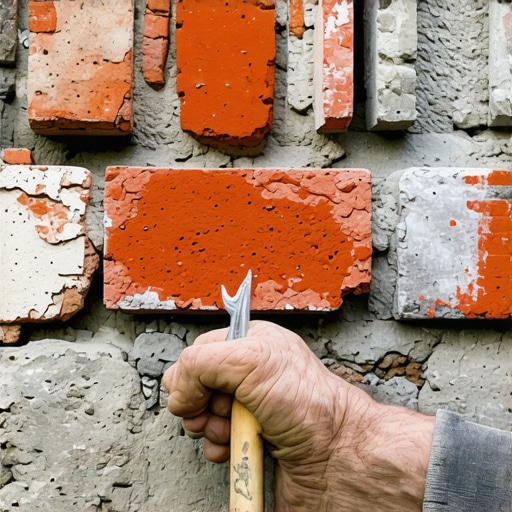
The Ghost of Craftsmanship Past
I stood on a swaying scaffold five stories up, looking at a 1920s commercial facade where the homeowner thought it was just a hairline crack. But when I put my scope inside the cavity, I saw the structural steel was rusted to dust, expanded to three times its original thickness, and was literally Jacking the masonry apart from the inside. This is the reality of forensic masonry. You don’t just look at the surface; you look at the soul of the structure. Modern contractors treat a building like a Lego set, but a historic brick wall is a living, breathing organism. If you don’t respect its respiration, it will die. Most of what passes for restoration today is actually a slow-motion execution. I’ve seen beautiful orange-clay bricks from the turn of the century shattered because some ‘pro’ slapped a Type S Portland cement into the joints. They didn’t understand the ‘tooth’ of the material or the physics of moisture migration. Historic masonry is a delicate balance of compression and capillary action. When you disrupt that with modern materials, you aren’t fixing a problem; you’re creating a catastrophe that will manifest in five to ten years when the faces of the bricks start popping off like scabs.
“Water penetration is the single greatest threat to masonry durability.” – BIA Technical Note 7
The Physics of Breathability and the Portland Trap
To understand how we bring historic brick walls back to life, you have to understand the chemistry of the ‘mud.’ Before the 1940s, masonry was laid with lime-based mortars. These mortars are ‘soft’—not in the sense that they wash away, but in their modulus of elasticity. They allow the wall to move, expand, and contract with the seasons. More importantly, they are vapor-permeable. Moisture that gets into the wall can travel through the mortar joint and evaporate into the air. This makes the mortar joint ‘sacrificial.’ You want the mortar to wear out, not the brick. When a modern handyman uses a hard, impermeable Portland cement, he turns the mortar into a dam. The water is forced out through the face of the soft brick instead. When the winter hits and that trapped water freezes—expanding by 9%—it takes the face of the brick with it. This is why commercial masonry facade maintenance is so critical; it’s about ensuring the mortar is always softer than the unit it holds. We spend hours testing the compressive strength of the existing units before we even think about mixing a batch of mud. We look for that perfect 1:3 ratio of lime to sharp sand, matching the aggregate size to the original so the ‘wicking’ action remains consistent across the entire elevation.
The Forensic Inspection: Beyond the Surface
When we get called in for masonry rescue after disaster, the first thing we check is the ‘suction’ or the Initial Rate of Absorption (IRA). A dry, historic brick will suck the water right out of a fresh batch of mortar if you aren’t careful, leading to a ‘flash set’ where the mud doesn’t bond, but just sits there like a dried-out biscuit. We call this ‘burning’ the joint. To prevent this, we pre-wet the masonry, bringing it to a saturated surface-dry condition. This ensures the hydration process of the lime happens slowly, allowing the crystals to grow deep into the pores of the brick. This microscopic ‘tooth’ is what creates a bond that lasts a century. Whether we are performing commercial smokestack repair or a simple residential outdoor masonry fountain restoration, the physics are identical. Fountains, in particular, are a nightmare if you use the wrong tile grouts on masonry. You need a grout that can handle constant hydrostatic pressure without becoming brittle. If the grout is too rigid, the constant vibration of the water pumps and the thermal swings of the sun will cause micro-fractures that invite water into the substrate, leading to catastrophic failure of the stone veneer.
Foundation Logic and the Bowing Wall
The ground is never still. It’s a slow-motion ocean of soil and water. When we tackle foundation wall bowing repair, we aren’t just looking at the wall; we are looking at the geotechnical forces behind it. Hydrostatic pressure is a silent killer. When soil becomes saturated, it exerts massive lateral force against a foundation. If the wall wasn’t built with retaining wall reinforcement, it starts to belly inward. We see this often in older homes where the original lime-mortar foundations are being crushed by the weight of wet clay. The fix isn’t just slapping more cement on the inside. We often have to implement self-leveling masonry lifts or helical piers to stabilize the footing before we can even address the masonry. In cases of retaining wall block replacement, we emphasize the drainage layer. Without a clear path for water to exit—usually through weep holes or a gravel-packed backfill—even the strongest retaining wall installation will eventually succumb to the weight of the earth. We use a ‘slicker’ to strike the joints in a way that sheds water, ensuring that every drop is directed away from the core of the wall.
“The thickest walls are those built with the smallest stones, for the multitude of joints provides a better bond.” – Vitruvius, De Architectura
The Art of the Strike: Mud, Butter, and the Hawk
Watching a master mason is like watching a surgeon. We load the ‘mud’ onto a ‘hawk’—a flat square tool—and then ‘butter’ the brick with a precision that comes from decades of muscle memory. When we do a ‘soldier course’—bricks standing on end—the verticality must be perfect, or the entire structural integrity is compromised. We don’t just ‘tuckpoint’; we ‘repoint.’ Tuckpointing is a decorative technique to make joints look finer than they are. Repointing is the structural act of grinding out the failing mortar to a depth of at least twice the width of the joint and packing in new, compatible mud in ‘lifts.’ This prevents ‘honeycombing’—voids inside the joint that can trap water. We use a ‘slicker’ or a ‘jointer’ to compact the mud into the joint, which increases its density and water resistance. A ‘cold joint’—where new mortar meets old without a proper bond—is a failure point we avoid by meticulous cleaning and wetting of the substrate. This is the difference between a ‘handyman special’ that cracks in two years and a forensic restoration that stands for another hundred. Whether it’s a commercial smokestack repair involving extreme heat or a retaining wall reinforcement project, the goal is always the same: create a monolithic structure that respects the physics of its environment.
Ultimately, how we bring historic brick walls back to life is by being humble enough to listen to the original builders. They didn’t have laser levels or power grinders, but they had an intuitive understanding of materials that we are only now re-learning through forensic science. When you see a wall that has stood for 150 years, it isn’t an accident. It’s a testament to the correct ratio of lime, the right choice of sand, and a deep respect for the way water moves through a building. We don’t try to outsmart the old masters; we try to match their discipline. If you treat your masonry with the respect it deserves—using soft mortars, ensuring proper drainage, and avoiding the ‘lick-and-stick’ shortcuts of the modern era—your building will outlast you. Do it once, or do it twice; the choice usually comes down to whether you hire a mason who knows the chemistry or one who just knows how to mix a bag of premix.