
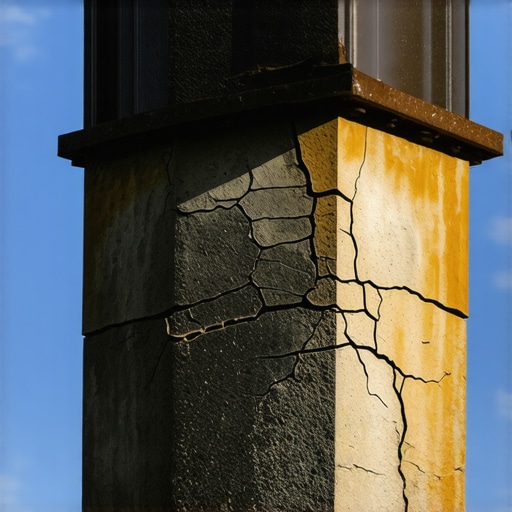
The Forensic Scene: When a Hairline Crack Hides a Structural Nightmare
The homeowner stood on the lawn, pointing up at a single vertical fissure that traced a jagged path through the soldier course at the top of the stack. ‘It just needs a little mud,’ he told me, confident that a twenty-minute butter job with a trowel would save his winter. But when I deployed a high-resolution drone chimney inspections rig to get a bird’s-eye view of the crown, the reality was grim. The internal clay liners had undergone total delamination from decades of thermal shock, and the masonry was effectively standing by habit alone. The structural steel of the brick lintel replacement was rusted to a ghost of its former self, expanding with such force that it was jacking the masonry apart from the inside out. This wasn’t a case for a slicker and a bucket of mortar; this was a forensic emergency.
“Water penetration is the single greatest threat to masonry durability.” – BIA Technical Note 7
The Physics of the Freeze-Thaw Cycle
In regions where the thermometer bounces across the freezing mark, masonry is under a constant state of siege. When liquid water enters the pore structure of a brick—a process driven by capillary suction—it waits for the temperature to drop. At thirty-two degrees Fahrenheit, that water undergoes a phase change, expanding by roughly nine percent in volume. This generates internal hydraulic pressures that exceed the tensile strength of the clay itself. Over time, this leads to spalling, where the face of the brick literally pops off, leaving the soft, porous interior exposed to the elements. This is why freeze-thaw damage restoration is never just about aesthetics; it is about stopping the slow-motion explosion of your chimney. If you see ‘honeycombing’ in your mortar joints or the ‘face’ of your bricks sitting in the gutters, your chimney’s structural integrity is leaking away.
The Chemistry of Mortar: Hydration vs. Carbonation
To understand if a patch will hold, you have to understand the ‘mud.’ Modern Portland cement cures through a chemical reaction called hydration, forming a dense matrix of calcium silicate hydrate. However, in historic chimneys, we often deal with lime-based mortars that cure through carbonation—absorbing CO2 from the air over decades. If a ‘handyman’ slaps a hard, Type S Portland mortar over a soft, pre-1940s lime joint, he has signed the chimney’s death warrant. The harder mortar creates a ‘cold joint’ that traps moisture. Because the new mortar is less permeable than the brick, the moisture is forced to exit through the brick face, causing it to shatter. Tuckpointing weatherproofing requires a sacrificial mortar—something softer than the surrounding masonry so that the joint fails before the brick does. This is the ‘sacrificial principle’ of the master mason.
“Mortar should be weaker than the masonry units it binds.” – ASTM C270
The Critical Checklist: Patch or Rebuild?
Determining the fate of a chimney requires a forensic eye. We look for three main indicators: 1. The 30 Percent Rule: If more than thirty percent of the masonry units are spalled or cracked, the internal bond is likely compromised, necessitating a rebuild. 2. Flue Integrity: If the clay liners are cracked, a chimney heat shield installation or a full relining is mandatory to prevent house fires. 3. The Lean: Use a plumb bob. If the stack is out of plumb, the foundation or the foundation underpinning has likely failed due to hydrostatic pressure or soil settlement. While advanced masonry adhesives have their place in an outdoor kitchen masonry build or an outdoor masonry fountain restoration, they have no business holding up a four-ton chimney stack. You either do it once, or you do it twice after it falls through your roof.
The Verdict: Preserving the Craft
A simple patch is for the surface; a rebuild is for the soul of the structure. When the ‘tooth’ of the brick is gone and the suction is lost, no amount of ‘buttering’ will save it. You have to grind out the joints, reach for the hawk and slicker, and rebuild the stack with the respect the original mason intended. Whether you are dealing with a failing chimney or a crumbling foundation, remember that masonry is a game of management—managing water, managing heat, and managing the relentless physics of the earth. Don’t let a ‘quick fix’ turn a repairable chimney into a pile of rubble.