
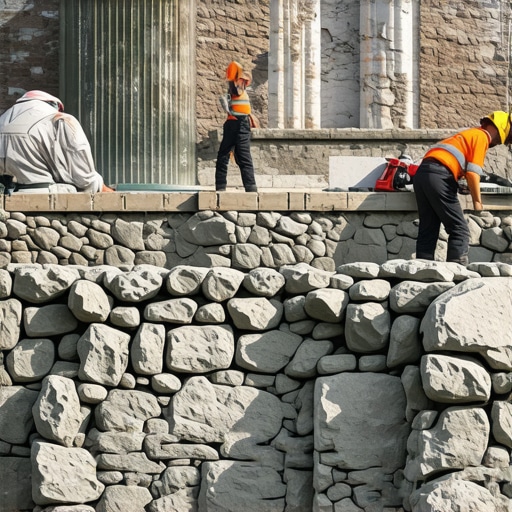
The Forensic Scene: When ‘Rock Solid’ Becomes Rubble
The call came in on a Tuesday. A homeowner in the valley was convinced his 1880s fieldstone foundation was ‘settling’ because of a few hairline fractures. When I arrived, the smell of damp earth and failing lime hit me like a sledgehammer. I didn’t just see cracks; I saw the aftermath of a ‘handyman special.’ Someone had slapped high-strength Portland cement over the original soft lime mortar, thinking they were doing a favor. I put my digital scope into a void near the corner, and what I saw was a structural nightmare: the interior rubble core of the wall had turned to dry powder, and the outer stones were literally peeling away from the building like a wet scab. The hard modern cement had trapped moisture inside the wall, and the freeze-thaw cycle had ground the internal limestone to dust. This wasn’t just a repair job; it was an emergency masonry repair situation. The wall was suffocating, and the physics of moisture migration were winning.
The Material Science: Why Fibers Matter in the ‘Mud’
When we talk about mortar repointing services for historic structures, we aren’t just slapping mud between rocks. We are managing the hydrostatic pressure and the thermal expansion of the building’s skeletal system. Modern fiber-reinforced mixes are a game-changer when used correctly, but you have to understand the chemistry. These aren’t your grandfather’s straw-bound bricks. We are talking about alkali-resistant (AR) glass fibers or basalt micro-fibers integrated into a lime-based or low-modulus matrix.
“Water penetration is the single greatest threat to masonry durability, and the selection of mortar must prioritize vapor permeability over compressive strength.” – BIA Technical Note 7
The micro-zooming of this process is fascinating. When mortar cures, it undergoes ‘autogenous shrinkage.’ In a standard mix, this creates microscopic fissures that eventually become highways for water. When we introduce fibers, they act as a three-dimensional web, arresting these micro-cracks before they can propagate. The fibers bridge the gaps in the interfacial transition zone between the cementitious paste and the aggregate. This is critical for tuckpointing weatherproofing, especially on tuckpointing curved walls where the geometry creates uneven stress points. The ‘tooth’ of the fiber-reinforced mix grips the uneven surface of the fieldstone with a tenacity that standard Type N mortar can’t match.
The Process: Striking the Joint and Parging the Void
Restoration is a surgical act. You don’t just go in with a grinder and hope for the best. For commercial masonry facade maintenance or a delicate residential restoration, the first step is the ‘surgical’ removal of failed mortar. We use sustainable block cutting techniques to ensure we aren’t vibrating the life out of the original stone. Once the joints are cleaned out to a depth of at least twice the width, we look at the ‘suction.’ A dry stone will suck the life out of your mud faster than a desert sun. We pre-hydrate the wall until it reaches a Saturated Surface Dry (SSD) state. This is where you ‘butter’ the stones. Using a hawk and a slicker, we push the fiber-reinforced mix into the back of the joint first. If the wall is a double-wythe rubble fill, we might perform chimney interior parging techniques to seal the internal voids. This creates a monolithic structural unit without sacrificing the ‘breathability’ that old stones require. For outdoor kitchen masonry build projects that incorporate old stone, this structural integrity is what prevents the ‘wavy’ look of settling over time. The mix must be softer than the stone itself—the sacrificial principle. If the mortar is harder than the stone, the stone will break. Period.
BIM Masonry Projects and Modern Forensics
Even on 150-year-old walls, we are now using BIM masonry projects data to model stress loads. By scanning the wall, we can see where the most pressure is exerted and customize the fiber density in our masonry waterproofing solutions. This isn’t just ‘Old World’ craft; it’s ‘Old World’ meets ‘Future Tech.’
“The durability of a masonry wall is inversely proportional to its stiffness when subjected to foundation movement.” – ASTM C270 Standards Commentary
When we deal with emergency masonry repair, we often find that ‘cold joints’—places where new mortar was added to old without proper bonding agents—are the primary failure points. The fibers in modern mixes help eliminate these weak spots by providing a mechanical bond that spans the age gap. Whether we are doing a soldier course on a new addition or stabilizing an ancient barn wall, the physics remains the same: manage the water, respect the stone, and never trust a man who says ‘one bag of cement fits all.’
Final Inspection: Do It Once, or Do It Twice
At the end of the day, masonry is about legacy. You can use cheap ‘lick-and-stick’ veneer and it might look good for two seasons. But if you want a wall that your grandkids will have to try hard to knock down, you invest in the forensic approach. Strengthening old stone walls with fiber-reinforced mixes is the only way to bridge the gap between 19th-century craftsmanship and 21st-century environmental stresses. Don’t let a ‘handyman’ turn your historic asset into a pile of rubble. Use the right mud, use the right fibers, and for heaven’s sake, let the wall breathe.