
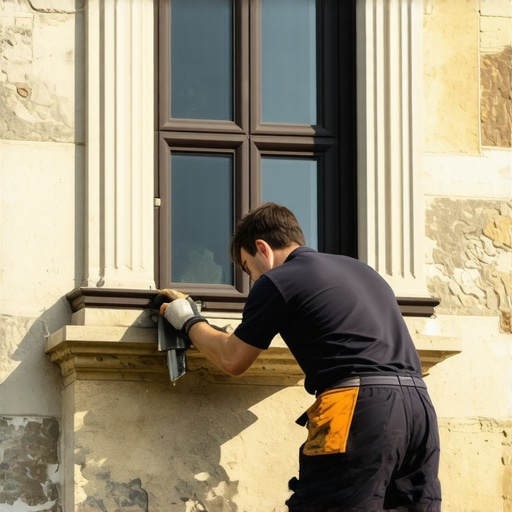
The Tragedy of the Suffocating Stone
I remember watching my old man take a pocket knife to a joint on a 1910 brownstone. If the blade sank in like butter, he knew the building was still alive. If the blade snapped, he knew some ‘expert’ had slapped modern Portland cement into those joints, and the stone was already dying from the inside out. He’d look at the owner and say, ‘You didn’t fix the wall; you built a tomb for it.’ That’s the reality of historic stone. Most people see a weathered facade and think it just needs a good scrub or a fresh coat of ‘stuff.’ They don’t realize that stone is a living, breathing respiratory system. When you treat a 100-year-old limestone or sandstone facade with the same disregard you’d give a modern brick veneer installation, you aren’t just losing the luster—you’re initiating a slow-motion structural suicide. Historic brickwork repointing and stone restoration require an understanding of chemistry that most ‘tailgate contractors’ couldn’t fathom if their life depended on it.
The Chemistry of Breathability and the Sacrificial Principle
To understand why your stone looks dull, gray, or is actively crumbling, you have to micro-zoom into the pore structure of the material. Stone is hygroscopic. It moves water. In the old days, we used lime-based ‘mud’ because it was softer and more porous than the stone itself. This is the ‘Sacrificial Principle.’ The mortar is designed to be the weakest link. It’s where the salts crystallize and where the freeze-thaw pressure is relieved. When a modern handyman uses a hard, non-breathable concrete patch or a high-strength Type S mortar on soft stone, the water gets trapped. In the winter, that water expands by 9%. Since it can’t get out through the hard mortar, it punches its way out through the face of the stone. We call this spalling, and once it starts, you aren’t just looking at a cosmetic issue; you’re looking at a brick veneer detachment repair or worse.
“Water penetration is the single greatest threat to masonry durability, and the use of incompatible mortar is the most common cause of accelerated masonry deterioration.” – BIA Technical Note 7
The Forensic Approach to Mortar Matching Services
You cannot just grab a bag of premix from a big-box store and expect it to work on a weathered facade. Authentic mortar matching services involve more than just a color chip. We look at the aggregate—the sand. Is it sharp? Is it river-washed? What’s the gradation? In the 19th century, they used whatever was local, which gave the building its unique ‘tooth’ and character. When we perform re-pointing services, we are looking for a chemical match. If the original wall used a natural hydraulic lime, we use a natural hydraulic lime. Using a tuckpointing machine services provider who doesn’t understand the ‘suction’ of the stone is a recipe for disaster. If the mortar is too dry, it won’t bond (a ‘cold joint’). If it’s too wet, it smears and kills the luster of the stone face. You have to ‘butter’ those joints with the precision of a surgeon, ensuring the hawk is at the right angle to prevent honeycombing within the joint depth.
Restoring the Arch: The Physics of the Keystone
One of the most common failures in weathered facades is the brick arch restoration. Over time, the foundation underpinning might shift, or the mortar in the ‘v-joints’ of the arch washes away. Once that happens, the mechanical bond is gone, and the arch becomes a ticking time bomb. We see this often in historic urban centers where self-leveling masonry lifts are required to stabilize the ground before we can even touch the stone. Restoring an arch isn’t just about pointing; it’s about ensuring the load-path is clear. If the voussoirs—the wedge-shaped stones—aren’t seated perfectly, the whole thing will ‘kick out.’ We often have to use a slicker to compress the mud deep into those joints to ensure the structural integrity is returned without changing the aesthetic profile of the soldier course or the lintels above.
The Myth of the ‘Lick-and-Stick’ Cure
I see it every day: homeowners who think they can fix a weathered facade with a clear silicone sealer. That is the quickest way to kill a stone wall. Those sealers create a plastic film that traps moisture behind the surface. The stone then undergoes sub-florescence—where salts expand under the surface and pop the entire face off. True luster restoration comes from gentle, chemical-neutral cleaning and precision historic brickwork repointing.
“Mortar should always be weaker than the masonry units it binds, ensuring that stresses are relieved within the joints rather than the stone.” – ASTM C270 Standard Specification
If your stone is weathered, it’s telling you a story about the building’s movement and its battle with the elements. You don’t hide that story; you repair the syntax so the building can stand for another hundred years. Whether it’s foundation underpinning to stop the ‘stair-step’ cracks or brick veneer installation for a modern addition that needs to match the old world, the physics remains the same: Respect the moisture, respect the movement, and never trust a man who doesn’t get his hands dirty in the mud.
“”