
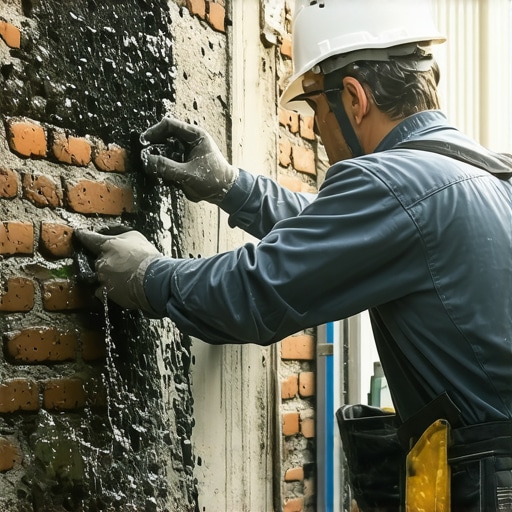
The Forensic Scene: A Ghost in the Wall
The homeowner in the historic district was proud of his ‘immaculate’ basement. He had spent a fortune on a contractor who slapped a thick, grey coating over the interior stone foundation. He thought it was dry. But when I pressed my moisture meter against a small, bubbling patch of paint near the floor, the needle pegged into the red. I didn’t need the meter, though. I could smell it—that sharp, metallic scent of oxidizing rebar and the damp, earthy aroma of a structure that was literally drowning from the inside out. When I chipped away a small section of that ‘waterproof’ coating, a gallon of trapped water didn’t just leak out; it sprayed. The previous guy hadn’t solved the problem; he’d just built a vertical swimming pool inside the wall. The foundation waterproofing was a failure because it ignored the physics of hydrostatic pressure and the chemistry of the masonry itself. This is the reality of forensic masonry: most ‘repairs’ are actually death sentences for old brick and stone.
Secret 1: The Myth of the Impermeable Wall (Breathability and Historic Pointing Styles)
The first secret to a job that outlasts your mortgage is understanding that masonry is not a solid, static object. It is a breathing, porous lung. Whether you are dealing with tuckpointing brick walls or a stone balustrade restoration, you must respect the ‘pore structure’ of the material. Old-world masonry relies on a ‘sacrificial’ principle. In a wall built before 1940, the bricks are soft and the mortar is even softer. The historic pointing styles—whether they were grapevine, weather-struck, or flush—weren’t just for aesthetics; they were designed to direct water away from the core while allowing the wall to ‘wick’ moisture back out to the atmosphere. When you ‘butter’ a joint with modern, high-strength Portland cement (Type S or M), you are creating a dam. The water enters the brick through capillary action, hits that hard, impermeable cement, and gets trapped. In a freeze-thaw climate, that water expands by 9%, and because the ‘mud’ won’t give, the face of your historic brick pops off in a process called spalling.
“Water penetration is the single greatest threat to masonry durability. The use of mortar that is significantly harder than the masonry units can lead to irreversible structural damage during thermal expansion cycles.” – BIA Technical Note 7
To do it right, you must match the mortar to the brick’s compressive strength. For historic pointing styles, this often means using a lime-putty mortar with zero Portland cement. This ‘soft’ mud allows the wall to shift slightly without cracking the units themselves. It’s the difference between a flexible willow tree and a brittle oak in a storm. If you’re looking at tuckpointing tools for DIY, don’t just grab a bag of pre-mix from a big-box store. You need to understand the ‘suction’ of the brick. If the brick is too dry, it will suck the moisture out of your mortar before the hydration process can complete, leaving you with a ‘burned’ joint that crumbles like a dry biscuit.
Secret 2: Managing the Hydrostatic Pressure and the ‘Cold Joint’ Nightmare
The second secret isn’t found on the surface of the wall; it’s found in the dirt behind it. In foundation waterproofing, the enemy isn’t just liquid water; it’s the weight of that water. Hydrostatic pressure can exert hundreds of pounds of force against a subterranean wall. Many contractors fail because they don’t understand the ‘cold joint’—that weak point where a new pour of concrete meets an old one, or where the wall meets the footing. If you don’t have a proper drainage plane, such as a dimpled membrane or a French drain at the footing level, the water will find its way through the microscopic cracks in your commercial parapet wall repair or your basement foundation. When I perform outdoor masonry fountain restoration, I see the same issue: builders forget that water wants to be everywhere. You need a ‘positive side’ waterproofing strategy (applying the barrier to the side where the water is coming from) rather than a ‘negative side’ Band-Aid. Without a way for the water to escape, even the most expensive coatings will eventually delaminate. In patio stone realignment, the ‘wavy’ look homeowners hate is almost always caused by poor compaction and the lack of a permeable base that allows water to move through rather than sitting and heaving the stones during a frost.
Secret 3: The Mechanical Bond and the Future of Robotic Masonry Repair
The third secret is all about the ‘tooth.’ For a tuckpointing brick walls project to last 50 years, the mechanical bond between the new mortar and the old unit must be absolute. This means grinding out the old joints to a depth of at least twice the width of the joint—no shortcuts. If you just ‘skim’ the surface (what we call ‘over-pointing’), the new material will fall out within three seasons. This is where robotic masonry repair is starting to change the game. We are seeing machines that can grind joints with a precision no human hand can match, ensuring a perfectly clean surface for the new ‘mud’ to grip. However, a robot doesn’t have the ‘feel’ for the stone. It doesn’t know when a stone balustrade restoration requires a slightly wetter mix because the sun is beating down on the south-facing side, causing ‘flash setting.’ Flash setting is a disaster; the mortar ‘burns’ and never reaches its full crystalline strength. This is also why chimney heat shield installation is so critical—the thermal shock from a fireplace can crack the mortar from the inside out if the materials aren’t rated for the specific expansion coefficients of the masonry.
“The selection of mortar for restoration must prioritize vapor permeability and lower compressive strength than the original masonry units to ensure the longevity of the assembly.” – ASTM C270 Standards
Whether you’re doing a patio stone realignment or a commercial parapet wall repair, remember: the masonry is the skin, but the drainage and the mortar chemistry are the bones. If you don’t get the chemistry of the ‘mud’ right, you’re just putting lipstick on a pig that’s about to fall over. Do it once, do it right, and respect the old-world logic that kept buildings standing for centuries before we started trying to ‘improve’ them with cheap chemicals.