
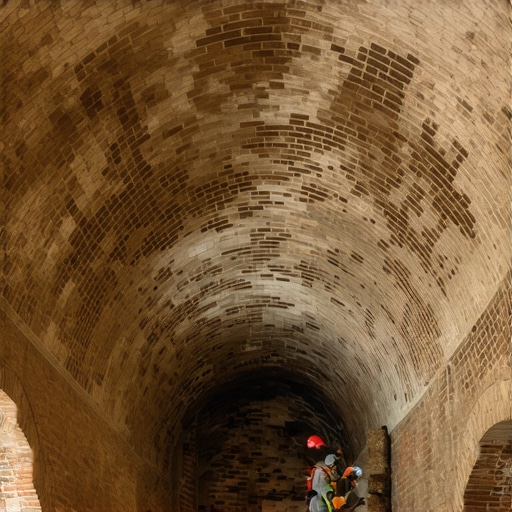
The Ghost in the Arch: Why Vaulted Ceilings Fail
I was standing in a subterranean wine cellar in a 19th-century estate when I first saw the horror. The homeowner thought it was just a hairline crack, a bit of character for a century-old room. But when I put my digital scope inside the joint, I saw the structural reality: the iron tie-rods were rusted to dust, and the brick was ‘exfoliating’ from the inside out. This isn’t just about aesthetics; it’s about the physics of gravity versus the chemistry of water. When you look up at a brick vaulted ceiling and see dampness, you aren’t just looking at a leak; you’re looking at a slow-motion structural collapse. Brick is a sponge. It has a pore structure that facilitates capillary action, pulling water deep into the masonry mass where it can sit for decades, rotting the very spirit of the building.
The Physics of the Vault: Compression and Capillary Suction
A vaulted ceiling lives in a state of constant compression. Every brick is a soldier in a war against gravity, leaning on its neighbor to transfer the load down to the springline and into the foundations. When water enters this system, it disrupts the equilibrium. In historic structures, we typically see soft-fired clay bricks held together by lime-based mud. These materials were designed to breathe. Modern contractors often make the fatal mistake of using high-strength Portland cement for repairs, which acts like a plastic wrap, trapping moisture inside the softer brick. This leads to spalling, where the face of the brick literally pops off because the water has nowhere else to go.
‘Water penetration is the single greatest threat to masonry durability, leading to efflorescence, subflorescence, and the eventual disintegration of the units themselves.’ – BIA Technical Note 7
The forensic reality is that water damage in a ceiling is often a symptom of a failure elsewhere—perhaps a leaking terrace above or a failed drainage system. Before we even talk about brick wall restoration, we have to talk about the historic mortar analysis. You cannot just slap any mud into these joints. You need to understand the calcium carbonate cycle and how the original lime mortar was tempered. If your repair material is harder than the brick, the brick will fail first. That is the cardinal rule of the master mason: the mortar must be the sacrificial element.
Step 1: Forensic Assessment and historic mortar analysis
First, we clear the salt. That white, fuzzy powder you see on the bricks is efflorescence. It’s the mineral residue left behind as water evaporates. But the real killer is subflorescence—salt crystals forming *inside* the pores of the brick. As these crystals grow, they exert internal pressure that can exceed the tensile strength of the clay. We begin with a historic mortar analysis to determine the original mix. Was it a hydraulic lime? Was there crushed oyster shell or local river sand? Matching the aggregate size and the binder strength is critical. We don’t use concrete pump masonry mixes here; this is surgical work that requires a hawk and a slicker, not a machine.
Step 2: Stabilizing the Arch and Repointing
If the water has washed out the joints to a depth of more than three-quarters of an inch, the vault is in danger of shifting. We might use fiber-reinforced mortars for the deep structural voids because they offer better tensile strength and reduced shrinkage during the curing process. When tuckpointing brick walls or ceilings, we aren’t just filling holes; we are reinstating the structural integrity of the arch. We grind out the failing mud to a uniform depth, usually using small pneumatic chisels to avoid vibrating the delicate structure. Then, we ‘butter’ the joints with fresh lime mud, packed in layers. Each layer must be thumb-print hard before the next is applied to ensure there are no voids where water can pool.
‘In all masonry, and especially in the construction of arches, care must be taken that the materials are well seasoned and the joints filled with a mortar of such quality that it shall not perish by the action of time.’ – Vitruvius, The Ten Books on Architecture
Step 3: Advanced Reinforcement and Modern Touches
Sometimes the damage is too far gone for simple repointing. This is where commercial masonry maintenance turns into forensic engineering. We might integrate stainless steel helical anchors or carbon fiber wraps hidden within the mortar joints. For those looking to restore an outdoor fireplace rebuild or a decorative interior vault, we might even look at metallic masonry finishes to provide a protective, breathable barrier that mimics the look of aged stone while repelling liquid water. If replacement bricks are needed, we look for sustainable block cutting techniques that harvest materials from the same geological vein as the original quarry to ensure the thermal expansion rates match.
The Danger of the Quick Fix
I see it every day: a handyman uses a self-leveling masonry lift or an epoxy injection to stop a leak in a vault. This is masonry malpractice. Epoxies are vapor-impermeable. They create a dam. The water will just find a new path, usually deeper into the structural core, leading to a catastrophic failure that no amount of brick wall restoration can fix. You have to respect the suction of the brick. You have to understand how the concrete pump masonry mixes used in the floor above might be leaching alkalis into the ceiling below. It is a holistic system, a delicate balance of stone, sand, and lime that has stood the test of time—until a modern ‘fix’ ruins it.
Long-Term Maintenance: The Mason’s Creed
Once the vault is restored, the job isn’t done. Commercial masonry maintenance requires annual inspections. We look for new ‘tears’ in the mortar. We check the moisture content with infrared thermography. We ensure that the transition between the old vault and any new work is seamless, avoiding the dreaded ‘cold joint’ where water loves to hide. Whether you are dealing with a historic wine cellar or a modern architectural feature, the principles remain: respect the material, manage the water, and never trust a man who doesn’t know how to keep his trowel clean. If you do it right, that brick vault will still be standing when your grandchildren are the ones doing the inspecting. If you do it wrong, you’re just building a pile of rubble one drop of water at a time.