
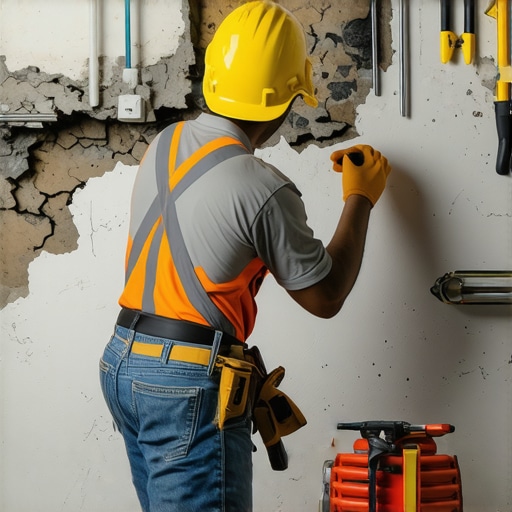
The Anatomy of a Growing Fracture
I was called out to a job site last November where the homeowner thought a simple tube of hardware-store caulk would solve a hairline fracture in his basement wall. But when I slid my borescope into the void, the reality was grim. The internal structural steel, which should have been encased in a protective alkaline environment of concrete, was rusted to a brittle red dust. That small crack wasn’t a blemish; it was a lung gasping for air. Most people see a crack and think about the surface. A forensic mason looks at the physics of the soil, the chemistry of the mix, and the invisible hand of hydrostatic pressure that is trying to reclaim the site. When a foundation crack keeps growing, you aren’t fighting a static problem; you are fighting a dynamic geological event.
“Water penetration is the single greatest threat to masonry durability.” – BIA Technical Note 7
The Physics of Settlement and Hydrostatic Pressure
In the North, where the freeze-thaw cycle is our constant adversary, a growing crack is often a symptom of ice lens formation. When water infiltrates the soil adjacent to your foundation, it doesn’t just sit there. During a freeze, that water expands by approximately 9% in volume. This isn’t just a gentle push; it is a relentless force that exerts thousands of pounds of pressure per square foot against your masonry. If you have honeycombing—those nasty air pockets formed during a poor concrete pour—you’ve essentially given that water a VIP pass into your structural core. The moisture enters, freezes, pops the internal matrix of the concrete, and the crack grows another millimeter. Over a decade, that millimeter becomes a structural failure. This is why a simple patch fails: you are trying to glue together two tectonic plates with a bit of ‘mud’.
Why Your Patch Keeps Failing: The Chemistry of the Bond
Most DIYers reach for a standard bag of Type S mortar. They butter the crack, smooth it with a slicker, and walk away. Three months later, the patch falls out. Why? Because of the ‘tooth’—or lack thereof. For a patch to hold, it requires mechanical and chemical adhesion. When you have an active crack, the concrete is moving. If your patching material is harder than the original substrate, the movement will simply find the weakest point—the bond line—and shear it off. I’ve seen this repeatedly in commercial masonry maintenance where speed is prioritized over science. We also have to talk about the ‘suction.’ If you apply a dry patch to a dry crack, the old concrete will suck the moisture out of the new mud before it can achieve a proper C-S-H (Calcium Silicate Hydrate) gel formation. You end up with a brittle, unbonded plug that has no structural integrity.
Structural Masonry Inspection: Diagnosing the Movement
Before you pick up a hawk and trowel, you need to know if the crack is moving vertically or horizontally. A stair-step crack in a soldier course or standard running bond often indicates uneven settlement. A horizontal bulge, however, is the harbinger of foundation wall bowing repair needs. This is where we look at retaining wall geogrid installation principles. If the soil behind the wall isn’t reinforced or drained, the wall becomes a dam. And masonry makes for a terrible dam. We look for signs of efflorescence—that white, salty powder. It’s the concrete’s way of crying. It means water is moving through the mineral structure, dissolving the calcium hydroxide, and depositing it on the surface. If you see this, your crack is an active waterway.
The Forensic Fix: From Band-Aids to Cures
If the crack is truly active, you stop looking at patches and start looking at stabilization. 3D printed masonry repairs are on the horizon for complex geometries, but today, we rely on high-pressure epoxy or polyurethane injections. But even that is a secondary fix. If the wall is bowing, you need carbon fiber straps or steel I-beams. In extreme cases of soil failure, we use helical piers—massive steel screws driven deep into the load-bearing strata. I often see people try to hide these issues by installing stone veneer over brick or concrete. This is a cardinal sin in forensic masonry. You are simply burying a cancer under a pretty skin. You can’t fix a structural defect with aesthetics. A proper structural masonry inspection must be the first step, followed by addressing the root cause, which is almost always drainage.
“The selection of mortar should be based on the strength of the masonry units to ensure the mortar is the sacrificial element.” – ASTM C270
Beyond the Foundation: The Interconnected System
Your foundation doesn’t exist in a vacuum. A failing brick patio restoration project or a clogged chimney flue liner installation can actually contribute to foundation issues by mismanaging water runoff. If your gutters are dumping water at the base of your chimney, you’ll soon be needing chimney leak detection and foundation work simultaneously. We use sustainable block cutting techniques to create custom drainage channels that divert water far from the footprint of the home. The goal is to keep the soil moisture content consistent. Drastic swings from bone-dry to saturated are what cause the clay to heave and shrink, which is the primary driver of those growing cracks. Whether it’s a retaining wall geogrid installation or a simple repointing job, the masonry must be allowed to breathe while the water is forced to leave. If you don’t respect the physics of the site, the site will eventually break your work. Do it once, do it right, or get used to the sound of your house shifting in the night.