
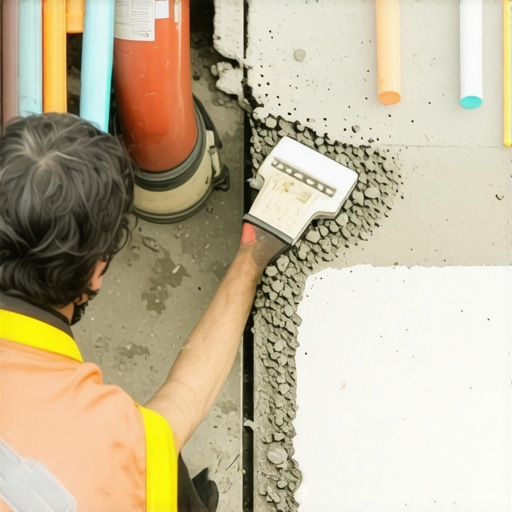
The Anatomy of a Failing Patch
The homeowner thought it was just a hairline crack. But when I put my scope inside the cavity and tapped the surface with my hammer, the sound wasn’t the dull ‘thud’ of solid stone. It was a high-pitched, resonant ‘clack’—the sound of a lie. The surface looked like a finished floor, but beneath that thin skin of Portland cement, the structural steel was rusted to dust and the patch was floating on a cushion of air. This is the reality of forensic masonry: what you see is rarely what you have. A hollow sound under a concrete patch is the final warning before a total adhesive failure.
When we talk about ‘hollow sounds,’ we are discussing the failure of the Interfacial Transition Zone (ITZ). This is the microscopic region where the new ‘mud’ attempts to shake hands with the old substrate. In a successful repair, the new material enters the pores of the old concrete through capillary action, creating a mechanical lock. But when a patch rings like a drum, it means that handshake never happened. Instead, you have delamination. The patch is essentially a shell, a ‘cold joint’ that has separated due to shrinkage, contamination, or the brutal physics of the freeze-thaw cycle. If you’re dealing with concrete block foundation repair or a brick veneer detachment repair, ignoring that sound is an invitation to structural disaster.
“Bond strength is the most critical factor in the longevity of any masonry repair; without it, the patch becomes a sacrificial layer that accelerates the decay of the underlying structure.” – ACI 562-16 Code Requirements for Assessment, Repair, and Rehabilitation of Existing Concrete
The Physics of the ‘Hollow’ Sound
To understand why a patch fails, we have to micro-zoom into the hydration process. When you mix a bag of repair mortar, a chemical reaction called hydration begins. Crystals of calcium silicate hydrate (C-S-H) grow and interlock. However, if the old concrete is dry and ‘thirsty,’ it will suck the moisture out of your new mix before those crystals can grow into the pores. This ‘flash drying’ leaves a layer of unhydrated powder at the interface—a literal wall of dust that prevents a bond. This is why we insist on Saturated Surface Dry (SSD) conditions. You want the old stone to be damp, but not dripping. If there is standing water, the water-to-cement ratio at the bond line sky-rockets, creating a weak, watery ‘slurry’ that will eventually crumble and sound hollow when tapped with a slicker.
The Freeze-Thaw War in Northern Climates
In regions where the thermometer drops below thirty-two, a hollow patch is a ticking time bomb. Water is a unique beast; it expands roughly 9% in volume when it turns to ice. If you have a hollow pocket under a chimney cap replacement or a sidewalk patch, that pocket acts as a reservoir. Snow melts, the water seeps into the micro-cracks, and it fills that hollow void. When the temperature drops, the water expands with a force of thousands of pounds per square inch. It doesn’t just pop the patch off; it ‘spalls’ the healthy concrete beneath it, turning a minor repair into a masonry rescue after disaster. This is why full repointing services are never just about aesthetics—they are about sealing the envelope against hydrostatic pressure and ice-jacking.
Diagnosing the Failure: From Sounding to Scoping
Before you reach for the hawk and trowel, you must perform a forensic audit. We use a method called ‘sounding.’ I take a heavy steel chain or a masonry hammer and drag it across the surface. A solid bond vibrates through your feet; a hollow bond vibrates through your ears. If we find extensive ‘drummy’ areas in modular masonry construction or along a brick veneer detachment, we have to look for the culprit. Is it ‘honeycombing’? That’s when the aggregate wasn’t vibrated properly, leaving air pockets. Is it a ‘cold joint’? That’s where the old pour set completely before the new mud was applied. In many cases, especially with concrete block foundation repair, the hollow sound indicates that the internal rebar has oxidized. Rust occupies more space than steel, and as it grows, it literally jacks the concrete away from the metal, creating a void that rings hollow.
“Water penetration is the single greatest threat to masonry durability, leading to efflorescence, corrosion of embedded metals, and catastrophic delamination of surface patches.” – BIA Technical Note 7
The Fix: Excavation and Re-Bonding
You cannot ‘fix’ a hollow sound by rubbing more mud on top. You have to be a surgeon. You must grind out the failed patch until you hit ‘bright’ stone—original, uncontaminated masonry. This is where facade cleaning and masonry cleaning become technical requirements, not just cosmetic ones. If there is oil, carbon crust, or biological growth on the substrate, the new patch will never stick. We use a needle scaler or a diamond-shroud grinder to create ‘tooth’—a rough profile that gives the new material something to bite into. For large-scale vertical failures, we utilize self-leveling masonry lifts or specialized mortarless masonry systems that rely on mechanical anchors rather than just chemical adhesion.
The Master’s Method: Buttering and Striking
When the substrate is prepped, we apply a bonding agent—often a slurry of neat cement and water, or a sophisticated epoxy resin. Then comes the ‘buttering.’ You don’t just throw the mud at the hole. You ‘burn’ a thin layer into the pores with a margin trowel first, then build up your layers. For full repointing services, we use a slicker to pack the joints tight. Air is the enemy. Every pocket of air is a potential site for a hollow sound and future failure. In historic restorations, we avoid modern Portland cement, which is too hard and brittle. Instead, we use lime-based mortars that have ‘autogenous healing’ properties—meaning they can actually seal micro-cracks over time through carbonation, preventing that hollow delamination from ever starting.
When to Panic and When to Pivot
If you tap your chimney cap replacement and it sounds like a hollow coconut, you are looking at a falling hazard. If your concrete block foundation repair yields a hollow thud, you might be looking at a wall that is ready to buckle under soil pressure. This isn’t just about ‘handyman’ aesthetics. This is about the physics of load-bearing structures. A hollow patch is a sign of a failed system. Whether you are looking at modular masonry construction or an old 1920s bungalow, the rules of the ‘mud’ remain the same. Respect the suction of the brick, ensure the cleanliness of the stone, and never trust a patch that doesn’t ‘ring’ solid. Do it once, do it right, or the frost will do it for you.