
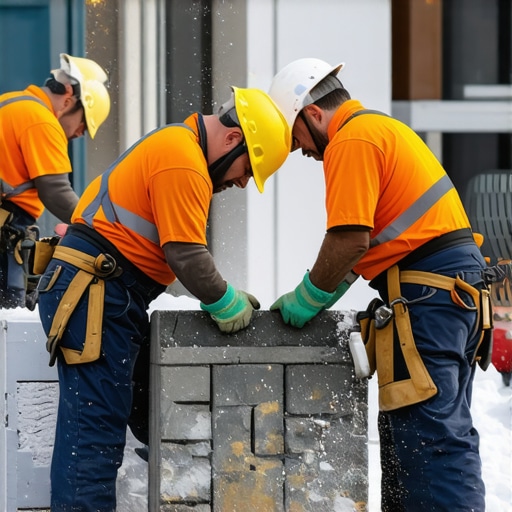
The Forensic Reality of Frozen Masonry
The facility manager called me out to a mid-rise office complex because he noticed a few ‘dusty red flakes’ on the pavement near the entrance. He figured it was just the building showing its age, maybe a bit of wind erosion. But when I bored a hole for the fiber optic scope into the brick cavity, I found a structural nightmare. The steel shelf angles, meant to carry the weight of the masonry curtain wall, were so bloated with rust from decades of salt infiltration that they had expanded to nearly twice their original thickness. That ‘dust’ was the sound of the soldier course literally being crushed by its own support system. This wasn’t just a cosmetic issue; it was a forensic scene where the structural steel was slowly being turned to dust by the very elements it was meant to defy. This is the reality of commercial masonry in a freeze-thaw environment. When the temperature drops, the physics of your building changes, and if you aren’t paying attention to the chemistry of your mud, you’re just waiting for a collapse.
The Molecular War: Why Winter Destroys Masonry
To understand why winter maintenance is a specialized craft, you have to look at the pore structure of the brick and the capillary suction of the mortar. When water enters a masonry unit, it doesn’t just sit there. It occupies the microscopic voids within the clay or concrete. As the thermometer dips below 32 degrees, that water undergoes a phase change, expanding by roughly 9% in volume. In a well-built wall, there is enough room in the entrained air voids for this expansion. In a wall saturated by poor drainage or failed masonry water damage repair, that expansion generates internal pressures exceeding 2,000 pounds per square inch. This is the primary driver of spalling, where the face of the brick pops off like a scab, exposing the soft, under-fired core of the unit to even further degradation.
“Water penetration is the single greatest threat to masonry durability, particularly in regions where the freeze-thaw cycle is prevalent.” – BIA Technical Note 7
When we talk about foundation crack repair during the winter months, we aren’t just talking about filling a gap. We are fighting hydrostatic pressure from the frozen soil. Frozen earth acts like a giant, slow-moving hydraulic jack, pushing against foundation walls with immense force. If your commercial property hasn’t been properly waterproofed, that moisture enters the modular masonry construction joints, freezes, and widens the gap. I’ve seen 12-inch thick reinforced blocks sheared clean through because the ‘handyman’ who did the last repair used a rigid epoxy that didn’t allow for the natural movement of the wall. In my world, you don’t use a ‘Band-Aid’ when the patient needs surgery.
Modern Diagnostics: AI Masonry Assessment and Thermal Imaging
The old way of checking a wall was to walk the perimeter with a hammer and listen for the ‘hollow’ thud of delaminated stone. While I still trust my ears, we’ve moved into the era of AI masonry assessment. By using high-resolution thermal cameras paired with machine learning algorithms, we can now map the moisture content behind the facade without pulling a single brick. These systems detect the thermal bridge where moisture has compromised the insulation or where fire-rated masonry installation seals have failed. It allows us to pinpoint exactly where the ‘mud’ has turned to mush. This data-driven approach is critical for large-scale chimney repair services where the height and exposure make manual inspection both dangerous and incomplete. If you can see the heat escaping through a cracked flue liner on a thermal scan, you know you’ve got a fire hazard before the smoke ever tells you.
The Maintenance Checklist: From Capstones to Metallic Finishes
Winter maintenance isn’t just about looking for cracks; it’s about the integrity of the entire envelope. Retaining wall capstone replacement is often the first line of defense. If the capstone—the roof of your wall—is cracked or its joints are open, water flows directly into the heart of the structure. I always tell my clients: a wall is only as good as its hat. Once water gets behind those stones, the freeze-thaw cycle will heave the entire wall out of plumb within three seasons. We also have to consider the aesthetic and protective layers, such as metallic masonry finishes. These modern coatings are great for urban aesthetics, but they can trap moisture if applied over ‘green’ or damp masonry. The bond fails, and the finish peels away in sheets, leaving a ‘cold joint’ where the new work meets the old.
“Mortar should be maintained at a temperature to permit hydration and prevent the formation of ice crystals within the matrix.” – ASTM C270 Standards
We are seeing more green roofing masonry integration in commercial spaces, which adds a whole new layer of complexity to winter care. The soil in those green roofs acts as a massive thermal mass and a moisture reservoir. If the masonry parapets aren’t properly flashed and vented, that moisture migrates into the brickwork. During the winter, this can lead to massive efflorescence—that white, salty crust you see on buildings. It’s not just ugly; it’s the sound of the building’s minerals being leached out. Proper maintenance involves checking the drainage layers of these green systems to ensure they aren’t backing up and forcing water into the sustainable block cutting joints of the structural walls.
The Art of the Winter Repair: Mud, Heat, and Patience
If you have to do a masonry water damage repair in January, you better know your chemistry. You don’t just mix a bag of Type S and hope for the best. We use ‘mud’ that has been heated, and we protect the work area with thermal blankets to keep the hydration process moving. If the mortar freezes before it cures, the C3S crystals—the things that give cement its strength—don’t grow. You end up with a brittle, sandy mess that will fall out by April. This is especially true for modular masonry construction where the precision of the joints is everything. I’ve seen guys ‘butter’ a soldier course in ten-degree weather without heat, and by the time they hit the end of the wall, the first brick was already loose. That’s not craftsmanship; that’s a waste of the client’s money. Do it once, or do it twice—I prefer the former.
Conclusion: The Forensic Eye
Commercial masonry isn’t a ‘set it and forget it’ material. It’s a living, breathing assembly of minerals and chemistry that reacts to every degree of temperature change. Whether it’s the precision required for fire-rated masonry installation or the specialized tools used in AI masonry assessment, the goal remains the same: keep the water out and the heat in. Don’t wait for the flakes on the sidewalk to call a pro. By the time the brick starts talking to you, it’s usually screaming. Look for the ‘slicker’ marks of a professional, ensure your retaining wall capstone replacement is handled before the first frost, and never trust a contractor who doesn’t respect the ‘tooth’ of the stone. Real masonry is built to last centuries, but only if you have the sense to maintain it through the winter.