
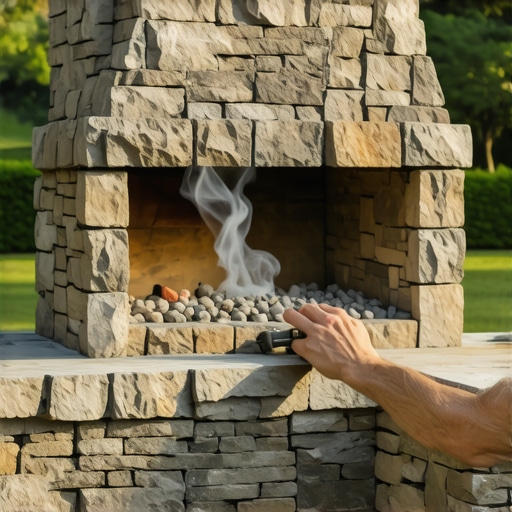
The Anatomy of a Failing Draft
My mentor, a man who had been buttering joints since the Truman administration, once held a candle to the throat of a cold firebox. He told me, ‘If the flame doesn’t bow to the chimney, the chimney is lying to you.’ He was talking about the invisible logic of air pressure, a concept many modern installers ignore when they slap together a fireplace. I have stood before hundreds of outdoor hearths where the homeowner is weeping because their $15,000 investment is doing nothing but choking the patio with soot. They think it is a minor glitch, but usually, it is a failure of physics. When a fireplace smokes, it is a symptom of a systemic imbalance between the firebox volume and the flue’s ability to evacuate gas. We are going to look at the forensics of why your fireplace is failing and how to perform a masonry damage assessment that actually solves the root cause.
The Physics of the Smoke Shelf and the Bernoulli Principle
To understand a smoking fireplace, you have to understand fluid dynamics. Smoke is not just ‘hot air’; it is a heavy slurry of carbon particulates and water vapor. In an outdoor environment, you are fighting a constant war against ambient wind and cold air ‘plugs’ inside the masonry. If the flue is too cold, the smoke loses its buoyancy. This is where high-performance mortar mixes become critical. Traditional mud doesn’t have the thermal reflectivity required to keep the gases hot enough to rise quickly.
“The flue area should be at least one-tenth of the area of the fireplace opening for chimneys over 15 feet in height to ensure proper drafting.” – BIA Technical Note 19
When I inspect a smoking hearth, I first look at the ratio. If your firebox opening is 40 inches wide and 30 inches high, and you are venting into an 8×8 flue, you have a math problem, not a cleaning problem. The smoke hits a bottleneck, creates turbulent eddies at the lintel, and rolls back into the seating area. We fix this by either shrinking the firebox opening with a soldier course of historic brick salvage or by extending the flue height to increase the ‘stack effect.’
Adjusting the Flue: The Forensic Fix
Adjusting the flue is not always about tearing the whole thing down. Often, the issue lies in the smoke shelf—that flat area behind the damper. In many ‘handyman specials,’ I see this shelf filled with mortar droppings or, worse, built flat. A proper smoke shelf must be parged smooth to allow the downdraft to transition back up the chimney without creating a ‘cold joint’ of stagnant air. If the air is rolling, we need to use a slicker to smooth out the internal transitions. For those dealing with historic masonry preservation, we often find that the original lime-based parging has eroded, leaving raw brick edges that snag the smoke. Using a concrete pump masonry mixes approach for relining isn’t always feasible in these delicate structures; instead, we hand-butter a new lining using a high-heat refractory mix. This restores the ‘tooth’ of the flue and ensures the laminar flow of gases is maintained from the throat to the chimney cap.
The Thermal Shock Factor in Outdoor Masonry
In northern climates, the freeze-thaw cycle is the silent killer of masonry. Water expands 9% when it freezes, and if you have used a hard Portland-heavy mortar on a chimney that sits cold for six months, you are asking for trouble. This is why spalled concrete steps repair and fireplace maintenance go hand-in-hand. The same moisture that pops the face off your steps is getting into the chimney crown. When you light a fire in a frozen chimney, the internal temperature jumps from 30 degrees to 800 degrees in minutes. This thermal shock causes ‘honeycombing’ in the mortar joints. To prevent this, we utilize mortar matching services to find a mix that has the right elasticity. A stone balustrade restoration or a brick veneer installation around a fireplace must account for this expansion. If you don’t have a 2-inch clearance between the firebox and the veneer, the whole facade will eventually buckle and crack vertically as the heat forces the materials to expand outward.
Restoring the Aesthetic and Functional Integrity
Beyond the smoke, the degradation of an outdoor fireplace often affects the surrounding landscape features. I often see cases where an outdoor masonry fountain restoration is needed simultaneously because the same poor drainage that ruined the fountain base is heaving the fireplace foundation.
“Refractory mortar must be used in the construction of fireboxes to withstand temperatures exceeding 2,000 degrees Fahrenheit without losing structural bond.” – ASTM C199
If your fireplace is smoking, check the masonry damage assessment logs for signs of foundation settlement. A fireplace that leans even half an inch can develop gaps in the flue liners, allowing smoke to leak into the wall cavity. This isn’t just a nuisance; it’s a fire hazard. Whether you are doing a stone balustrade restoration or just trying to get a clean burn for a Friday night, you have to respect the materials. Don’t use ‘lick-and-stick’ stone over a failing core. Use the right mud, respect the ratio, and remember that masonry is a living, breathing thing that requires a clear airway to function.