
The Forensic Reality of the Crumbled Facade
I have spent forty years on scaffolding, my knuckles permanently scarred by the rough grit of Indiana limestone and the sharp edges of over-fired clay bricks. I have seen the damage wrought by the well-intentioned but ill-informed. You see a dirty building; I see a complex respiratory system that has been choked for a century by coal soot and industrial grime. My mentor, a man who could tell you the moisture content of a batch of lime mortar by the way it ‘sung’ against his hawk, always taught me that the surface of a stone is its ‘fire-skin.’ Once you break that skin with aggressive sandblasting or caustic acids, the stone is effectively dead. It begins to weep minerals, it loses its structural integrity, and eventually, you are left with crumbling mortar joint repair jobs that never end because the substrate itself is failing. The industry has long needed a scalpel instead of a sledgehammer, and that is where the physics of robotic laser cleaning enters the forensic scene.
“Water penetration is the single greatest threat to masonry durability, but the removal of the protective surface patina through abrasive cleaning is a close second.” – BIA Technical Note 7
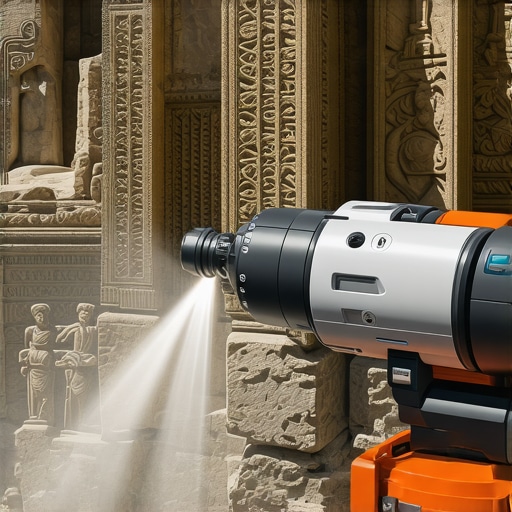
When we talk about tuckpointing machine services or commercial parapet wall repair, we are usually discussing the symptoms. The disease is often the buildup of gypsum crusts and carbon deposits that trap moisture within the stone. In the old days, we used ‘the mud’—a heavy lime-based mortar—to butter the joints and hope the stone could still breathe. But on fragile historic details—those ornate corbels, the delicate ivy carvings, the weeping faces on a Victorian cornice—you cannot just go in with a grinder. You need something that respects the molecular boundary of the material. Laser cleaning works through a process called selective ablation. The laser beam is tuned to a frequency that is absorbed by the dark pollutants but reflected by the lighter-colored stone underneath. When the pulse hits the dirt, it vaporizes instantly—a microscopic explosion of plasma that leaves the underlying ‘fire-skin’ untouched. It is the most surgical tool in our arsenal for crumbling mortar joint repair and preservation.
The Physics of the Photonic Trowel
Why does this matter for your commercial parapet wall repair? Because parapets are the most exposed part of any structure. They take the brunt of the freeze-thaw cycle. If you use high-pressure water or chemicals to clean them, you are forcing liquid deep into the core of the wall. When that water freezes, it expands by 9%, and suddenly you have foundation slab jacking issues or structural shifting because the moisture has migrated where it should never be. Robotic laser cleaning is a dry process. There is no runoff, no chemical leaching into the soil, and no saturation of the masonry. I have used self-leveling masonry lifts to position these robotic units against tuckpointing curved walls where a human hand would be too shaky to ensure a consistent clean. The robot maintains a perfect distance, ensuring that the energy density remains uniform across every square inch of the stone.
We have to look at the chemistry of the bond. When we apply advanced masonry adhesives or decorative metallic masonry finishes to a historic restoration project, the surface must be pristine. If there is even a micron of carbon film left, your adhesive will fail within two seasons. This is where ‘lick-and-stick’ contractors get into trouble. They slap modern materials over ancient grime and wonder why the face of the building falls off in three years. I have inspected ‘repaired’ chimneys where the chimney sweep and repair guy just smeared new mortar over old soot. That is a cold joint, and it is a death sentence for the masonry. By using laser ablation first, we ensure that the new ‘mud’ or the advanced masonry adhesives are bonding to the actual mineral structure of the stone, not a layer of 1950s smog.
Modern Innovations and the Master Mason’s Grudge
I have a healthy skepticism for mortarless masonry systems. In new construction, they have their place, but in the forensic world of restoration, we rely on the sacrificial nature of the joint. The mortar must be softer than the stone. If the wall moves—and it will move—the mortar should crack, not the stone. When we are performing tuckpointing machine services on a high-rise, we are essentially rebuilding the building’s shock absorbers. The laser allows us to see the true condition of the joints. Often, what looks like a solid joint is just a ‘buttering’ of hard Portland cement over crumbling mortar joint repair needs. Once the laser clears the soot, the truth comes out. You might find that the commercial parapet wall repair requires more than just a slicker and some mud; you might find that the structural steel behind it is ‘honeycombing’—rotting away because moisture was trapped by that very same grime we just removed.
“The choice of cleaning method should be based on the principle of using the least impactful means possible to achieve the desired result without altering the physical properties of the masonry.” – ASTM C270 Standards for Masonry Restoration
We are now seeing the integration of metallic masonry finishes in modern retrofits, where laser-cleaned stone is paired with zinc or copper accents. This requires a level of precision that traditional methods cannot match. If you are tuckpointing curved walls on a historic rotunda, the shadows created by the curvature make it impossible to clean evenly with hand tools. The robotic laser doesn’t care about shadows. It tracks the geometry, adjusting its focal point in real-time. It is the only way to preserve the ‘tooth’ of the stone so that the next generation of masons isn’t cursing our names for ruining a masterpiece. Whether we are talking about foundation slab jacking to stabilize a leaning monument or simple chimney sweep and repair, the goal is longevity. You do it once, or you do it twice. And if you do it twice, you’re not a mason; you’re a handyman with a bucket of mud. We use self-leveling masonry lifts and robotic optics because the buildings we fix were meant to outlast us, and it’s our job to make sure they do.