
The Forensic Scene: When the Trowel Tells the Truth
I was called out to a 1912 Victorian row house last autumn, a structure that had survived a century of storms only to be nearly leveled by a ‘handyman’ with a seven-inch angle grinder. From the sidewalk, it looked like a massacre; the red clay faces of the bricks were scarred with horizontal ‘over-cuts’ where a heavy-handed operator had tried to clear the joints. But when I put my digital scope into the voids during one of my routine drone chimney inspections, the real horror was revealed. Behind that outer skin, the structural core of the brickwork was turning to powder. The previous contractor had used a high-strength Portland cement—a material so hard and rigid that it had effectively turned the mortar joints into a dam. Instead of the wall breathing, moisture was trapped, and the internal hydrostatic pressure was literally crushing the historic clay from the inside out. This wasn’t just a cosmetic failure; it was a forensic case of material incompatibility.
“Water penetration is the single greatest threat to masonry durability, accounting for nearly 90 percent of all masonry failures.” – BIA Technical Note 7
The Physics of the ‘Sacrificial’ Joint
To understand why precision grinding is the only way to save these old souls, you have to understand the chemistry of the bake. Historic bricks, particularly those fired before the mid-20th century, are ‘soft.’ They were fired at lower temperatures, resulting in a porous structure that acts like a lung. In the world of forensic masonry, we talk about the brick spalling prevention through the lens of vapor permeability. When we perform brick column repair or deep repointing, the mortar must be the ‘sacrificial’ element. It should be softer and more permeable than the brick itself. If the mortar is too hard—like a modern Type S or a standard concrete patch—the thermal expansion and contraction will find the weakest point. In a historic wall, the weakest point becomes the brick face. The 9% expansion of water as it transitions to ice within the pore structure will pop that brick face right off, a phenomenon known as spalling.
The Tool of the Trade: Micro-Zooming into Precision Grinding
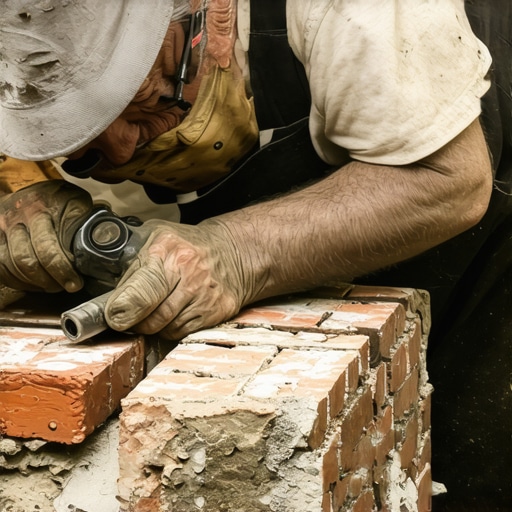
Precision grinding isn’t about speed; it’s about surgery. We use small-diameter diamond blades, often 4-inches or smaller, equipped with vacuum shrouds that create a near-zero-dust environment. This isn’t just for the lungs of the mason; it’s to keep the masonry joint sand repair area visible. You have to see the ‘tooth’ of the brick. When raking out a joint to a depth of 3/4 inch to 1 inch, the goal is to create a clean, square ‘U’ shape, not a ‘V.’ A ‘V’ joint lacks the surface area for the new ‘mud’ to grab onto. We ‘butter’ the joints carefully, ensuring the new high-performance mortar mixes—typically a Type O or a custom lime putty blend—can achieve a mechanical bond with the roughened interior of the brick. This ‘tooth’ provides the friction necessary to resist the lateral forces of the wall. If you use a heavy-handed grinding technique, you round off the edges of the brick, destroying the ‘shadow line’ and permanently altering the architectural profile of the building.
“The mortar should be designed to be weaker than the masonry units so that any cracks that occur will be in the mortar joints where they can be easily repaired.” – ASTM C270 Standard Specification for Mortar for Unit Masonry
The Hydration Cycle and High-Performance Mortar Mixes
When we talk about ‘mud’ in the trade, we aren’t just talking about wet sand. We are talking about the carbonation cycle. A proper lime-based mortar doesn’t just ‘dry’; it cures through the absorption of $CO_2$ from the atmosphere, turning back into calcium carbonate. This process can take weeks, even months. During this time, the mortar remains flexible, allowing it to ‘self-heal’ micro-cracks. This is the opposite of tile grouts on masonry or modern mortarless masonry systems, which rely on rigid chemical bonds. When we are called for chimney rebuild services, we have to account for the extreme thermal shock. The flue reaches hundreds of degrees while the exterior face might be sub-zero. Using a rigid, high-cement mix in this scenario is a death sentence for the masonry. We need that flexibility to manage the differential movement.
Geotechnical Reality: Soil Heaving and Structural Stress
In our forensic inspections, we often find that masonry failure is a symptom, not the disease. Soil heaving or settling can put immense tension on a brick facade. Unlike steel, masonry is incredibly strong in compression but has almost zero tensile strength. This is why you see ‘stair-step’ cracks. Precision grinding allows us to open these cracks deeply enough to install stainless steel ‘helical’ reinforcement bars before repointing. This ‘stitches’ the wall back together, allowing it to act as a monolithic unit again. We also have to consider green roofing masonry integration. When a client wants a garden on their roof, they are introducing a constant source of moisture and organic acids right at the parapet wall. Without a high-performance flashing system and a specialized mortar that can handle constant dampness without ‘wicking’ it into the building interior, the brickwork will fail within five years.
The Art of the Strike: Finishing for Longevity
Once the ‘mud’ is on the ‘hawk’ and we’ve ‘buttered’ the joints, the ‘slicker’ or jointer tool comes into play. We don’t just smooth it over. We ‘strike’ the joint when it is ‘thumb-print hard.’ This compacts the mortar, pushing it tight against the brick edges to ensure a watertight seal. This is where the ‘handyman’ fails; they strike too early, leaving the mortar smeared on the brick face, or too late, failing to get that critical compaction. Proper striking creates a ‘weather-struck’ or ‘concave’ joint that sheds water like a duck’s back. This is the final line of defense in brick spalling prevention. It’s the difference between a wall that lasts another century and one that ends up in a rubble pile before the next decade is out. Don’t be fooled by a ‘cheap’ quote. In masonry, you either do it once, or you do it twice—and the second time is always more expensive because you’re paying me to fix the first guy’s butchery. “