
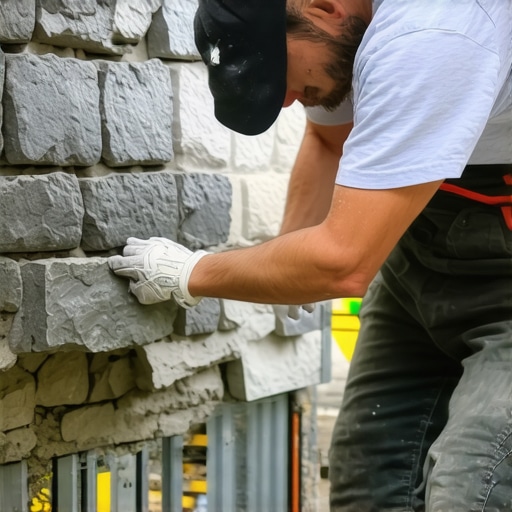
The Anatomy of a Loose Stone: A Forensic Perspective
The first time I saw the failure, it wasn’t a collapse; it was a whisper. I was standing on a parapet wall overlooking a high-end commercial facade, the kind where the client expects the masonry to outlive their grandchildren. The homeowner thought it was just a hairline crack in the mortar joint of the coping. But when I put my scope inside that narrow void, I didn’t see solid bed joints. I saw that the structural steel underneath was rusted to a fine, red dust, and the mortar had turned into a sandy pulp from decades of trapped moisture. This is the reality of masonry forensics: the most dangerous failures are the ones you can’t see until the stone shifts under your hand.
Coping stones serve as the ‘umbrella’ for your wall. Whether they are crowning a brick quoin or capping a concrete block foundation, their job is to shed water away from the vertical face. When that bond breaks, you aren’t just looking at a trip hazard or an aesthetic flaw; you are looking at an open invitation for hydrostatic pressure to begin its slow, violent work of tearing your structure apart from the inside out. Traditionally, fixing a loose coping stone meant a ‘messy reset’—lugging a mixer to the roof, hauling bags of ‘mud’ (mortar) through a clean house, and inevitably splashing gray cement over everything. But modern precision adhesives have changed the physics of the repair, provided you understand the chemistry of the ‘tooth’ of the stone.
“Water penetration is the single greatest threat to masonry durability.” – BIA Technical Note 7
The Physics of the Freeze-Thaw Cycle
In regions where the thermometer bounces across the freezing mark like a rubber ball, the enemy is the 9% expansion of water. When water gets behind a coping stone and freezes, it exerts thousands of pounds of pressure per square inch. If you’ve used a standard Portland-based mortar for a thin-set repair, that mortar is often too brittle. It doesn’t breathe, and it doesn’t flex. This leads to brick spalling where the face of the brick literally pops off because the mortar was harder than the unit itself. In my three decades of forensic inspections, I’ve seen more damage caused by ‘lick-and-stick’ repairs with the wrong materials than by the elements themselves. This is why we look toward sustainable masonry materials and high-performance polymers that offer a different kind of bond.
Precision adhesives are not just ‘glue.’ We are talking about structural polyurethanes and modified epoxies designed to penetrate the pore structure of the stone. When you ‘butter’ a stone with these materials, you are creating a chemical weld. Unlike traditional mud, which relies on a mechanical bond (filling the nooks and crannies of the stone), these adhesives create a molecular bridge. This is crucial for historic brick salvage or when dealing with concrete flatwork services where the substrate might be old, weathered, or compromised by past ‘handyman specials.’
Why the ‘Messy Reset’ Fails
The old-school method of resetting a stone involves a full bed of mortar. The problem is ‘suction.’ A dry, porous stone will suck the water right out of the mortar before it has a chance to hydrate. This is called ‘burning’ the joint. You end up with a cold joint—a connection that looks solid but has zero structural integrity. You can tap it with your trowel and hear that hollow ‘thunk’ that tells any Master Mason the bond is dead on arrival. Precision adhesives eliminate the suction issue. They don’t rely on water for hydration; they rely on a chemical reaction that is indifferent to the thirst of the stone.
Furthermore, when you are doing cracked brick wall repair or chimney heat shield installation, the weight of the material matters. Piling pounds of heavy mortar onto a delicate or shifting structure adds dead load. Precision adhesives allow for a ‘low-profile’ repair. We can stabilize a loose coping stone with a fraction of the mass, ensuring that the modular masonry construction remains agile enough to handle thermal expansion without cracking.
“Mortar should always be weaker than the masonry units it binds to ensure that stress cracks occur in the mortar joints, which are easier to repair than the stones themselves.” – ASTM C270 Standard Specification
The Forensic Process: Step-by-Step Restoration
Before you even touch a tube of adhesive, you have to address the ‘carbon crust’ and the biological growth. This is where facade cleaning becomes a structural necessity, not just a cosmetic one. You cannot bond to dirt. I’ve seen guys try to butter a stone over a layer of lichen and wonder why it popped two weeks later. You need to get down to the ‘tooth’ of the material. This often involves grinding out the old, failing mortar using a diamond blade, ensuring you don’t create ‘honeycombing’—those nasty little air pockets that trap water.
Once the substrate is clean, we look at the ‘bed.’ For a coping stone, the adhesive isn’t just applied in a glob. It’s applied in a specific ‘soldier course’ pattern of beads that allows for air escape and prevents the ‘suction cup’ effect during the set. This is precision work. We use a ‘slicker’ or a specialized jointer tool to ensure the perimeter is sealed with a color-matched sealant that looks like a traditional mortar joint but behaves like a high-tech gasket. This is how you achieve a brick quoin repair that looks like it was laid by a master in 1920 but has the resilience of 21st-century material science.
The Long-Term Value of Forensic Repairs
Whether you are dealing with concrete block foundation repair or installing a chimney heat shield, the goal is always the same: moisture management. A loose coping stone is a symptom of a larger systemic failure in the building envelope. By using precision adhesives, we are not just sticking a stone back in place; we are sealing a breach. We are preventing the brick spalling that leads to the eventual need for historic brick salvage. We are ensuring that the concrete flatwork services you paid for aren’t undermined by water running down the interior of the wall cavity.
Don’t be fooled by the simplicity of the ‘caulk gun’ approach. A forensic-level repair requires an understanding of the pH of the stone, the moisture vapor transmission rate of the wall, and the thermal expansion coefficient of the adhesive versus the masonry. It’s the difference between a ‘fix’ that lasts a season and a restoration that lasts a lifetime. When I walk away from a job, I want to know that if someone taps that stone with a hammer, it’s going to ‘ring’ with the solid sound of a perfect bond. That is the standard of a Third-Generation Mason. Do it once, do it right, or don’t bother picking up the hawk.