
The Deceptive Crown: Why Ground-Level Inspections Are a Mason’s Nightmare
I’ve spent forty years hauling a hawk and trowel up shaky extension ladders, and if there is one thing I’ve learned, it’s that masonry lies. From the driveway, your chimney looks like a pillar of strength. But masonry is a porous, living skin, and the chimney is its most exposed limb. It catches the wind, the driving rain, and the brutal thermal shock of internal flue temperatures reaching 800 degrees while the exterior brick is hit with a sub-zero gale. I’ve seen commercial masonry facade maintenance programs fail because they relied on binoculars and a prayer. The truth is, the most lethal defects in a chimney or a commercial parapet wall repair project happen in the ‘blind zones’—the areas where a human on a ladder simply cannot reach without risking their neck or damaging the substrate.
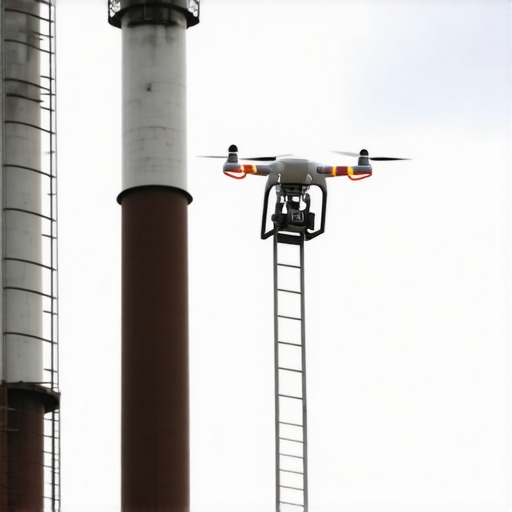
The homeowner thought it was just a hairline crack. But when I put my scope inside and flew the high-resolution drone over the shoulder of the stack, I saw the structural steel was rusted to dust. The drone’s 4K camera caught what my eyes, even from three feet away on a ladder, might have missed: the metallic brick colors application on the decorative corbeling was masking a deep, horizontal shear crack. This wasn’t just a cosmetic issue; the entire upper third of the chimney was disconnected from the house, held in place by nothing but gravity and a few stubborn shards of mud. In the world of historic masonry preservation, what you don’t see will eventually kill the building.
“Water penetration is the single greatest threat to masonry durability. Because chimneys are exposed to the elements on all four sides, they require specialized moisture control and flashing details.” – BIA Technical Note 19B
The Physics of the ‘Chimney Micro-Climate’
To understand why we need drones, you have to understand the chemistry of a failing chimney. When you burn fuel, you’re creating water vapor and sulfuric acid. In an old, unlined chimney, these gases permeate the concrete masonry unit restoration efforts or the soft lime mortar of a historic stack. This is the ‘wicking’ effect. The moisture travels through the brick via capillary action. When that moisture hits the exterior face—the ‘cold side’—it hits a wall of freezing air. In northern climates, this water expands by 9% as it turns to ice. This is the freeze-thaw cycle. It doesn’t just crack the brick; it spalls it, popping the face of the brick off like a scab. By the time you see red dust on your roof, the structural integrity of the brickwork pointing styles is already compromised.
Standard re-pointing services often fail because the contractor doesn’t understand the ‘suction’ or the ‘tooth’ of the old masonry. If you slap a high-strength Portland cement into a joint between soft, 19th-century bricks, the cement won’t move. The brick will. The drone allows us to see the ‘cupping’ of these joints from an aerial perspective that reveals the pattern of failure across the entire commercial masonry facade maintenance area. We can see if the failure is localized or if the retaining wall batter correction logic needs to be applied to the way the chimney is leaning away from the roofline.
The Drone’s Eye: Finding the ‘Cold Joint’ and ‘Honeycombing’
When we fly a forensic drone inspection, we aren’t just looking for cracks. We are looking for honeycombing in the concrete wash and cold joints where a previous ‘handyman special’ stopped and started their mud work. A ladder allows you to see the side of the chimney, but a drone allows us to hover directly over the flue. We can look for the ‘ring’ of the brick. My grandfather used to tap a brick with his trowel; if it didn’t ring like a bell, it was dead. Today, we use thermal imaging on drones to find ‘dead’ masonry. The thermal sensor detects the heat signature of moisture trapped behind the tuckpointing brick walls. If one section of the chimney stays colder than the rest after the sun goes down, I know exactly where the water is hiding.
This is critical for chimney repair services. If I butter a joint that is backed by saturated brick, that new mortar will ‘flash set’ or burn. It won’t hydrate properly because the dry, thirsty brick will suck the water out of the mud before the chemical bond can form. The drone gives us a map of where to pre-hydrate and where to excavate. It’s the difference between a 10-year fix and a 50-year restoration.
“Mortar should always be weaker than the masonry units it binds, acting as a sacrificial element that allows for thermal movement and moisture evaporation.” – ASTM C270 Standards
Beyond the Ladder: Commercial Parapets and Facades
In commercial masonry facade maintenance, the scale is too large for ladders. I’ve seen commercial parapet wall repair jobs where the contractor only fixed what they could see from the scaffolding. But the drone can fly the entire perimeter, identifying retaining wall batter correction issues where the parapet is actually bowing outward due to rusted outriggers. We can see the metallic brick colors application on the high-rise sections and determine if the coating is trapping vapor—a common death sentence for high-rise brickwork. This is where concrete masonry unit restoration becomes a surgical process rather than a guessing game. We can identify every failed tuckpointing brick wall section across a twenty-story face in a single afternoon.
Don’t fall for the ‘lick-and-stick’ contractors who promise a quick fix with a bucket of caulk. Masonry requires respect for the physics of gravity and the chemistry of lime. Whether it’s historic masonry preservation or modern chimney repair services, the drone is the only tool that provides the forensic truth. It finds the hidden dangers that ladders can’t reach, ensuring that when we finally do pick up the slicker and the hawk, we are fixing the root cause, not just the symptom.