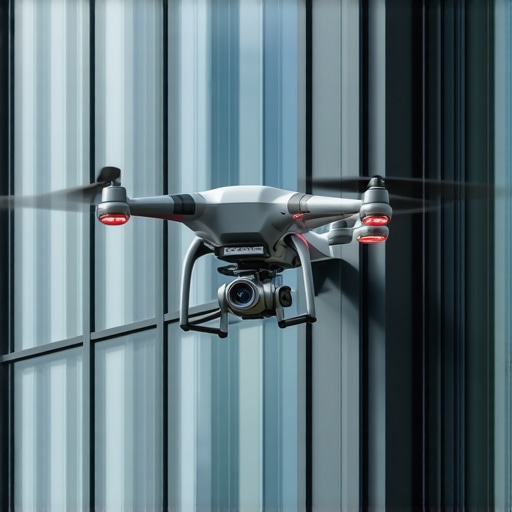
The wind howls different when you are four hundred feet above the pavement. Up there, the air is thin, the grit is real, and the stakes are lethal. For forty years, I have seen masonry from the business end of a trowel and the seat of a swaying swing stage. I have seen what happens when a developer tries to save a buck on structural brick ties replacement and the resulting facade starts to breathe like a dying lung. It is not pretty. But the industry is changing. We are moving from the era of ‘eyeballing it’ to the era of the high-definition forensic eye. AI-powered drones are not just gadgets for hobbyists; they are the most significant advancement in facade integrity since we stopped using mud and straw.
The Forensic Scene: A Ghost in the Wall
The homeowner of a historic high-rise thought it was just a hairline crack, a minor nuisance near the 22nd-floor cornice. But when I put my scope inside after a drone scan flagged a thermal anomaly, I saw the truth: the structural steel was rusted to dust. The drone had picked up a temperature differential that the human eye could never perceive. Moisture was trapped behind the brick veneer detachment repair that had been botched a decade prior. This is the reality of modern forensics. If we had not caught that ‘ghost’ in the wall, three tons of masonry would have eventually succumbed to gravity and the relentless pull of wind-driven rain. This is why we do not just look at bricks anymore; we look at the physics of the entire building envelope.
“Water penetration is the single greatest threat to masonry durability. The use of modern drone-mounted thermal imaging allows for the detection of subsurface moisture before it manifests as visible spalling or efflorescence.” – BIA Technical Note 7
The Physics of High-Altitude Decay
In a high-rise environment, the enemies are thermal expansion and the ‘venturi effect.’ A building is a living thing. It grows in the sun and shrinks in the cold. Without proper relief joints, the masonry will buckle. This is where brick veneer detachment repair becomes a surgical necessity. The drone’s AI camera scans for ‘pillowing’—the subtle outward bulge of a brick wall that indicates the ties have failed. When those ties go, usually due to the chemical reaction known as ‘rust jacking,’ the brick is no longer part of the building; it is just a heavy object waiting to fall.
We look at the ‘tooth’ of the repair area. When we engage in brick quoin repair at height, we are dealing with the corners—the most stressed part of the structure. If the original mortar was too hard (a common mistake with modern Portland cement on older structures), the drone will show us vertical shearing. We must then specify sustainable tuckpointing mortars that offer high vapor permeability. These mortars are not just ‘green’; they are scientifically designed to be ‘sacrificial.’ They must be softer than the brick itself, allowing moisture to escape through the joint rather than forcing it through the face of the brick, which causes the dreaded face-pop or spalling.
Scanning for the Invisible: Chimneys and Copings
The drone’s primary weapon is its ability to hover inches away from stone coping installation points that would require $20,000 in scaffolding just to reach. I have seen countless cases where a ‘minor’ leak was actually a total failure of the coping seal. Chimney leak detection via drone reveals the micro-fractures in the ‘crown’ or the ‘wash.’ If the concrete at the top of that chimney has ‘honeycombing’—those tiny voids left by poor vibration during the pour—the drone’s high-res lens will catch it. Water enters those voids, freezes, and expands by 9%, literally exploding the masonry from the inside out.
The Ground Truth: Foundations and Retaining Walls
While the drones handle the heights, the forensic logic remains the same at the base of the building. We see concrete block foundation repair needs that often stem from the same hydrostatic pressure issues found on roofs. If the stone coping installation is failing above, the water cascades down, saturating the soil and leading to failing retaining wall repair requirements. I have stood over many a retaining wall block replacement job where the contractor forgot the weep holes. Without drainage, that wall is just a dam. And dams eventually break. We use the same forensic sensors to check the ‘batter’ or the lean of a wall to determine if the soil is heaving or if the base was simply insufficient.
“Mortar is intended to be the moisture-regulating component of the wall system. Its selection must be based on the compressive strength and absorption characteristics of the masonry units used.” – ASTM C270 Standard Specification for Mortar
The Chemistry of the Fix
When we ‘butter’ a brick for a brick quoin repair, we aren’t just slapping mud. We are creating a chemical bond. The ‘suction’ of a dry brick can pull the water out of the mortar too fast, causing it to ‘flash set.’ This creates a ‘cold joint’ where the mortar never actually bonds to the unit. AI drones can now use multi-spectral imaging to analyze the moisture content of the masonry before we even start the concrete flatwork services or tuckpointing. This ensures the substrate is ‘SSD’—Saturated Surface Dry—the holy grail of masonry bonding.
For sustainable tuckpointing mortars, we often look at hydraulic lime. Unlike Portland cement, which cures through a relatively quick hydration process, lime mortar recarbonates over decades. It literally breathes. It moves with the building. It doesn’t fight the brick; it protects it. This is the ‘Old World’ wisdom that we are now verifying with ‘New World’ technology.
Conclusion: The Master’s Eye
Don’t be fooled by a ‘handyman special’ or a guy with a ladder and a bucket of pre-mix from the big box store. High-rise masonry is a discipline of millimeters and megapascals. Whether it is structural brick ties replacement or ensuring the proper pitch on stone coping installation, the drone is just a tool. The real power lies in the forensic interpretation of the data. We are looking for the ‘slicker’ joints that were struck too wet, the ‘soldier course’ that is leaning, and the ‘hawk’ marks that suggest a rushed job. We are preserving the skyline, one pixel and one brick at a time.