
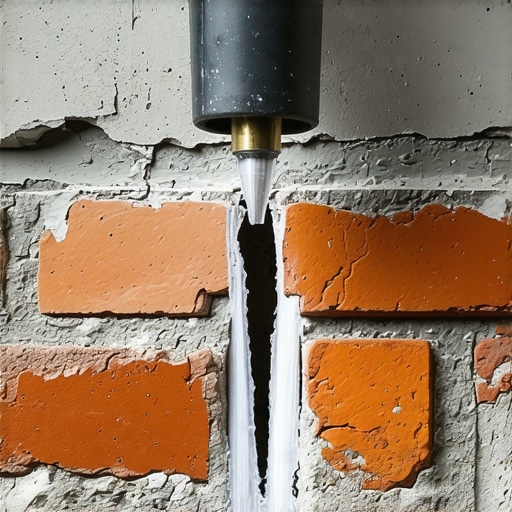
The Forensic Scene: When the Bond Fails
The homeowner called me out because she thought it was just a hairline crack snaking across her 1920s facade. But when I put my scope inside that fissure, I saw the structural steel was rusted to dust, and the previous ‘handyman’ had tried to bridge the gap with a tube of hardware-store silicone. That’s the problem with modern masonry; people think a bead of goo can replace a century of engineering. I’ve spent thirty years in the mud, following in the footsteps of a grandfather who could tell a brick’s quality just by the ring it made against a trowel, and I’ve seen what happens when we ignore the physics of vertical loads. We are currently seeing a massive shift in how we handle emergency masonry repair, specifically with the introduction of high-performance structural adhesives into commercial parapet wall repair and historic masonry preservation. But before you pick up a cartridge of epoxy, you better understand the ‘tooth’ of the substrate and the chemistry of the bond.
The Physics of the Micro-Mechanical Interlock
When we talk about re-pointing services or flush pointing services, we are usually discussing the mechanical bond of lime or Portland-based mortars. Traditional ‘mud’ works by migrating into the pores of the clay or stone. As the water leaves the mix, the cementitious crystals grow into those voids, creating a grip. Advanced adhesives operate on a different plane. We’re talking about aliphatic amines and bisphenol-A resins that create a cross-linked polymer chain. This isn’t just ‘sticking’ things together; it’s a molecular fusion. However, in historic brick salvage, this strength is often the enemy. If you use a resin with a higher modulus of elasticity than the 100-year-old brick, the brick will shatter during the first thermal expansion cycle. You have to match the adhesive’s flexibility to the masonry unit’s density.
“Mortar should always be weaker than the masonry units it binds, acting as a sacrificial element to protect the integrity of the wall.” – ASTM C270 Standard Specification
Tuckpointing Curved Walls and the Geometry of Failure
One of the most difficult tasks in my trade is tuckpointing curved walls. When you’re working a radius, the joints are constantly under varying degrees of compression and tension. Traditional mortar often struggles here because the ‘buttering’ process on a curved surface leads to uneven compaction. This is where advanced thixotropic adhesives are changing the game. These materials are engineered to stay put—they don’t sag or ‘run’ out of the joint before they set. In a forensic inspection, I look for ‘honeycombing’ in these joints. If the mason didn’t get full depth, the wall is a ticking time bomb. Using a concrete pump masonry mix injected with high-bond polymers can ensure that every cubic millimeter of the void is filled, preventing the moisture ingress that leads to spalling.
The Freeze-Thaw Enemy: Why Breathability is Non-Negotiable
In the North, we fight a war against the 9%. That’s how much water expands when it turns to ice. If you’re performing re-pointing services on a historic building and you use a non-permeable adhesive to ‘seal’ the wall, you are trapping vapor. That vapor has nowhere to go. When the temperature drops, it freezes behind the adhesive face and pops the front of the brick off like a bottle cap. This is why historic masonry preservation requires a ‘breathable’ bond. Modern research into modified silane-polyethers is providing us with adhesives that are waterproof yet vapor-permeable. It’s a paradox of chemistry that allows us to perform emergency masonry repair on a soldier course or a header without sentencing the rest of the wall to a slow death by internal pressure.
“Water penetration is the single greatest threat to masonry durability, and the management of moisture vapor is the most critical aspect of any restoration project.” – BIA Technical Note 7
[image_placeholder_1]
Foundation Slab Jacking and the Subsurface Equilibrium
Sometimes the problem isn’t the wall; it’s what the wall is sitting on. Foundation slab jacking has traditionally relied on heavy cement grouts, but we’re seeing a move toward high-density structural foams. These aren’t your typical insulation foams; these are geotechnical resins that can lift a 20-ton commercial corner. The physics here involves hydrostatic pressure. When we inject these resins, they expand in the soil, filling the voids caused by erosion and compacting the surrounding earth. As a forensic inspector, I look for ‘cold joints’ in the lift. If the resin wasn’t injected at the right temperature or pressure, you get layering, which will eventually shear under the weight of the masonry above. It’s a delicate balance of soil mechanics and chemistry.
Sustainable Block Cutting and the Future of the Trade
We are also seeing a push toward sustainable block cutting. This involves using diamond-wire saws and advanced cooling lubricants to salvage material that would have previously gone to a landfill. When we’re doing a commercial parapet wall repair, we try to reuse as much of the original stone as possible. The ‘slicker’—that tool we use to profile the joint—now has to work with hybrid materials that are half-traditional mud and half-polymer. We are ‘buttering’ the back of salvaged veneers with high-bond adhesives to ensure they never migrate from the substrate. It’s about doing the job once. My grandfather always said, ‘If you don’t have time to do it right, when will you have time to do it over?’ That’s why I have no patience for the ‘lick-and-stick’ crews. They use the wrong mud, ignore the suction of the brick, and leave the homeowner with a mess that I have to come in and fail during a forensic audit. Use the right chemistry, respect the old world physics, and for the love of the craft, keep the water out.
The Hard Truth of Modern Repairs
Whether you are dealing with a concrete pump masonry mix for a new build or trying to save a crumbling 1880s chimney, the rules of gravity and moisture remain the same. Advanced adhesives are a tool, not a crutch. They allow us to achieve bond strengths and flexibility that were impossible fifty years ago, especially in emergency masonry repair scenarios where time is the enemy. But they require a master’s touch. You need to understand the ‘hawk’ and the ‘slicker’ just as much as you understand the chemical datasheet of the epoxy. Don’t let a salesman tell you a resin can replace proper drainage and structural support. It’s all one system, from the foundation slab jacking at the bottom to the commercial parapet wall repair at the top. Do it once, do it right, and respect the stone.