
The Forensic Scene: A Ghost in the Limestone
I was standing on a suspended scaffold fourteen stories up a commercial facade in downtown Chicago, the wind whipping off the lake with enough teeth to bite through a heavy canvas coat. The property manager had called me out for what he described as a ‘minor cosmetic adjustment’—a single piece of decorative Indiana limestone that looked slightly proud of the wall. To the untrained eye, it was a shadow. To me, it was a warning. When I inserted the fiber-optic scope into the head joint, I didn’t see the solid grey of cured Type N mortar. I saw orange flakes—the rusted remains of wall ties that had long since surrendered to the elements. The ‘mud’ behind that stone had turned into a sandy, crumbly mess, victims of a century of the freeze-thaw cycle. This wasn’t a cosmetic fix; it was a structural failure in slow motion. If that stone let go, it wouldn’t just be a repair job; it would be a tragedy. This is the reality of traditional masonry in a world of high-rise vibrations and extreme thermal swings. Sometimes, the old ways aren’t the best ways, and that’s where the transition from traditional mortar to high-tack adhesives becomes a matter of survival for a building’s skin.
The Physics of the Vertical Struggle
In vertical stone repair, we are fighting a constant war against gravity and moisture. Traditional mortar, or ‘mud’ as we call it on the hawk, relies on a mechanical bond. It needs to ‘bite’ into the pores of the stone and the substrate. But in a commercial masonry facade maintenance context, the substrate is often non-porous or compromised. When you’re dealing with stone wall repair on a vertical surface, the weight of the stone wants to shear the bond before it even has a chance to reach initial set. In the North, the enemy is the 9% expansion of water. Rain hits the facade, finds a hairline crack in a brittle mortar joint, and sits there. When the temperature drops, that water expands, exerting thousands of pounds of pressure per square inch. Over decades, this pops the face off the stone—a process known as spalling. Modern high-tack adhesives, unlike rigid Portland-based mortars, offer a degree of elasticity. They don’t just sit in the pores; they chemically weld the stone to the backup wall, creating a bond that can handle the building’s natural racking and thermal expansion without snapping like a dry twig.
“Water penetration is the single greatest threat to masonry durability, leading to efflorescence, subflorescence, and the eventual disintegration of the bond.” – BIA Technical Note 7
When we talk about stone wall repair or even outdoor masonry fountain restoration, we have to account for the ‘suction’ of the material. A dry, porous stone will suck the moisture right out of a traditional mortar bed, leading to a ‘flash set’ where the mortar dries before it can actually hydrate and bond. This results in a weak, powdery joint that will fail within a few seasons. High-tack adhesives bypass this hydration crisis. They don’t rely on a water-chemical reaction to gain strength. Instead, they use advanced polymers that maintain their ‘tooth’ even on damp or non-porous surfaces. This is critical in failing retaining wall repair, where hydrostatic pressure is constantly pushing water through the structure. If you’re just buttering the back of a stone with standard mortar in a high-moisture environment, you’re basically just putting a Band-Aid on a sucking chest wound.
The Adhesive Revolution: Beyond the Mud
[IMAGE_PLACEHOLDER]
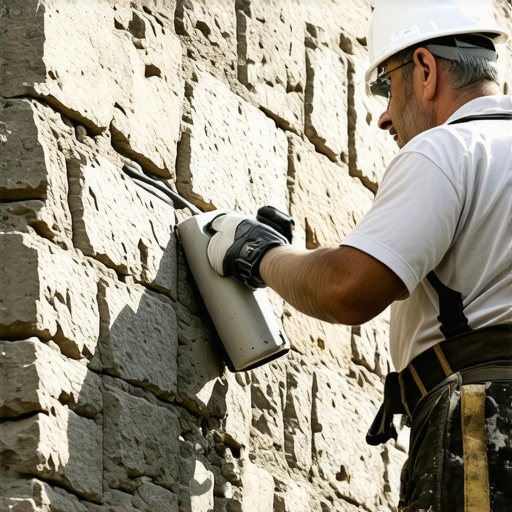
The shift toward adhesives isn’t just about convenience; it’s about the evolution of modular masonry construction. We are now seeing high-performance polyurethanes and modified silane polymers that can hold a twenty-pound stone on a vertical surface without any mechanical support within seconds of application. This ‘high-tack’ property is what allows for rapid commercial smokestack repair or robotic masonry repair where human hands can’t spend hours bracing a single unit. In robotic applications, the precision of the adhesive bead is paramount. A robot can’t ‘feel’ the suction of a brick like my grandfather could, but it can calculate the exact microliters of adhesive needed to create a permanent bond. This technology is becoming the backbone of commercial tuckpointing alternatives, where we can reinforce existing joints with injected resins rather than grinding out and replacing the entire bed, which often does more damage to the surrounding stone.
Foundation and Retaining Walls: The Geogrid Connection
In the world of forensic masonry, I often see retaining walls that look like they’ve been through a war. Usually, it’s because the original builder ignored the physics of soil. A retaining wall isn’t just a stack of stones; it’s a dam. When repairing these, especially in failing retaining wall repair scenarios, we often integrate retaining wall geogrid installation. The geogrid acts as the ‘skeleton’ of the soil, while the stones are the ‘skin.’ Using high-tack adhesives in these vertical repairs allows the wall to flex slightly as the soil behind it settles and heaves with the seasons. Traditional mortar is too stiff for this; it cracks, lets in water, and the freeze-thaw cycle finishes the job. By using a flexible adhesive, we create a monolithic structure that still has the ‘give’ required to survive in the dirt. Whether it’s a foundation repair or a decorative garden wall, the principle remains: you need a bond that is stronger than the material it’s holding, but flexible enough to not fight the earth’s movement.
“The bond strength of the masonry unit to the mortar is the most critical factor in resisting lateral loads and preventing moisture ingress.” – ASTM C270 Standard Specification
I’ve seen too many ‘handyman specials’ where someone tried to fix a stone wall with a tube of cheap construction adhesive from a big-box store. Those are often solvent-based and will ‘gas out’ over time, becoming brittle and failing. True forensic-grade high-tack adhesives are a different breed. They are often moisture-cured, meaning they actually get stronger in the damp environments typical of masonry. This is why they are the gold standard for outdoor masonry fountain restoration, where the stone is constantly subjected to splashing and humidity. You can’t ‘butter’ a stone with mortar in a fountain and expect it to last—the water will leach the lime right out of the mud. You need a polymer that doesn’t care about the water.
The Reality of Restoration
There’s a cynical side to this trade. I see the ‘lick-and-stick’ stone veneer going up on every new commercial strip mall, and I know I’ll be back there in ten years to fix it. These installers often skip the ‘scratch coat’ or use a mortar that is far too hard for the thin-set stone. When I’m called in for commercial masonry facade maintenance, I’m often looking at stones that have simply fallen off because the thermal expansion of the steel stud wall didn’t match the expansion of the rigid mortar. High-tack adhesives bridge that gap. They act as a gasket between the building’s frame and its stone skin. It’s the difference between a building that breathes and a building that breaks. We are moving toward a future where robotic masonry repair will be the norm, and these machines will use adhesives with the precision of a surgeon. But until then, it takes a human eye—and maybe a third-generation mason’s cynicism—to know when to put down the trowel and pick up the adhesive gun. Doing it once is masonry; doing it twice is a mistake. Don’t let your vertical stone become a hazard. Understand the chemistry, respect the physics, and choose the bond that actually holds.