
The Forensic Reality of the Hairline Crack
The homeowner thought it was just a hairline crack, a minor blemish on a century-old facade that had survived wars and winters. But when I put my scope inside that void, I didn’t see a simple settlement issue; I saw a structural crime scene. The structural steel lintel was rusted to dust, expanded to three times its original thickness because a previous handyman had slapped a bead of hardware-store caulk and a patch of hard Portland cement over a joint that needed to breathe. That ‘quick fix’ trapped moisture against the iron, turning a hundred-dollar repointing job into a five-figure structural masonry inspection and restoration nightmare. This is the reality of the trade: masonry isn’t a static pile of rocks; it is a thermal engine, a moisture-wicking lung, and a chemical laboratory that most modern contractors don’t understand.
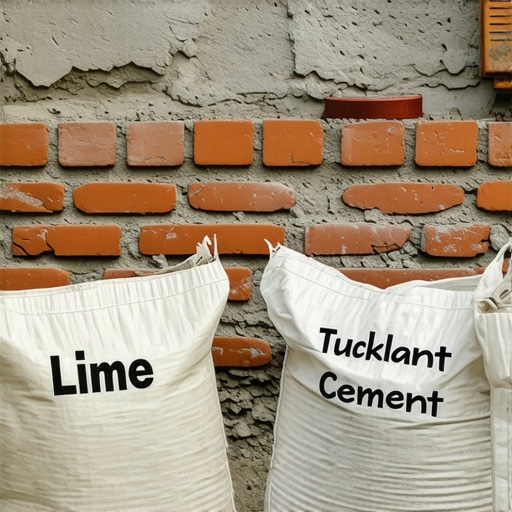
The Chemistry of the Mud: Lime vs. Portland
To understand why your building is failing, we have to micro-zoom into the molecular lattice of the binder. Before the mid-20th century, lime was king. Non-hydraulic lime mortar doesn’t ‘set’ in the way we think of modern concrete; it undergoes a process called carbonation. When you mix slaked lime (calcium hydroxide) with sand and water, it slowly absorbs carbon dioxide from the atmosphere to revert back into calcium carbonate (limestone). This process can take weeks, even months, to reach full strength, but it offers a superpower: autogenous healing. When a lime-based wall develops a micro-crack, rainwater dissolves a small amount of free lime, which then migrates into the crack and re-precipitates, effectively ‘healing’ the wound. Portland cement, by contrast, relies on a rapid hydration reaction. Tricalcium silicate and dicalcium silicate react with water to form a rigid crystalline structure that is incredibly strong, incredibly fast—and incredibly brittle.
“Mortar should be designed to be weaker than the masonry units so that any stress-induced cracking occurs in the mortar joints where it can be easily repaired.” – BIA Technical Note 7B
In the world of mortar repointing services, we live by the Sacrificial Principle. The mortar is the fuse in your electrical system; it’s meant to break so the expensive parts—the bricks—don’t have to. When you use a high-strength Portland ‘mud’ on a soft, historic brick, you’ve installed a fuse made of solid steel. When the building moves or the temperature swings, the brick, being softer than the mortar, is the thing that shatters. We call this spalling. You’ve seen it: the faces of the bricks popping off like scabs, leaving a soft, orange powder exposed to the elements. That is the direct result of a ‘lick-and-stick’ contractor using the wrong chemistry for the era.
The Physics of Vapor Permeability and the ‘Tooth’ of the Stone
A wall is a sieve, not a tank. Moisture enters through the brick and must exit through the mortar. Lime mortar is highly permeable; it has a high ‘perm-rating’ that allows water vapor to pass through the joints and evaporate. Portland cement is nearly waterproof. When you butter a joint with Portland on an old wall, you are effectively wrapping your building in plastic. The moisture gets trapped behind the hard cement, and during a freeze-thaw cycle, it expands by 9%. That pressure has nowhere to go but out through the face of the brick. This is why masonry cleaning and the proper brickwork sealants application are so dangerous in the wrong hands; if you seal a wall that hasn’t properly breathed, you are rotting it from the inside out.
“The use of mortar with high compressive strength and low permeability in conjunction with older, softer masonry units often leads to accelerated deterioration of the units.” – ASTM C1713
When I’m performing a structural masonry inspection, I’m looking for the ‘tooth’ of the stone. This is the mechanical bond where the mortar has bitten into the microscopic pores of the masonry unit. If the mortar is too ‘hot’ (too much Portland), it dries too fast, a phenomenon we call ‘flash setting.’ This prevents the mortar from developing a proper bond, leading to a ‘cold joint’ where water can sit and fester. For a successful chimney structural repair or an outdoor masonry fountain restoration, the suction of the brick must be balanced with the moisture content of the mud. If the brick is too dry, it sucks the water out of the mortar before it can hydrate. If it’s too wet, the mortar swims and never grabs.
Application: The Art of the Slicker and the Hawk
True mortar repointing services aren’t about just filling a hole. We start by grinding out the old, failing joints to a depth of at least twice the width of the joint, ensuring we have clean, square shoulders for the new material. We don’t use a caulk gun; we use a hawk and a slicker. We ‘butter’ the head joints and push the mud into the bed joints in ‘lifts’ or layers, compacting it to eliminate air pockets—what we call honeycombing. For specialized projects, such as a fire-rated masonry installation or the application of metallic brick colors application, the chemistry must be even more precise to handle the thermal shock or the pH levels of the pigments.
We also see this failure in patio stone realignment. Homeowners often think their pavers are sinking because the stone is heavy. In reality, it’s the lack of compaction physics in the base. If you don’t have 6 to 8 inches of crushed aggregate, compacted in 2-inch lifts, your foundation is nothing but a suggestion. The same logic applies to your foundation walls. Hydrostatic pressure from poorly drained soil will push a wall inward; if that wall is held together with brittle Portland cement instead of flexible lime, it won’t just lean—it will snap.
The Bottom Line: Do It Once or Do It Twice
The marketplace is flooded with handymen who will promise a cheap fix. They’ll use a pre-mixed bag of Type S mortar from a big-box store because it’s easy to work with and sets fast. But in the forensic masonry world, ‘fast’ is usually synonymous with ‘failed.’ If your building was built before 1940, you shouldn’t see a single grain of Portland cement near it. You need a mix that understands the history of the kiln it came from. Whether you are dealing with a chimney structural repair or just want a masonry cleaning that won’t destroy your lime-wash, you have to respect the material science. You can pay for the right mud now, or you can pay me to come back in five years with a jackhammer to fix the damage the cheap mud did. The choice is usually written in the cracks of your walls.