3 Chimney Repair Signs That Could Save Your 2026 Home
The Invisible Decay: Why Your Chimney is a Ticking Time Bomb
I’ve spent forty years on scaffolding, and if there is one thing I have learned, it is that a chimney is not just a stack of bricks; it is a living, breathing lung for your home. People look up and see a sturdy column of clay and stone, but when I look, I see a complex thermal engine fighting a losing battle against gravity and chemistry. Most homeowners ignore their masonry until they find a brick lying in the grass, but by then, the structural war is already lost. We are moving toward 2026, a year where climate volatility and aging housing stocks are going to make or break foundations across the country. If you don’t know how to read the language of your masonry now, you’re going to be writing a very large check later.
The Forensic Scene: Last autumn, I was called to a suburban estate where the owner thought he had a minor cosmetic issue—a simple ‘hairline crack’ running along the shoulder of his chimney. He’d already had a handyman slop some silicone caulk into the gap. When I arrived, I didn’t look at the crack; I looked at the base. I took my digital scope and bored a tiny hole into the interior wythe. What I saw wasn’t just a crack. The internal structural steel lintels were so heavily oxidized they had expanded to twice their original size, a phenomenon we call ‘oxide jacking.’ The rust was literally exploding the brickwork from the inside out. The ‘hairline’ crack was actually the final scream of a masonry assembly under thousands of pounds of internal pressure. If he had waited another winter, that 30-foot stack would have peeled away from the house like a banana skin.
1. The Tell-Tale Flaking: Spalling and the Freeze-Thaw Catastrophe
The first sign that your chimney is failing is what we call spalling. This isn’t just a bit of dust; it’s when the face of the brick pops off, leaving a raw, pitted surface. To understand why this happens, you have to micro-zoom into the pore structure of the clay. Bricks are essentially petrified sponges. They have a capillary network that pulls moisture deep into their core through suction. In a freeze-thaw damage restoration context, we look at the physics of the water molecule. When water transitions from a liquid to a solid, its volume increases by approximately 9%. If that water is trapped within the crystalline lattice of a dense, modern brick—or worse, trapped behind a ‘lick-and-stick’ stone veneer—the internal hydraulic pressure exceeds the tensile strength of the clay. It literally shatters the brick from the inside.
“Mortar is intended to be a sacrificial element in the masonry assembly, designed to be weaker and more permeable than the masonry units themselves.” – BIA Technical Note 1
In the lead-up to 2026, we are seeing more ‘flash-freeze’ events. If your masonry has been treated with cheap, non-breathable sealants, you are trapping that moisture. A proper chimney needs to breathe. When I see stone veneer repair jobs where the installer didn’t use a drainage plane, I know I’m looking at a future pile of rubble. The mortar has to be the ‘wick’ that draws the moisture out. If your mortar is harder than your brick—common in ‘handyman specials’ where they use straight Portland cement—the brick will always be the one to break. You need high-performance mortar mixes that balance compressive strength with vapor permeability.
2. The ‘Sand-Storm’ Effect: Mortar Disintegration and the Art of Repointing
If you can take your thumb and scratch the mortar out of the joints like it’s beach sand, you have a critical failure of the binder. Mortar isn’t just glue; it’s a chemical bond. In older homes, this is often the result of the carbonation process being exhausted. Over a century, the lime in the mortar reacts with CO2 to turn back into calcium carbonate. Eventually, it loses its ‘tooth.’ In newer builds, it’s often a sign of ‘flash setting,’ where the mud was applied to dry bricks that sucked all the hydration out of the mix before it could crystallize. This leaves the joint brittle and hollow.
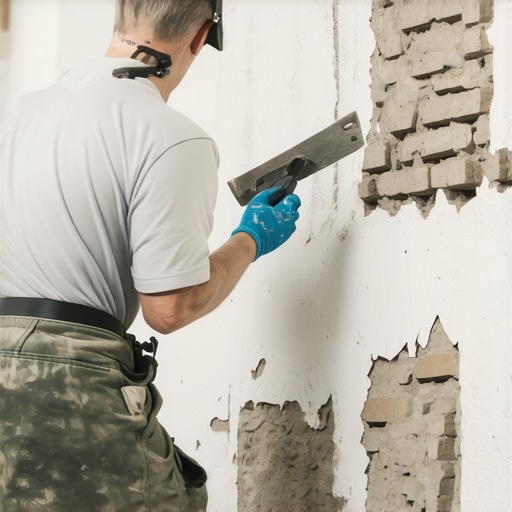
This is where flush pointing services become vital. We don’t just ‘butter’ the joints. A real mason grinds out the old, dead material to a depth of at least one inch, cleans the dust to ensure a mechanical bond, and then packs in the new mud in lifts. We use a slicker or a jointer tool to compress the mortar, which brings the ‘cream’ to the surface and seals the edges against the brick. Without this compression, you’re just putting a Band-Aid on a bullet wound. For high-stress areas, we’re now utilizing advanced masonry adhesives and polymers that allow for slight thermal movement without cracking, though these must be used judiciously in historic restoration.
3. Vertical Shifting and the Bowing Chimney
The most terrifying sign is a chimney that is literally walking away from the house. If you see a gap at the roofline, you aren’t just looking at a chimney problem; you’re looking at a foundation wall bowing repair issue. Chimneys are incredibly heavy, concentrated loads. If the soil hydration levels change—common in the fluctuating droughts and floods we’re seeing—the footing can tilt. This is foundation crack repair territory.
“The compressive strength of the mortar should not exceed that of the masonry units to ensure that stresses are distributed evenly across the wall surface.” – ASTM C270
We are now seeing AI masonry assessment tools that can detect sub-millimeter shifts in masonry plumb lines before they are visible to the naked eye. By 2026, these assessments will be standard for home inspections. If your chimney is leaning, we look at the modular retaining walls nearby and the general drainage of the site. Often, the chimney is the ‘canary in the coal mine’ for a larger geotechnical failure. We use brick veneer installation techniques that include mechanical ties to the primary structure, but if the foundation is heaving, those ties will eventually shear off. You have to address the root cause—the soil and the hydrostatic pressure—before you ever touch a trowel to the brickwork.
The Future of Forensic Masonry
Don’t be fooled by a fresh coat of paint or a ‘quick fix.’ Masonry is about the long game. It’s about understanding the ‘suction’ of the stone and the ‘slake’ of the lime. When we perform a foundation crack repair or a chimney rebuild, we are looking at how that structure will handle the next fifty years of weather. Use a hawk and a trowel to do it right, or don’t do it at all. If you see efflorescence—that white, salty powder—don’t just wash it off. That is the chimney’s way of crying. It’s telling you that water is moving through the core and depositing minerals on the face. Listen to your house. It’s talking to you in cracks and dust. If you listen now, you’ll save your home by 2026. If you wait, you’ll just be another forensic scene I’m documenting for a demolition crew.