
4 Brick Column Repair Signs to Check Before 2026 Storms
The Forensic Scene: When a Column Becomes a Liability
The homeowner thought it was just a hairline crack, a subtle grey line tracing the mortar on a six-foot decorative pier. But when I put my borescope inside the modular masonry construction, I saw the structural steel was rusted to dust. The column wasn’t supporting the porch anymore; it was a stack of loose clay held together by gravity and hope. This is the reality of masonry in an era of increasing climate volatility. As we approach the projected 2026 storm cycles, which experts suggest will bring higher humidity and more frequent freeze-thaw oscillations, those brick columns are your first line of defense—or your first point of failure. I have spent thirty years looking at what happens when the ‘mud’ fails, and it isn’t pretty. To understand why a column fails, you have to understand the ‘tooth’ of the stone and the suction of the brick. If the bond is broken, the structure is a ghost.
“Water penetration is the single greatest threat to masonry durability.” – BIA Technical Note 7
The Physics of the Failure: Why Your Columns Are At Risk
In the North, we fight the expansion of water—a 9% increase in volume when it hits 32 degrees Fahrenheit. If that water is trapped behind a hard, non-breathable Portland cement, it doesn’t just sit there. It exerts thousands of pounds of pressure, popping the face off the brick in a process we call spalling. For columns, this is amplified. A column is a four-sided target for driving rain. Unlike a house wall, it has no thermal mass from an interior heated space to help dry it out. It stays damp. It stays cold. And eventually, it gives up. When we talk about high-performance mortar mixes, we aren’t just talking about strength; we are talking about flexibility and vapor permeability. You need a mix that allows the masonry to breathe, or you are just building a ticking time bomb.
Sign 1: The Stair-Step Fracture and Foundation Heaving
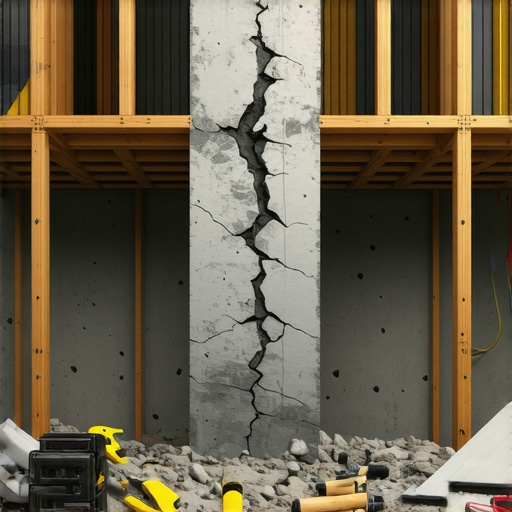
If you see a crack that looks like a staircase climbing your column, you aren’t looking at a brick problem; you’re looking at a soil problem. This is the ‘Crack Whisperer’s’ first clue. This pattern usually indicates that the footing—the concrete base the column sits on—is tilting or sinking. Perhaps the masonry joint sand repair wasn’t maintained at the base, allowing water to pool and soften the clay below. In the forensic world, we look for ‘hydrostatic pressure.’ If the soil becomes saturated, it pushes. If it freezes, it heaves. A tuckpointing cost estimation for this kind of damage is usually a waste of money unless you address the foundation. You can butter the joints all you want, but if the ground is moving, the brick will follow. We use helical piers to stabilize these, driving steel deep into the load-bearing strata to stop the dance.
Sign 2: Spalling and the Failure of ‘Lick-and-Stick’ Aesthetics
Look at the faces of your bricks. Are they flaking off like old paint? That’s spalling. This often happens when a porous stone sealer was applied incorrectly or when a modern, too-hard mortar was used to repair an older column. The ‘Old Master’ rule is simple: the mortar must always be softer than the brick. It is the sacrificial lamb. It is supposed to erode so the brick doesn’t have to. When I see a column where the mortar is standing proud but the brick is recessed and crumbling, I know a handyman used a high-strength Type S cement on a soft, handmade brick. You’ve killed the wall’s ability to move. Before the 2026 storms, you need to check if your tuckpointing needs a complete overhaul with a lime-based mix that respects the material’s natural expansion and contraction.
“The strength of the masonry is directly related to the bond between the unit and the mortar.” – ASTM C270
Sign 3: The ‘Leaking Hat’ – Cap and Coping Failures
A brick column is only as good as its roof. Whether it’s a cast stone cap, a metallic masonry finishes copper topper, or a simple chimney cap replacement adapted for a pier, the goal is to shed water away from the core. If the cap has a ‘cold joint’—a gap where the mortar has pulled away from the stone—water will travel straight down the center of the column. This is where modular masonry construction becomes a nightmare. Many modern columns are hollow or filled with loose rubble. Water enters at the top, freezes in the middle, and blows the column apart from the inside out. Inspect the ‘drip edge’—the little groove under the cap that forces water to fall to the ground rather than running down the brick face. If that groove is filled with dirt or paint, your column is soaking wet every time it rains.
Sign 4: Efflorescence and the Salt Ghost
That white, powdery substance on your bricks isn’t just an eyesore; it’s a chemical red flag. Efflorescence is the deposit of soluble salts carried to the surface by water. It tells me exactly where the water is moving inside the structure. If it’s concentrated at the bottom, you have ‘wicking’ from the ground. If it’s at the top, your cap is leaking. To fix this, you don’t just wash it off; you find the source. We are seeing more of this with green roofing masonry integration where moisture levels are higher near the structure. Use a slicker to check the hardness of the joints where the white powder is heaviest. If the mud crumbles like crackers, the salts have eaten the binder, and you’re looking at a full repoint. This is also a prime time to check your outdoor masonry fountain restoration projects, as they often share the same plumbing and moisture issues.
The Solution: Doing It Once, Not Twice
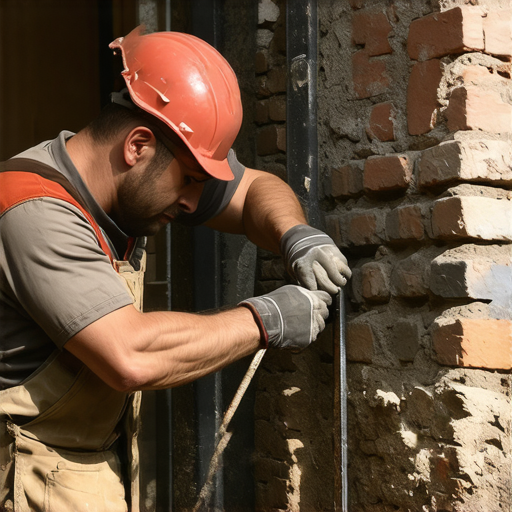
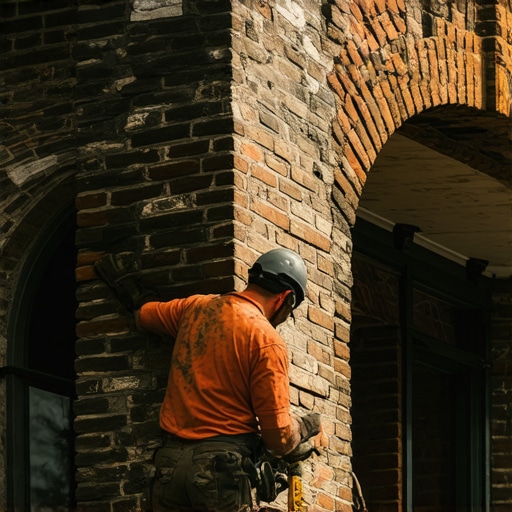
When preparing for the 2026 storms, don’t settle for a ‘slap and dash’ repair. A proper forensic repair involves grinding out the old joints to a depth of at least 3/4 of an inch—no ‘shaving’ the surface. We use a hawk and trowel to ‘butter’ the joints with a pre-hydrated mortar to prevent honeycombing. If you’re looking at a soldier course of bricks at the top, ensure they are tied into the core with stainless steel anchors. The cost of doing it right is high, but the cost of a column collapsing onto a car or a guest is much higher. Use the right ‘mud,’ respect the physics of the stone, and your masonry will still be standing when your grandkids are holding a trowel.

![Emergency Masonry Repair: 3 Signs Your Wall Might Collapse [2026]](https://masonryrescue.com/wp-content/uploads/2026/03/Emergency-Masonry-Repair-3-Signs-Your-Wall-Might-Collapse-2026.jpeg)