
How to Match 19th-Century Mortar for 2026 Historic Tuckpointing
The Ghost in the Wall: Why History Fails at the Hands of a Grinder
I remember Elias, an old Estonian mason who could tell the lime content of a mortar joint just by the way it tasted. He once stopped me from buttering a course of salvaged clinker bricks because he noticed the sand I was using was too ‘polite.’ It was play-sand, rounded by river water, lacking the sharp, angular ‘tooth’ required to interlock with the porous face of a 150-year-old unit. He told me that if the mud doesn’t respect the brick, the brick will eventually spit it out. That lesson stays with me every time I step onto a site for a structural masonry inspection. We are currently seeing a plague of ‘restoration’ work where contractors treat a 19th-century facade like a modern subdivision, slathering Type S Portland cement over soft, hand-molded clay. By 2026, the results of these 2010-era mistakes are coming home to roost in the form of catastrophic spalling and structural failure. Historical re-pointing services are not about aesthetics; they are about high-stakes chemistry and the preservation of a breathing organism.
The Physics of the Sacrificial Joint
In the world of 19th-century masonry, the mortar was never meant to be the strongest part of the wall. This is a concept modern ‘tailgate’ contractors struggle to grasp. The mortar is sacrificial. It is designed to be softer and more permeable than the masonry units it bedded. When the earth shifts or the freeze-thaw cycle begins its violent expansion, the mortar joint is supposed to take the stress and the moisture. It is the lungs of the building. If you plug those lungs with modern, non-breathable Portland cement, the moisture becomes trapped. Since water expands roughly 9% in volume when it turns to ice, and that ice is trapped behind a wall of hard cement, it has nowhere to go but through the face of the brick. This is how you end up with spalling—the tragic sight of a historic brick’s face popping off like a scab, leaving a raw, powdery interior exposed to the elements.
“Mortar should always be weaker than the masonry units so that any stress-induced cracking occurs in the mortar joints where it can be repaired, rather than in the masonry units themselves.” – BIA Technical Note 7B
The Chemistry of Carbonation vs. Hydration
To understand how to match 19th-century mortar, you have to look at the molecular level. Modern concrete and ‘lick-and-stick’ veneers rely on hydration—a rapid chemical reaction that gains strength in days. Historic lime mortar relies on carbonation. This is a slow, methodical dance where calcium hydroxide reacts with atmospheric carbon dioxide to revert back into calcium carbonate (limestone). This process can take decades to fully complete, and it allows the wall to ‘self-heal.’ If a microscopic crack forms, moisture can dissolve a bit of the free lime and redeposit it into the crack, sealing it. While we talk about self-healing concrete foundations in modern engineering as a breakthrough, the masons of the 1880s were already building with a version of it. When performing professional masonry restoration, we are trying to replicate this specific vapor-permeable behavior.
The Forensic Match: Aggregate, Binder, and Pigment
Matching mortar for a 2026 project requires more than a color chart from the local hardware store. It requires a sieve analysis. I’ve spent hours in the lab washing old mud through screens to find the original aggregate profile. Was it pit sand? Was it crushed oyster shells? The ‘tooth’ of the sand dictates the structural integrity of the joint. If the original mason used a sharp, well-graded bank sand, and you replace it with fine masonry sand, your structural repointing will fail within five years because the shrinkage rates won’t match. We also have to consider the ‘fines’—the tiny dust particles that give the mortar its characteristic hue. In the 19th century, they didn’t have synthetic iron oxide pigments. The color came from the local earth. To do a brick column repair properly on a historic porch, you might need to source sand from three different states just to get the light-refraction right under the sun.
Reading the Cracks: Structural Masonry Inspection
When I walk a property, I’m looking for the story the cracks are telling. A ‘stair-step’ crack following the mortar joints often points to minor settlement or thermal expansion. But a vertical crack that shears straight through the bricks? That’s a structural scream. That’s when we stop talking about masonry cleaning and start talking about foundation helical pier installation. In many historic buildings, the masonry isn’t just a skin; it’s the load-bearing heart. If the soldier course above a window is sagging, it’s not just a ‘tuckpointing’ job. It’s a failure of the masonry arch or the underlying steel lintel. By 2026, we are increasingly using BIM masonry projects—Building Information Modeling—to map these failures in 3D, allowing us to see how a shift in the foundation is affecting the parapet three stories up.
“The use of high-strength mortars in the repair of historic masonry is often the primary cause of further deterioration.” – ASTM C270 Standards Commentary
The Execution: Slickers, Hawks, and the Art of the Mud
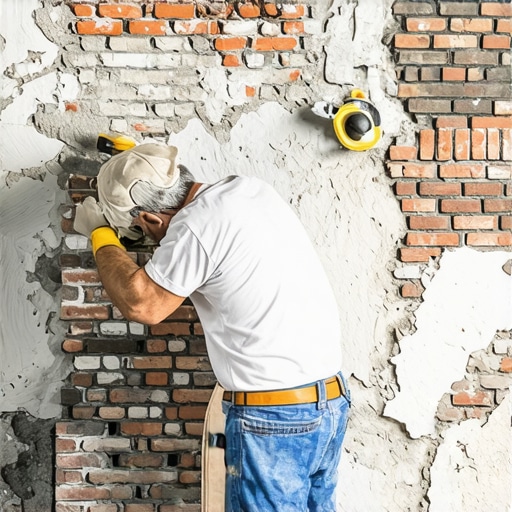
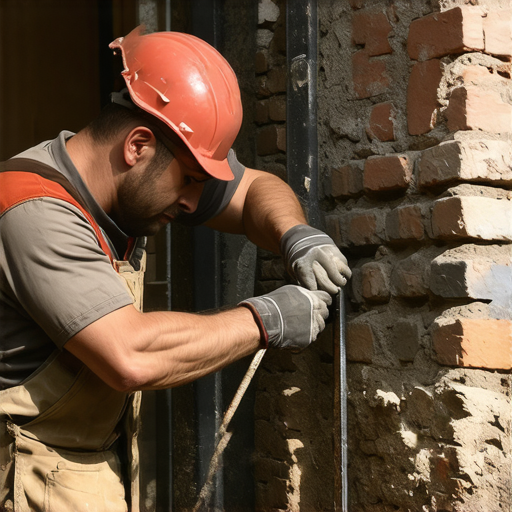
Watching a novice try to ‘butter’ a joint is painful. They move too fast, they leave honeycombing in the bed joint, and they don’t understand suction. Historic bricks are incredibly thirsty. If you put fresh mud onto a dry 19th-century brick, the brick will suck the water out of the mortar instantly, ‘burning’ the mix and preventing a proper bond. You have to pre-hydrate the wall. You have to treat it like a living thing. When we strike the joint with a slicker or a jointer tool, we aren’t just making it look pretty. We are compacting the mud against the ‘shoulders’ of the brick to ensure a watertight seal. This is the difference between a job that lasts 80 years and a ‘handyman special’ that crumbles after two winters.
Modern Innovations in Historic Contexts
While I advocate for old-world mud, we cannot ignore the tools of 2026. For high-stress areas, we are seeing the rise of metallic masonry finishes and stainless steel lateral ties that can be retrofitted into historic walls without being visible. We are also seeing professional masonry restoration firms utilizing non-potable water sensors to monitor moisture levels inside a wall post-repair. But even with all this tech, if the base chemistry of your mortar match is off—if you’ve used a Type M mortar where a Type O was required—the tech won’t save you. You are just documenting a slow-motion wreck. Whether it’s a simple masonry cleaning to remove carbon crust or a full-scale foundation helical pier installation, the rule remains: match the strength, match the breathability, and respect the tooth of the stone.