5 Concrete Block Foundation Repairs to Stop 2026 Basement Cracks
The Anatomy of a Dying Foundation: Why the ‘Whisper’ Matters
I walked into a basement last Tuesday where the homeowner was convinced he just needed a new bucket of waterproof paint. He pointed to a thin, horizontal line running across the third course of blocks. To the untrained eye, it was a cosmetic nuisance. But when I pulled out the borescope and performed a structural masonry inspection, the reality was grimmer. The hollow cores of those concrete masonry units (CMUs) were filled with three gallons of stagnant, pressurized groundwater. The wall wasn’t just ‘cracked’; it was a hydraulic bomb waiting to go off. This is the difference between a handyman’s guess and forensic masonry. If you see a stair-step pattern or a bowing midsection, your house is talking to you. By 2026, the cumulative effect of shifting soil cycles will turn that whisper into a scream. We don’t just ‘fix’ walls; we analyze the geotechnical failure that caused the masonry to yield. We look for honeycombing in the original pour and check if the cold joint between the footing and the wall has become a highway for moisture.
“The lateral pressure exerted by saturated soil can exceed 60 pounds per square foot per foot of depth, far surpassing the structural capacity of unreinforced masonry.” – NCMA TEK 14-1B
1. Carbon Fiber Reinforcement: The High-Tensile Shield
When a block wall begins to bow inward, it’s because the tension side of the masonry—the side you see inside the basement—is being stretched beyond its limit. Concrete is king in compression, but it’s a pauper in tension. To stop the 2026 collapse, we use carbon fiber straps. This isn’t just ‘buttering’ some fabric onto the wall. We grind the block face to reach the ‘tooth’ of the material, exposing the raw aggregate. We use a high-modulus epoxy to bond the straps. The physics is simple: the carbon fiber has a higher tensile strength than steel. By linking the strap to the rim joist and the floor slab, we create a rigid exoskeleton. This prevents further brick veneer detachment repair needs later on, as the foundation remains immobile, protecting the outer brick wall restoration work you’ve already invested in. If you ignore the bow, you aren’t just losing a basement; you’re shearing the structural brick ties replacement anchors that hold your home’s skin to its bones.
2. Helical Piering and the Physics of Settlement
Vertical cracks often mean your house is literally breaking in half because the soil underneath has given up. In regions with heavy clay, the soil shrinks during droughts and swells during the spring thaw. This constant heaving snaps tile grouts on masonry and creates spalled concrete steps repair nightmares outside. The solution is helical piers. We’re talking about massive steel screws that we drive deep into the earth, past the ‘active zone’ of the soil, until we hit load-bearing strata. We then use hydraulic jacks to lift the foundation back to level. This is where digital twin masonry projects come into play; we can now model the stress points of a building before we ever strike a slicker or a hawk. It allows us to predict how the masonry will react to the lift, ensuring we don’t cause more stone veneer repair issues on the facade during the stabilization process.
3. The Sacrificial Surface: Masonry Joint Sand Repair and Repointing
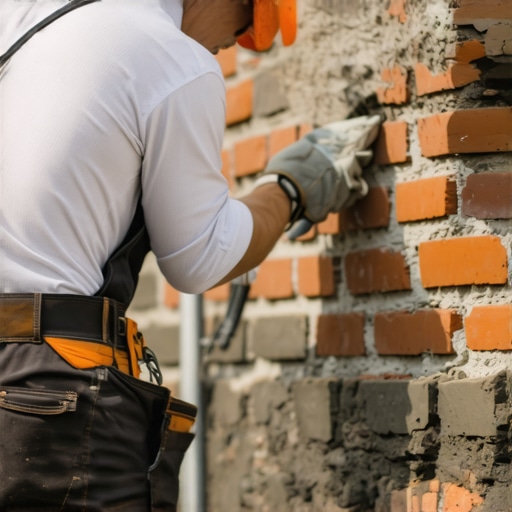
Water is the universal solvent, and your mortar joints are the front lines. Many people think the harder the mortar, the better. That’s a ‘handyman special’ mistake. If you use a high-strength Portland cement on old, soft block or brick, the masonry will lose. When the wall shifts or water freezes (expanding 9% in volume), the hard mortar stays put while the block faces pop off. This is called spalling. For effective masonry repair services, we use the ‘sacrificial principle.’ The mortar should always be slightly softer than the unit it holds. We perform masonry joint sand repair by excavating the failing ‘mud’ to a depth of at least twice the joint width. We then ‘butter’ the joints with a Type N or Type O lime-based mix, striking it with a slicker to pack it tight. This ensures that any future stress or moisture-driven expansion eats the mortar—which is cheap to replace—rather than the block itself.
“Mortar joints in foundation walls must act as the first line of defense against moisture ingress while maintaining the flexibility to accommodate minor thermal movements.” – ASTM C270 Standard Specification
4. Hydrostatic Pressure Relief: The French Drain and Weep Hole System
You can’t fight the earth; you have to outsmart it. If water is pooling against your foundation, the ‘suction’ of the dry block will pull that moisture into the basement via capillary action. This leads to efflorescence—that white, crusty salt—and eventually, structural rot. To stop 2026 cracks, we install interior or exterior drainage. We’re talking about perforated pipes buried in a bed of 3/4-inch clean stone. For block walls, we often drill ‘weep holes’ into the bottom course. This allows the water trapped inside the hollow cores to drain into the system rather than sitting there, slowly dissolving the tile grouts on masonry from the inside out. It’s about managing the ‘head’ of water. Without this, even the best brick wall restoration is just a temporary mask on a terminal patient.
5. Digital Twins and the Future of Structural Inspections
We are entering the era of the digital twin masonry projects. By using LIDAR and photogrammetry, we create a 3D model of your foundation that is accurate down to the millimeter. This allows us to track crack propagation over years. If I see a crack that was 2mm wide in 2024 and it’s 4mm in 2025, I know exactly where the soil is failing. This isn’t just tech for tech’s sake; it’s about surgical precision. Instead of a ‘scorched earth’ approach where we dig up the whole yard, we can pinpoint exactly where structural brick ties replacement or localized stone veneer repair is needed. It saves the homeowner thousands and preserves the ‘Old World’ integrity of the masonry. Whether it’s brick veneer detachment repair or a simple spalled concrete steps repair, the data doesn’t lie. Do it once, or do it twice—the choice is always yours, but the physics of the earth won’t wait for your budget to catch up.