3 Mortar Matching Secrets to Boost 2026 Resale Value
The Forensic Reality of a ‘Minor’ Crack
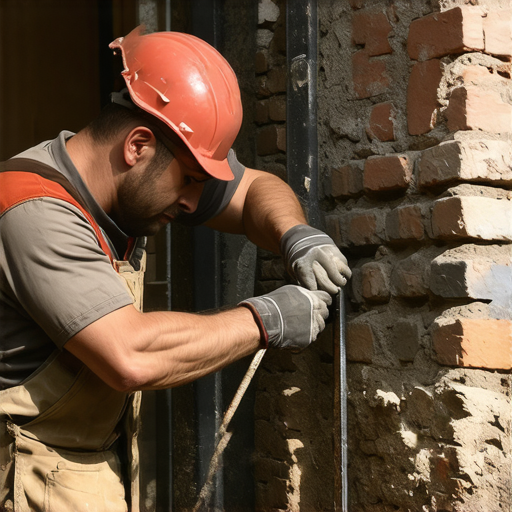
I was standing on a rusted scaffold last October, staring at what the homeowner called a ‘minor cosmetic blemish.’ To the untrained eye, it was just a hairline crack snaking across three courses of common red brick. But when I slid my fiber-optic scope into a weep hole, the reality hit: the structural brick ties replacement needed wasn’t just a suggestion; those galvanized strips had turned into orange dust. The facade was essentially a 20-ton curtain hanging by a prayer. Most inspectors would have told him to slap some caulk in there and call it a day. That’s the kind of ‘handyman special’ that kills resale value. If you’re looking at your property with an eye on 2026, you need to understand that mortar isn’t just glue—it’s the lungs and the shock absorber of your building. Using the wrong high-performance mortar mixes on a vintage structure is a death sentence for the masonry unit itself.
“Water penetration is the single greatest threat to masonry durability.” – BIA Technical Note 7
1. The Chemistry of the Match: Why ‘Close Enough’ Isn’t Good Enough
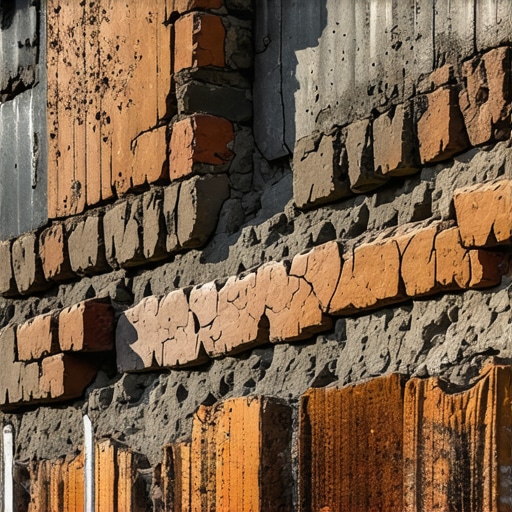
When I talk about mortar matching, I’m not just talking about color. I’m talking about the compressive strength and the vapor permeability. Most modern contractors will show up with a bag of Type S Portland cement and start buttering the brick. On a pre-1940s home, that is a cardinal sin. Hard cement traps moisture inside the softer, historic brick. When the temperature drops and that water expands by 9%, the face of your brick pops off like a scab. We call this spalling. To boost resale value, you need re-pointing services that use a petrographic analysis to match the original lime-to-sand ratio. The ‘mud’ must be sacrificial; it has to be softer than the brick so that the inevitable stresses of the earth cracking occur in the joint, not the stone. This preservation of the original masonry fabric is what sophisticated buyers look for during a 2026 structural audit.
2. The Physics of the Joint: Pointing Styles as a Shield
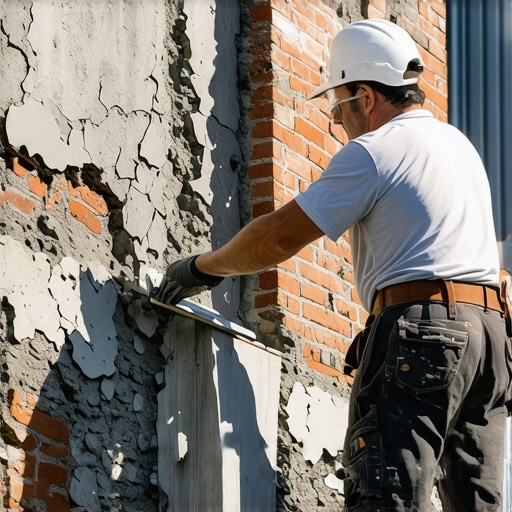
Your choice in brickwork pointing styles is the difference between a dry basement and a structural nightmare. Many amateurs love the look of a ‘recessed’ or ‘raked’ joint because it creates deep shadows. However, in climates with heavy driving rain, a raked joint is just a shelf for water to sit on. I always advocate for a ‘concave’ or ‘vee’ joint. By using a slicker tool to compress the mud into the joint, you create a dense, mechanical bond that sheds water like a duck’s back. This compaction increases the ‘tooth’ of the mortar against the brick’s edges. If you are dealing with stone veneer repair, the stakes are even higher. Those thin-cut stones are often stuck on with nothing but prayer and cheap thin-set. Without a proper weather-struck joint, water gets behind the veneer, freezes, and the whole facade peels off like wet wallpaper. A professional tuckpointing machine services approach ensures that the depth of the grind is consistent—at least twice the width of the joint—to allow for a proper mechanical bond.
“Mortar should be weaker than the masonry units so that any cracks occur in the mortar joints where they can be easily repaired.” – ASTM C270 Standard Specification
3. Sub-Surface Integrity: Ties, Foundations, and Batter
Resale value isn’t just about what you see; it’s about what the inspector’s hammer reveals. If your chimney is swaying, it’s likely the internal flues are shifting, requiring chimney rebuild services that address the core, not just the skin. For foundations, we are seeing a massive shift toward self-healing concrete foundations. These mixes contain dormant bacteria or capsules of sodium silicate that activate when a crack forms, chemically sealing the breach before hydrostatic pressure can turn your crawlspace into a swimming pool. And let’s talk about that leaning garden wall. A retaining wall batter correction isn’t just about pushing it back. It’s about calculating the angle of repose for the soil and ensuring that for every foot of height, the wall leans back into the hill. If you don’t have a 1:6 ratio of batter, that wall is a liability, not an asset. Proper masonry water damage repair starts at the footing, ensuring that the ‘cold joint’ between the wall and the floor is sealed with a non-shrink grout that can handle the sheer weight of the saturated earth behind it.
The Long Game: Why Craftsmanship Wins
In this trade, you can’t fake the funk. You can see a ‘handyman’ repair from the street—the mortar is smeared on the brick faces, the color is five shades too grey, and the joints look like they were finished with a finger. Real re-pointing services require a hawk and trowel, a steady hand, and the patience to let the mud reach ‘thumbprint hardness’ before striking. Whether you are performing a simple repair or a full-scale restoration, the goal is a monolithic structure that moves together. When the 2026 buyer walks up to your home, they shouldn’t see your repairs. They should see a house that has stood for a century and looks ready to stand for another. Do it once, do it right, or don’t bother picking up the trowel.
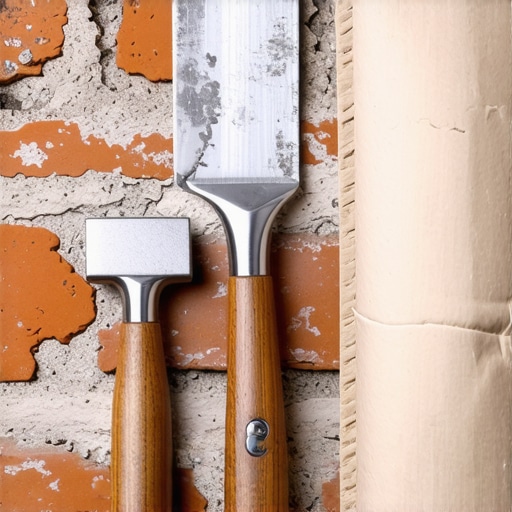
![7 Best Tuckpointing Tools for DIY Projects [2026 Tested]](https://masonryrescue.com/wp-content/uploads/2026/02/7-Best-Tuckpointing-Tools-for-DIY-Projects-2026-Tested.jpeg)
This article highlights some critical insights that are often overlooked by homeowners aiming to preserve their property’s value. I particularly resonate with the emphasis on matching mortar chemically and physically—not just visually—since many neglect this aspect, leading to long-term damage that isn’t immediately visible. I once worked on a vintage brick building where the incorrect mortar caused spalling just a few years after restoration. It made me wonder: how many older properties are being under-maintained because of superficial repairs that don’t address the underlying structural issues? Also, I’d love to hear if others have experience with self-healing concrete—does it truly hold up well in real-world conditions? Overall, this kind of meticulous craftsmanship seems essential for sustainable restorations that respect the original integrity while preparing for future resilience.