
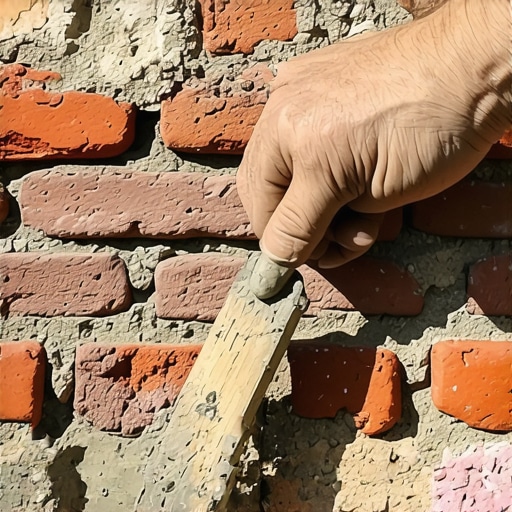
The Lesson of the Thirsty Brick
I remember my father standing in the shadow of a 19th-century textile mill, holding a piece of red clay brick that had been pulverized into orange dust. He didn’t just look at it; he smelled it. He told me, ‘Son, a brick is a living thing. It breathes, it drinks, and it moves. If you choke it with the wrong mud, it’ll commit suicide just to get away from the mortar.’ He took his hammer and tapped a neighboring brick that was still intact. It rang with a high-pitched, metallic ‘ting.’ That’s the sound of structural integrity. But the mortar surrounding it—a modern, grey Portland cement—was hard as flint, while the brick face was spalling off in thick flakes. This is the tragedy of modern masonry: we are killing our history with the very materials we think are ‘stronger.’
The Physics of the Sacrificial Joint
In the world of historic brick salvage and restoration, strength is often the enemy. Modern concrete patch materials and Type S mortars are designed for high compressive strength, but in a pre-1940s building, the mortar isn’t there to be strong; it’s there to be the ‘sacrificial lamb.’ We call this the sacrificial principle. Historic bricks, fired in old kilns, are softer and more porous than their modern counterparts. When you apply a hard, impermeable mortar to tuckpointing brick walls of this vintage, you create a moisture trap.
“Mortar should always be weaker than the masonry units it binds, ensuring that stresses and moisture find relief through the joint rather than the brick face.” – BIA Technical Note 1
Micro-zooming into the pore structure, we see that liquid water moves through masonry via capillary action. In a wall built with sustainable tuckpointing mortars—specifically those based on Natural Hydraulic Lime (NHL) or lime putty—the mortar joints act as a wick. Because the lime mortar has a higher vapor permeability than the brick, the water migrates toward the joint to evaporate. If you ‘butter’ those joints with modern Portland cement, the water reaches the joint, hits a wall, and is forced back into the brick. When the temperature drops, that trapped water undergoes freeze-thaw damage restoration nightmares. It expands by 9%, and since the cement won’t budge, the face of your historic brick pops off. That is brick spalling prevention 101: the mud must breathe.
The Chemistry of Carbonation vs. Hydration
To understand why sustainable tuckpointing mortars are superior, we have to look at the ‘mud’ chemistry. Modern cement cures through hydration—a rapid chemical reaction that creates a rigid crystalline matrix. It’s fast, it’s cheap, and it’s brittle. Lime mortar, however, cures through carbonation. It absorbs CO2 from the atmosphere over months and years, slowly turning back into limestone. This process allows for ‘autogenous healing.’ When a historic building shifts slightly—and they all do—micro-cracks form. In a lime joint, moisture dissolves a small amount of free lime and redeposits it into the crack, effectively ‘healing’ the wound. You won’t get that from a bag of hardware store premix.
The Restoration Reality: Tuckpointing vs. Repointing
Most folks use the terms interchangeably, but in the trade, they are worlds apart. Repointing is the process of raking out the old, decayed mud and replacing it. Tuckpointing is an aesthetic trick of the eye. We use a mortar that matches the brick color perfectly, then lay a very thin, contrasting ‘fillet’ or ‘bead’ of white lime putty down the center. It makes a sagging, 100-year-old wall look like it has perfectly sharp, narrow joints. It’s a specialized skill that requires a steady hand and a ‘slicker’ tool to strike the joint properly. For a commercial smokestack repair, the stakes are even higher. You’re dealing with extreme thermal expansion and wind loads. If you don’t use a mortar with the right ‘tooth’ and flexibility, the whole stack can develop vertical fissures that lead to catastrophic failure.
Chimneys and Foundations: The Forensic Front Lines
Your chimney is the most vulnerable part of the house. It’s an island of masonry exposed to the elements on all four sides, plus the internal heat cycles. A chimney sweep and repair job often reveals that the interior flue tiles are fine, but the exterior masonry is ‘honeycombing’ because of acid rain and poor mortar choices. The same logic applies to the ground level. When I’m called for a foundation wall bowing repair, the first thing I look for isn’t just the crack; it’s the water. Hydrostatic pressure from saturated soil can push a wall inward. If the mortar joints are too hard, the bricks will snap. If they are lime-based, the wall has a bit of ‘give.’ However, no mortar can save a wall without a retaining wall drainage upgrade. You have to move the water away from the ‘hawk’ and the trowel before you start laying units.
“The selection of mortar for historic masonry is a matter of matching the physical properties of the existing materials to ensure long-term compatibility.” – ASTM C270 Standard Specification
The Master’s Process: Doing it Right
If you’re looking at a historic facade, don’t let a handyman near it with a high-speed grinder. They’ll ‘smile’ the bricks—nicking the tops and bottoms of the units and ruining the ‘suction’ for the new mud. You rake those joints by hand or with a specialized vacuum-shrouded oscillating tool. You ‘butter’ the joints in lifts, never more than 1/2 inch at a time, to ensure the carbonation reaches the back of the joint. It’s slow work. It’s expensive work. But if you use the right sustainable tuckpointing mortars, you aren’t just fixing a wall; you’re preserving a legacy for another three generations. Anything less is just a ‘cold joint’ waiting to fail.