
The Forensic Scene: Beneath the Surface of a Hairline Crack
The homeowner stood in their finished basement, pointing at a line no thicker than a pencil lead. To them, it was a minor eyesore, a blemish on the drywall. But when I peeled back the insulation and put my digital scope into the core of that poured concrete wall, the reality was grim. The internal structural steel was rusted to a fine, reddish dust, a victim of decades of silent oxidation. What looked like a simple hairline crack was actually the primary intake for a subterranean river. This is the reality of masonry damage assessment in a world where homeowners are sold ‘quick fixes’ instead of engineering solutions. When we talk about stopping basement seepage, we aren’t just slapping a coat of paint on a wall; we are engaging in a high-stakes battle against the literal weight of the earth.
“Water penetration is the single greatest threat to masonry durability.” – BIA Technical Note 7
The Physics of Failure: Hydrostatic Pressure and Soil Heaving
To understand why foundation waterproofing through high-pressure injections is necessary, you have to understand the ‘head pressure’ of the water table. Soil isn’t a static mass; it is a living, moving sponge. In the northern climates, where the freeze-thaw cycle reigns supreme, that sponge expands by 9% every time the temperature drops below thirty-two degrees. This creates a mechanical pincer move on your foundation. On the outside, saturated soil exerts hundreds of pounds of hydrostatic pressure per square foot. On the inside, your basement is a hollow void. The concrete is the only thing standing between the two, and even the best-poured wall has a ‘pore structure’ that can be exploited by capillary suction.
When we see honeycombing in the concrete—those clusters of coarse aggregate without enough ‘mud’ to fill the gaps—we know the water has already found its highway. The water doesn’t just sit there; it migrates through the micro-fissures at a molecular level. This is where tuckpointing weatherproofing and exterior coatings often fail; they only treat the surface. To truly stop the seepage, we have to go deep into the substrate, into the very heart of the cold joint where the footer meets the wall.
[IMAGE_PLACEHOLDER]
The Chemistry of the Cure: High-Pressure Polyurethane Injections
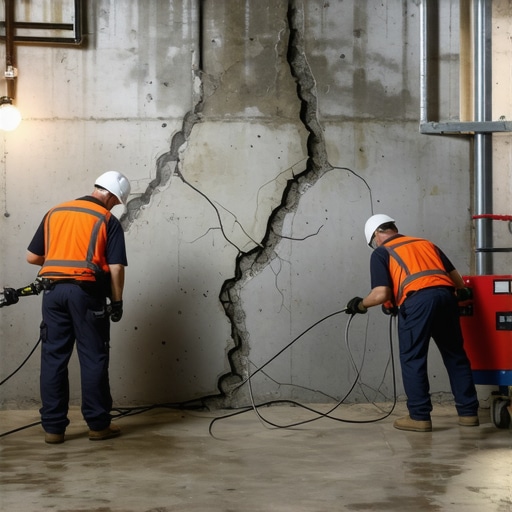
We don’t use the ‘handyman special’ epoxy kits you find at big-box stores. Those are rigid. Foundations move. If you put a rigid epoxy into a moving crack, the concrete will just crack again an inch to the left. Instead, we use high-pressure injections of hydrophobic or hydrophilic polyurethanes. This isn’t just ‘filling a hole’; it’s a chemical reaction. Once we drill our ports at a 45-degree angle to intersect the crack mid-wall, we ‘butter’ the surface and begin the injection. As the resin hits the water inside the crack, it flashes. It expands up to 20 times its original volume, turning from a liquid with the viscosity of motor oil into a dense, closed-cell foam that is 100% impermeable to water.
This process requires a ‘slicker’ touch than most realize. If you crank the pressure too high, you risk ‘blowing the face’ off the concrete. If it’s too low, the resin won’t penetrate the micro-pores. We are looking for that specific moment where the resin starts to bleed out of the next port—that’s how we know we’ve achieved total saturation. This is the same logic we apply to chimney structural repair; if you don’t address the internal void, the exterior ‘mud’ is just a mask.
Integrating the Structural Envelope: From Ties to Lifts
A basement doesn’t exist in a vacuum. Often, seepage is a symptom of a larger systemic failure. If I see a wall bowing inward while I’m doing an injection, I know the structural brick ties replacement is likely next on the list. When the ties that bind a masonry veneer to the structural frame rust away, the wall loses its lateral stability. This leads to shifting loads that put even more stress on the foundation. In extreme cases of settlement, we look toward self-leveling masonry lifts to restore the original geometry of the home before we even think about sealing a crack.
“The use of high-pressure injection resins provides a monolithic seal that adapts to the thermal movement of the structure, unlike traditional rigid fillers.” – ASTM D6489 Standard
We also have to look at the ‘hardscape’ surrounding the house. A failing brick patio restoration project can be the primary cause of a wet basement. If the pavers have sunk and the pitch is toward the foundation, you are essentially funneling thousands of gallons of rainwater directly into your ‘honeycombing’ concrete. We use fiber-reinforced mortars for these repairs because they offer the tensile strength needed to survive the soil heaving that caused the problem in the first place.
Modern Solutions: Mortarless Systems and Re-Pointing Services
For those who hate the maintenance of traditional masonry, mortarless masonry systems are gaining traction, but they still require a dry foundation to sit on. Whether we are providing re-pointing services for a 1920s bungalow or injecting a modern poured-wall basement, the goal is ‘breathability’ where possible and ‘impenetrability’ where necessary. In the basement, we choose the latter. There is no ‘breathability’ for a foundation wall; it is a dam, and it must be built like one. By the time I’m done with a high-pressure injection, that crack isn’t just sealed; it’s the strongest part of the entire wall. We don’t just stop the water; we restore the integrity that the ‘lick-and-stick’ contractors took away. If you’re tired of the damp smell and the crumbling lime, it’s time to stop looking at the surface and start looking at the chemistry beneath. Do it once, do it right, or you’ll be doing it twice while your floor joists rot above you.