
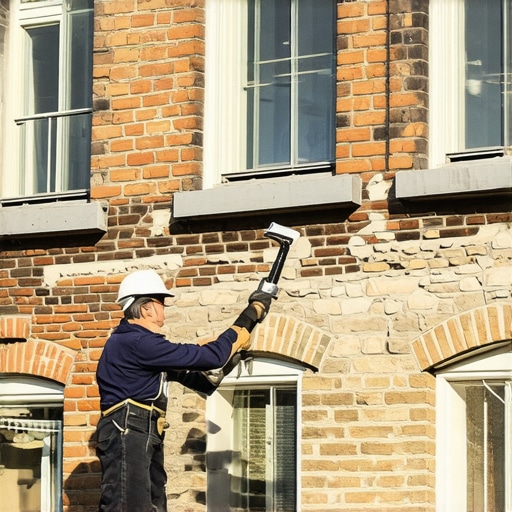
The Ghost in the Wall: Why Your Facade is Faltering
I remember a project in the historic district where a homeowner called me out because his 1890s brickwork looked like it was ‘melting.’ He’d hired a handyman the year before to patch a few spots. That handyman, bless his heart, used modern Type S Portland cement—a material hard enough to pave a highway—on bricks that were fired in a wood-burning kiln a century ago. By the time I arrived, the faces of the bricks were popping off like scabs, a process we call spalling. The wall was gasping, trapped behind a burial shroud of non-breathable ‘mud.’ My mentor used to say that a building is a living thing; if you plug its pores, it will rot from the inside out. Understanding a full repointing service isn’t about aesthetics; it is a forensic rescue mission for your home’s skeleton.
“Water penetration is the single greatest threat to masonry durability. The use of mortar that is harder than the masonry units can lead to irreversible damage during thermal expansion cycles.” – BIA Technical Note 7
The Physics of the Sacrificial Lamb
In the world of historic masonry, the mortar is the sacrificial lamb. It is designed to be softer and more permeable than the brick or stone it holds together. When the sky opens up and the rain hits, the moisture needs a way out. In a properly pointed wall using lime-based mortars, the moisture wicks through the mortar joints and evaporates. If you use a modern, dense cement, the moisture gets trapped. When the freeze-thaw cycle hits, that trapped water expands by 9% in volume, and since it can’t escape through the hard cement, it blasts the face of your historic brick into the garden. During a full repointing service, we are restoring that breathability. We are ensuring the modulus of elasticity in the mortar is lower than the masonry units, allowing the building to shift, groan, and expand without cracking the ‘soldier course’ or the brick arch restoration we might be performing overhead.
The Forensic Inspection: Beyond the Naked Eye
Before we even touch a ‘slicker’ or a ‘hawk,’ we have to know what we are dealing with. On older chimneys, we often deploy drone chimney inspections. Why? Because the ‘honeycombing’ of the mortar at the 40-foot mark isn’t visible from the driveway. We’re looking for ‘cold joints’ and evidence of ‘sulfate attack’—a chemical reaction where salts in the brick react with the cement to create expansive minerals. If the chimney is leaning or the internal flue is cracked, we move from repair to chimney rebuild services. This stage also involves checking the ‘suction’ of the brick. We literally throw a little water on it. If it disappears instantly, the brick is thirsty and will ‘burn’ the new mortar by sucking the hydration out before it can cure. This is where the chemistry starts. We have to pre-wet the wall to ensure the new ‘mud’ bonds to the ‘tooth’ of the old masonry.
The Ritual of Raking and Preparation
You cannot simply butter new mortar over the old. That is called ‘skin-pointing,’ and it’s a crime in the trade. We have to rake out the old, failing joints to a depth of at least twice the width of the joint, or until we hit sound mortar. This is a dusty, gritty process. We use small pneumatic hammers or hand chisels because a large grinder in the wrong hands will ‘smile’—that’s when the blade nicks the top and bottom of the bricks, permanently scarring the building. Once the joints are raked, we perform a deep masonry cleaning to remove carbon crusting and biological growth. If we find structural failure, we might recommend foundation slab jacking or retaining wall installation nearby to stop the house from moving while we work. The wall must be clean, damp, and open, ready for the new life we’re about to pack into it.
“Mortar for restoration should be based on the analysis of the original material. Generally, a lime-rich mortar is required to provide the necessary flexibility and vapor permeability.” – ASTM C270 Standards
Mixing the ‘Mud’: The Chemistry of Carbonation
Modern concrete hardens through a fast hydraulic reaction. Historic lime mortar is different. It hardens through carbonation. It literally breathes in carbon dioxide from the air to turn from a paste (calcium hydroxide) back into stone (calcium carbonate). This is a slow, beautiful process that can take weeks. We mix our mud with sharp, well-graded sand—not that fine ‘play sand’ you see at big-box stores. The sand provides the ‘skeleton,’ and the lime is the ‘glue.’ If we are working on an outdoor masonry fountain restoration, we might use a natural hydraulic lime (NHL) that can set underwater, but for most walls, it’s about matching the color and texture of the original 19th-century aggregate. We don’t use dyes; we find the right sand. It’s about the ‘tooth.’ When we pack the mortar into the joint, we do it in ‘lifts’ or layers, firmly tamping it to ensure there are no voids where water can hide.
Restoring the Arches and Accents
A full service often uncovers hidden tragedies. Brick arch restoration is one of the most technical tasks. The arch is held together by friction and the ‘keystone’ effect. If the mortar in an arch fails, the bricks begin to slip. We have to build temporary wooden ‘centers’ to support the weight while we replace the mortar. This isn’t just about ‘pointing’; it’s about structural integrity. The same applies to modular retaining walls on the property. If they weren’t built with proper drainage, hydrostatic pressure will push the wall forward. We look at the whole property. You can’t fix a chimney if the foundation is sinking. You can’t have a beautiful facade if the chimney repair services didn’t address the lead flashing at the roofline. Everything is connected.
Curing: The Final, Crucial Step
The biggest mistake a ‘handyman’ makes is walking away as soon as the joint is struck. Lime mortar is a thirsty beast. If the sun hits it too hard or the wind dries it too fast, it will ‘flash set’ and crumble. We perform ‘mistings.’ We keep the wall damp for days, sometimes covering it in wet burlap. We are waiting for that chemical conversion. This is the difference between a job that lasts five years and a full repointing service that lasts fifty. When the mortar finally cures, it should be slightly weaker than the brick, allowing the building to expand in the summer heat and contract in the winter chill without a single crack. This is the ‘Old World’ way. It’s not fast, and it’s not cheap, but it’s the only way to honor the craft and keep the roof over your head. When we’re done, the wall won’t just look better—it will be functionally superior, ready to face another century of storms.