
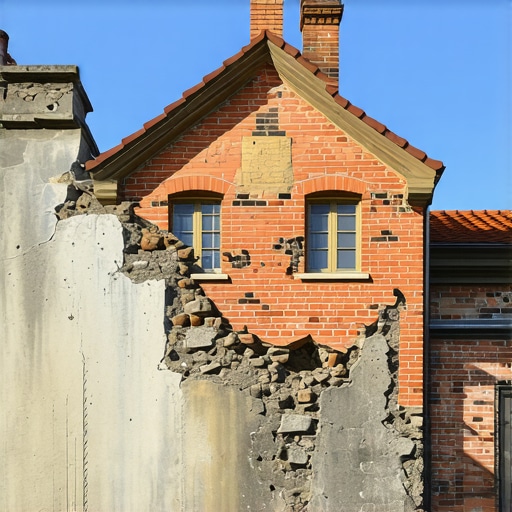
I stood in front of a 1912 Queen Anne Victorian last Tuesday, and the homeowner was nearly in tears. She had just spent twenty thousand dollars on what a local handyman called ‘freshening up the joints.’ To the untrained eye, it looked clean. To me, it looked like a death sentence. When I pulled my digital borescope out and fed it into a hairline fracture near the water table, the truth was laid bare: the inner wythe of the wall was literally turning into a pile of damp red dust. The structural steel lintels were rusted to half their original thickness, expanding like a puff pastry and jacking up the soldier course above the windows. This wasn’t a maintenance issue; it was a forensic disaster caused by a fundamental misunderstanding of masonry physics.
The Fatal Mismatch: Why Modern Mud Fails Old Clay
The core of the problem lies in the chemistry of the binder. Before the mid-1930s, bricks were fired in kilns at lower temperatures than today’s hard-burned units. These ‘soft’ bricks are porous and flexible. They were meant to be laid with lime-based mortars. Modern Portland cement, the stuff you find in every big-box store bag labeled Type S or Type N, is a different animal entirely. It is hard, brittle, and essentially waterproof. When you butter a soft historic brick with this high-strength mud, you create a structural conflict.
“The use of high-strength Portland cement mortars in restoration often leads to irreversible damage to historic masonry units.” – ASTM C270 Standards
This is the ‘Sacrificial Principle’ of masonry. In a healthy historic wall, the mortar must be softer and more permeable than the brick. The mortar is designed to be the sacrificial element—it takes the brunt of the weathering, the movement, and the moisture. When you use modern cement, you flip that script. The brick becomes the softest part of the system. During a thermal cycle, the wall wants to expand. The cement joints are like iron bars that won’t budge, so the brick faces are forced to crush themselves against the mortar, leading to spalling—where the face of the brick literally pops off in a jagged shard.
The Physics of Vapor Permeability and the Freeze-Thaw Trap
In the colder climates where freeze-thaw cycles rule the winter, the wrong mortar is a ticking time bomb. Think of a historic brick as a sponge. It breathes. It takes in moisture from the air and the ground through capillary action and releases it through evaporation. This is what we call vapor permeability. Lime-based sustainable tuckpointing mortars allow this moisture to travel through the joint and escape. Modern cement, however, acts as a vapor barrier. It traps the water inside the brick. When that trapped water hits 32 degrees Fahrenheit, it expands by approximately 9 percent. Since it can’t exit through the dense cement ‘mud,’ it exerts internal pressure on the clay pores. After a few dozen cycles, the internal structure of the brick shatters. This is why you see white, crusty powder—efflorescence—blooming on the surface. That is the sound of your house crying for help. I’ve seen chimneys requiring chimney structural repair where the top three feet were held together by nothing but habit because the Portland cement had turned the interior bricks into mush while the joints stayed perfectly intact.
The Hardscape Truth and Foundation Failures
The damage doesn’t stop at the facade. I often see homeowners trying to fix a leaning wall with retaining wall batter correction using the same flawed logic. They think adding more weight or harder cement will hold back the earth. But without masonry waterproofing solutions that account for hydrostatic pressure, you’re just building a dam. Water collects behind the wall, the soil heaves, and the wall bows. The same applies to foundation wall bowing repair; if the parge coat on the exterior is a hard cement mix, it traps moisture against the foundation, leading to honeycombing in the concrete or rot in the stone. We are seeing a rise in the need for commercial masonry facade maintenance because 1950s and 60s buildings are now hitting their limit of tolerance for these bad repairs. Even concrete flatwork services are often ignored, but if your driveway or walkway doesn’t slope away from the masonry, you are feeding a constant stream of liquid into the base of your wall, exacerbating the suction effect of the dry brick.
The Restoration Reality: Sustainable Tuckpointing Mortars
True restoration requires a hawk and a slicker, but more importantly, it requires the right mix. We talk about ‘Type O’ or ‘Type K’ mortars, or even pure lime putties. These materials don’t just ‘dry’; they carbonate. The carbonation process is a slow dance with the CO2 in the atmosphere that can take months. This slow cure allows for autogenous healing. If a micro-crack forms due to settlement, the lime can actually dissolve and re-precipitate into the crack, sealing it. Try getting Portland cement to do that. When we perform masonry repair services, we often use AI masonry assessment tools to map the thermal bridge and moisture density of a wall before we ever rake out a joint. This allows us to see exactly where the ‘lick-and-stick’ repairs of the past have caused hidden rot. Even the tile grouts on masonry in decorative vestibules must be checked; if they are too hard, they will snap the tiles as the building breathes.
Conclusion: Do It Once or Do It Twice
You can hire a handyman who will slap some gray mud into the cracks and call it a day. It will look great for two years. By year five, you’ll be calling me for a full forensic teardown. Investing in the right materials—the breathable, soft, lime-based mortars that the original masons used—is the only way to ensure a building lasts another century. Don’t let a bag of cheap cement kill a house that has survived a hundred years of storms. Masonry is a living system of physics and chemistry; treat it like a rock, and it will crumble like sand.