
The Silent Disintegration: When Industrial Masonry Fails
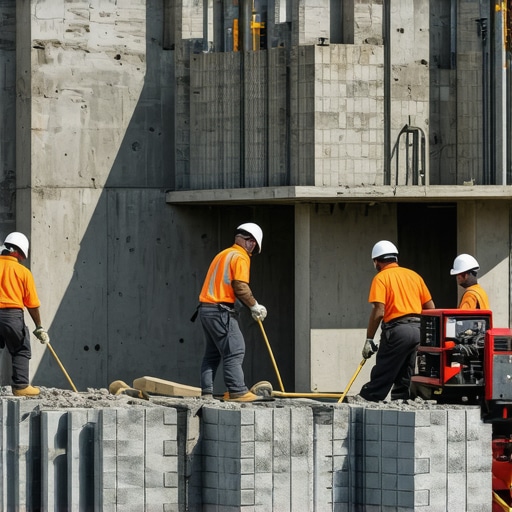
I was standing in the shadow of a massive 1940s power station last November, and the air smelled like ozone and wet iron. The facility manager was bragged about his new paint job, but I wasn’t looking at the color. I was looking at the way the light hit a vertical bulge in the south wall. I took my hammer and tapped a single Concrete Masonry Unit (CMU) near the base. It didn’t ring; it thudded, a dull, wet sound like hitting a bag of damp flour. The homeowner—or in this case, the plant supervisor—thought it was just a cosmetic issue. But when I put my scope inside a core-drilled hole, I saw the structural steel was rusted to dust, expanded to three times its original thickness, and was literally exploding the block from the inside out. This wasn’t a job for a handyman with a bucket of premix; this was a forensic structural masonry inspection that revealed a building on the brink of a localized collapse.
“CMUs must be viewed as porous membranes, not solid barriers. In industrial settings, the chemical permeability of the unit dictates its lifespan more than its compressive strength.” – ASTM C90 Structural Guidance
The Microscopic War: Chemistry of CMU Decay
In harsh industrial environments, we aren’t just fighting the weather; we are fighting chemistry. Concrete is a porous creature. Its structure is a network of capillaries formed during the hydration process when water meets Portland cement to create Calcium Silicate Hydrate (C-S-H) gel. In a pristine lab, this is a beautiful thing. In a refinery or a chemical processing plant, those pores are wide-open doors for sulfates, chlorides, and carbon dioxide. When CO2 enters the block, it reacts with the calcium hydroxide to form calcium carbonate. This sounds fine, but it lowers the pH of the concrete from a protective 12 or 13 down to 9. Once that happens, the ‘passivation’ layer on the rebar vanishes. The steel begins to oxidize, and because rust occupies more volume than steel, it exerts internal ‘jacking’ pressure that causes massive honeycombing and spalling.
We have to talk about the ‘tooth’ of the block. For a proper brick wall restoration or CMU repair, the surface profile must be aggressively prepped. You can’t just slap new mud over old industrial grime. Facade cleaning in these environments often requires low-pressure chemical washes followed by a specific abrasive media to open the pores without destroying the aggregate bond. If the block is too ‘slick,’ the new material won’t bite. You need that suction, that mechanical bond where the new mortar actually grows into the old substrate.
AI Masonry Assessment: The Modern Forensic Tool
Gone are the days when we just guessed what was happening behind the face of a wall. We are now seeing the rise of AI masonry assessment. By fedding thermal imaging data and LIDAR scans into specialized algorithms, we can detect ‘cold spots’ that indicate moisture accumulation or voids where the original grout was never poured. This isn’t just tech for tech’s sake. In a massive industrial complex, you can’t hand-tap 100,000 square feet of masonry. The AI identifies the anomalies, and then the master mason goes in with the hammer to confirm. It’s the marriage of old-world intuition and high-speed data. This is particularly vital for structural masonry inspection where a failing retaining wall repair could save a million dollars in downstream equipment damage.
Foundation Waterproofing and the Hydrostatic Nightmare
In these heavy industrial zones, the foundations are often subjected to massive vibration and hydrostatic pressure. If the foundation waterproofing was done with a cheap tar-coat thirty years ago, it’s long gone. We’re now looking at crystalline waterproofing technologies that actually migrate into the concrete. When moisture hits these chemicals, they grow crystals that plug the pores. It’s a self-healing mechanism that stops the water before it can reach the interior. If you’re dealing with a failing retaining wall, you don’t just patch the cracks. You have to address the ‘weep holes’ and the drainage aggregate behind the wall. Without a way for water to escape, the wall is just a dam that wasn’t designed to hold a lake.
“Water penetration is the single greatest threat to masonry durability, accounting for over 90% of all accelerated deterioration cases in industrial masonry.” – BIA Technical Note 7
Metallic Masonry Finishes and Specialized Protection
In environments where heat is a factor—like near smelting furnaces or high-pressure steam lines—standard masonry paint is a joke. It’ll bubble and peel in a week. This is where metallic masonry finishes come into play. These aren’t just for looks. These coatings often contain zinc or aluminum flakes that provide a sacrificial layer or reflect radiant heat. For historic masonry preservation within an active plant, these finishes can be a lifesaver, maintaining the breathability of the old units while providing a barrier against corrosive particulates. When we apply these, we ‘butter’ the back of the repair units carefully to ensure there are no cold joints where moisture could later sit and freeze.
Chimney Flue Liner Installation: The Industrial Interior
Industrial stacks are the most abused masonry structures on the planet. They deal with thermal shock, acidic condensate, and constant wind loading. A chimney flue liner installation in this context isn’t just about sticking a pipe down a hole. It’s about calculating the expansion coefficient of the liner versus the masonry shell. If the liner expands too much, it’ll crack the soldier course at the top of the stack. We use cast-in-place liners or high-grade stainless steel with specialized insulation wraps to ensure the exterior masonry stays at a stable temperature, preventing the freeze-thaw cycles that lead to spalling.
The Restoration Process: From Mud to Masterpiece
When it’s time to actually lay the mud, the craft takes over. You don’t use a standard Type M mortar for every industrial job. Type M is hard—too hard for many restoration projects. We often go back to Type N or even specialized lime-based mortars if we’re doing historic masonry preservation. The mortar must be the ‘sacrificial’ element. I’d rather the mortar joint crack in fifty years than have the block itself shatter because it had nowhere to move. We use the hawk and trowel to slick the joints, ensuring a ‘weathered’ or ‘concave’ profile that sheds water effectively. Even on something as seemingly decorative as an outdoor masonry fountain restoration in a corporate industrial park, the physics of water shedding remain the same. If the water sits, the masonry dies. Do it once, do it right, and use a slicker tool to compress the joint face to keep the moisture out. If you see a guy ‘shaving’ his joints with a trowel instead of striking them, fire him. He’s leaving the pores open to the world.