
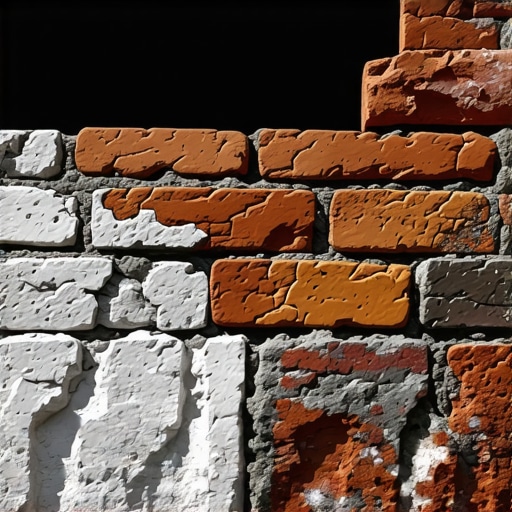
The Ghost in the Wall: A Forensic Discovery
I was called out to a sprawling industrial complex last November, just as the first frost was biting into the mortar joints. The property manager pointed to a 30-foot section of the north-facing facade and called it a ‘cosmetic dusting.’ To the untrained eye, it looked like someone had spilled a bag of flour over the red clay. But when I pulled out my high-resolution scope and looked into the masonry’s throat, I didn’t see a dusting; I saw a structural execution in progress. The structural steel lintels behind those bricks were choked with rust, expanding like a slow-motion explosion because the ‘white dust’ was actually the signal of a systemic hydraulic failure. The homeowner or manager who ignores these signs is simply watching their equity dissolve one salt crystal at a time.
The Chemical Warfare of Efflorescence
To understand why your building is weeping, we have to look at the chemistry of the ‘mud’ and the clay. Efflorescence is the migration of a salt solution through a porous material, where it eventually comes to the surface, the water evaporates, and the salt is left behind. But there is a massive distinction between the ‘new building bloom’ and the ‘deep-seated rot’ of secondary efflorescence. Surface salt, often appearing in new builds, is usually just the residual salts from the initial hydration of the mortar. It’s the teenage acne of masonry—unsightly, but it usually clears up with a stiff brush and some rain. Deep brick efflorescence, however, is a different beast entirely. This is often the result of external water sources—leaking pipes, failing chimney crown repair needs, or poor commercial masonry facade maintenance—driving deep into the substrate and pulling out the very minerals that hold the brick together.
“Water penetration is the single greatest threat to masonry durability.” – BIA Technical Note 7
In the North, where the freeze-thaw cycle reigns supreme, this salt migration is lethal. When water carries these salts to the surface, it often gets trapped just beneath the face of the brick. This is called subflorescence. When that trapped water freezes, it expands by roughly 9%. That pressure, combined with the crystallization of the salts, creates an internal force that exceeds the tensile strength of the clay. The result? Spalling. You’ll see the entire face of a ‘soldier course’ or a header brick just pop off and land on the sidewalk. This isn’t just a maintenance issue; it’s an emergency masonry repair scenario before the structural integrity of the wythe is compromised.
The Physics of Capillary Suction and the ‘Slicker’
Every brick is essentially a dense forest of tiny straws. Through capillary action, a brick can suck water upward against gravity for several feet. If your commercial tuckpointing was done with a mortar that is too ‘hard’—meaning it has too much Portland cement and not enough lime—the water cannot escape through the joints. In a proper wall, the mortar is the sacrificial lamb. It should be softer and more permeable than the brick itself, allowing the ‘breathability’ that keeps the system dry. When a ‘handyman’ butters the joints with a high-strength Type S mortar on an old soft-brick building, he is effectively sealing the exit doors. The salts then concentrate inside the brick, leading to concrete masonry unit restoration needs that could have been avoided with a simple ‘slicker’ and the right mix of mud.
[IMAGE_PLACEHOLDER]
The Chimney: A Vertical Laboratory for Decay
Nowhere is this salt-driven decay more evident than in chimneys. A chimney is exposed to the elements on all four sides and subjected to extreme temperature differentials. When I perform drone chimney inspections, I’m looking for the ‘white beard’ around the top. This usually indicates that the interior flue liner has cracked, allowing acidic condensation to soak into the surrounding masonry. Without chimney rebuild services or at least a proper brickwork sealants application, the salts from the combustion process will combine with the moisture to eat the chimney from the inside out. If you see white streaks on your chimney, you aren’t just looking at salt; you’re looking at the ghost of your fireplace’s future.
“The masonry must be designed to breathe; to trap moisture is to invite the destruction of the unit.” – Vitruvius, De Architectura
Modern Miseries: Lick-and-Stick and Stone Veneer
We see a lot of stone veneer repair these days because people love the look of ‘Old World’ stone but don’t want to pay for the ‘Old World’ thickness. These thin-set veneers are notorious for trapping moisture. If the drainage plane behind the stone is blocked—or worse, non-existent—the efflorescence will manifest as ‘picture framing,’ where the edges of the stones turn white. This is the precursor to the stone literally falling off the wall because the bond has been ‘burned’ by the salt concentration. Brickwork pointing styles, such as the weathered joint or the concave joint, are designed to shed water, but with veneer, you’re often at the mercy of the adhesive’s chemistry. This is why brickwork sealants application must be handled with extreme caution; use a non-breathable sealer, and you’ll turn your beautiful stone wall into a giant, salt-filled blister.
The Forensic Fix: Beyond the Surface
So, how do we treat the ‘White Ghost’? First, we stop the water. There is no point in cleaning efflorescence if the chimney crown repair hasn’t been handled or the commercial masonry facade maintenance program hasn’t identified the source of the leak. Once the water is stopped, we use a dry brush first. Never start with water; you’ll just push the salts back into the pores. If the salt is deep, we might use a mild acidic wash, but it has to be neutralized immediately. Then, we look at the joints. Commercial tuckpointing with a lime-rich mortar allows the wall to start ‘breathing’ again, moving the evaporative plane from the center of the brick to the surface of the mortar joint. It’s about managing physics, not just slapping mud on a wall. Do it once, or do it twice—the choice usually depends on how much you respect the ‘tooth’ of the stone and the laws of thermodynamics.