
The Forensic Scene: A Seventy-Thousand Dollar Pile of Rubble
I stood looking at a seventy-thousand dollar retaining wall that lay in a pile of rubble because the contractor forgot one thing: drainage. It wasn’t the stone’s fault. It wasn’t even the mortar’s fault. It was the physics of water and the arrogance of a man with a skid-steer who thought he could outsmart gravity. The wall had developed a ‘belly’ three years prior—a subtle, pregnant curve in the middle courses of the ashlar pattern. The homeowner ignored it. Then came a week of relentless spring rain. The soil behind that wall saturated, the pore-water pressure spiked, and the entire structure surrendered to the mud in a single, terrifying heave. When I arrived with my level and a probe, the ‘lick-and-stick’ veneer was peeling off like wet wallpaper, revealing the hollow-core blocks that had been filled with nothing but hopes and dreams. This is the reality of modern masonry: if you don’t respect the hydrostatic pressure, the earth will eventually reclaim its own.
The Physics of the Bulge: Why Gravity Always Wins
When a wall begins to ‘belly,’ it is a cry for help from the structural core. Traditional masonry is excellent at handling compressive loads—weight pressing straight down. It is notoriously poor at handling lateral earth pressure. Behind every retaining wall is a wedge of soil trying to reach its natural angle of repose. When that soil gets wet, its weight doubles, and it begins to act like a hydraulic ram. If you’ve ever felt the ‘suction’ of a wet clay soil on your boots, imagine that force multiplied by a thousand tons pressing against your brickwork.
“Water penetration is the single greatest threat to masonry durability. Without proper drainage, hydrostatic pressure can exceed the structural capacity of even the most robust masonry assemblies.” – BIA Technical Note 7
This is where the chemistry of the ‘mud’ matters. If a contractor used a high-strength Portland cement (Type S) on an old lime-stone wall, he created a brittle barrier. The wall can’t flex. Instead of yielding slightly to the pressure, it snaps. This is why tuckpointing brick walls requires a deep understanding of mortar compatibility. You want the mortar to be the sacrificial lamb, not the stone itself.
The Anatomy of Failure: Hydrostatic Pressure and Soil Heaving
In the North, we deal with the brutal ‘freeze-thaw’ cycle. Water expands roughly 9% when it turns to ice. If that water is trapped inside your masonry joints or behind your stone veneer, it acts like a million tiny jackhammers. This leads to spalling, where the face of the brick literally pops off. We see this often in brick veneer detachment repair cases where the wall ties—those little metal strips that hold the brick to the house—have rusted to dust because moisture stayed trapped in the cavity. Drone chimney inspections have become a godsend here; we can see the ‘honeycombing’ of the mortar at the top of a stack without ever putting a ladder up. If the mortar has lost its ‘tooth,’ it’s no longer grabbing the brick; it’s just sitting there, waiting for a stiff breeze to knock it over.
The Forensic Solution: Reinforcement and Drainage
How do we fix a bulging wall? We don’t just ‘butter’ over the cracks with more mud. We have to address the heart of the problem.
- Hydrostatic Relief: This means installing ‘weep holes’ and ensuring there is a minimum of 12 inches of #57 clean stone behind the wall, wrapped in a high-quality filter fabric.
- Geogrid: Think of this as the ‘muscles’ of the soil. These synthetic grids lock the soil particles together, using the weight of the earth to hold the wall in place.
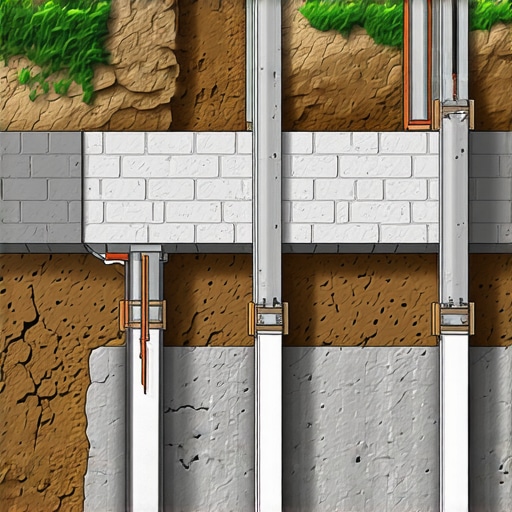
- Helical Piers: For foundations that are sinking or heaving, we use ‘The Cure’—screwing massive steel piers into the stable load-bearing strata below the frost line.
I’ve seen folks try to hide these issues with stone veneer over brick, but that’s like putting a tuxedo on a corpse. If the underlying structure is failing, the veneer will just detach. Instead, we look at self-healing concrete foundations—a technology where bacteria embedded in the mix produce limestone to seal cracks as they form—or 3D printed masonry repairs for complex, historic shapes that are otherwise impossible to replace. Even masonry cleaning and porous stone sealers play a role; if the stone can’t ‘breathe,’ the moisture stays trapped, and the cycle of destruction continues.
The Hardscape Truth: Compaction and Base
Most concrete flatwork services fail because they treat the soil like a static object. It isn’t. It’s a living, breathing, moving thing. Whether you’re laying a soldier course of bricks or a massive concrete driveway, the ‘base’ is everything. I’m talking about 8 inches of crushed aggregate, compacted in 2-inch lifts with a vibratory plate. If you see a guy ‘buttering’ his bricks without wetting them first—especially in the heat of a Texas summer—you’re looking at a ‘flash set.’ The dry brick sucks the moisture out of the mud before it can hydrate. The result? A ‘cold joint’ that will crumble in five years.
“Mortar shall be proportioned to provide a balance between workability, water retention, and compressive strength, ensuring that the bond remains the primary focus of the assembly.” – ASTM C270 Standards
The Value of a Master: Cost vs. Longevity
When you get a tuckpointing cost estimation, don’t just look at the bottom line. Ask about the ‘slicker’ they use to strike the joints. Ask if they’re using Type N or Type O mortar for your historic home. A ‘handyman special’ will use whatever bag of Premix is on sale at the big-box store. A Master Mason will match the ‘aggregate’ and the ‘color’ to ensure the repair is invisible and chemically compatible. You can do it once, or you can do it twice. Do it twice, and you’ll be calling me to perform a forensic autopsy on your bank account. In this trade, there are no shortcuts—only the slow, patient work of the trowel and the ‘hawk.’