
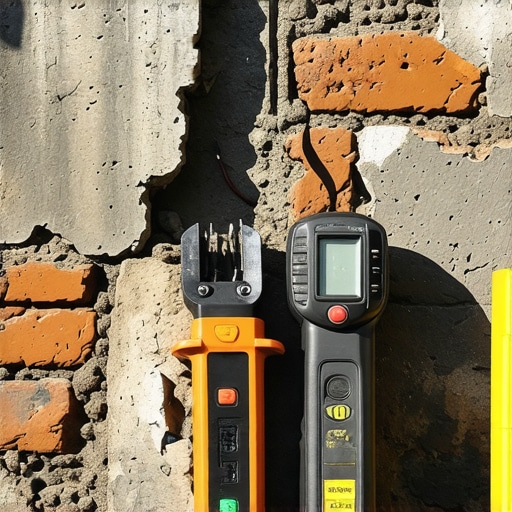
The Forensic Scene: The Ghost in the Wall
The homeowner thought it was just a hairline crack, a minor blemish on the face of a stately 1920s Georgian Revival. But when I put my borescope inside the cavity, I saw that the structural steel was rusted to dust. What looked like a solid mass of masonry from the street was actually a detached curtain of brick, held up by nothing more than hope and the friction of the mortar joints. In my thirty years as a third-generation mason, I have seen this tragedy play out across a thousand facades. We call it the ‘invisible failure.’ You can’t see the metal ties that bind the outer wythe of brick to the inner structure, but when those ties fail, the entire wall becomes a ticking time bomb. This isn’t a job for a ‘handyman special’ with a tube of caulk; this is a forensic battle against the slow, silent oxidation of the building’s skeleton.
The Physics of the Invisible Leash
Brick ties are the unsung heroes of masonry. They are the ‘leash’ that keeps the heavy exterior skin of your home from wandering off. In older homes, these were often simple corrugated strips of mild steel. The problem? Chemistry. Over a century, the lime-based mortar undergoes a process called carbonation. This lowers the pH of the environment surrounding the steel. When that alkalinity drops, the steel loses its ‘passive layer’ and begins to oxidize. As steel turns to rust, it expands—sometimes up to ten times its original volume. This ‘expansion jacking’ creates internal pressure that can pop the faces off bricks, a phenomenon known as spalling. If you see a horizontal crack following a mortar joint, you aren’t just looking at settlement; you are looking at the death rattles of a wall tie.
“Corrosion of metal ties can lead to catastrophic failure of the masonry veneer, particularly in regions prone to high wind loads or seismic activity.” – BIA Technical Note 28B
Diagnostics: The Crack Whisperer’s Toolkit
We don’t just start swinging hammers. That’s for the guys who don’t know the ‘tooth’ of the stone. We use non-destructive testing (NDT). The first step is the high-definition borescope. By drilling a tiny 1/4-inch hole in a vertical mortar joint—the ‘mud’ as we call it—we can slide an optic fiber into the air space. We’re looking for ‘red rot’ or the complete absence of metal. Next, we use high-sensitivity metal detectors or Ground Penetrating Radar (GPR) to map the tie spacing. If the original mason was lazy and didn’t butter the ties properly or spaced them every 36 inches instead of the standard 16, the wall is under-engineered. We also look for honeycombing in the mortar, which suggests that water has been washing through the cavity for decades, stripping the binder from the sand. This is often where emergency masonry repair becomes unavoidable. If we see the brickwork beginning to ‘belly’ or bow outward, we are past the point of simple maintenance.
The Chemistry of Restoration: Why Softness Wins
When we find failing ties, the instinct of the modern contractor is to grab a bag of high-strength Portland cement and ‘fix’ it. That is a death sentence for historic brick. Old bricks, fired in ‘beehive’ kilns, are softer and more porous than modern units. They need to breathe. If you point them with a hard, brittle cement, the brick becomes the weakest link. When the wall expands in the summer sun, the hard mortar won’t budge, so the brick crushes itself.
“Mortar should be designed to be weaker than the masonry units it binds to ensure that any stress-induced cracking occurs in the mortar joints, which are easier to repair than the masonry units themselves.” – ASTM C270
This is why historic brickwork repointing requires a custom-mixed lime putty or a Type O mortar. It’s a sacrificial lamb; it’s meant to weather so the brick doesn’t have to. During this process, we often integrate sustainable block cutting techniques to replace damaged units without wasting material.
Modern Cures for Ancient Ails
How do we fix the ties without a total teardown? We use ‘dry-fix’ helical anchors. These are stainless steel fins that we drive through the veneer and into the backup structure—be it wood, block, or concrete. They grip through mechanical tension, effectively re-tying the building without changing its appearance. If the failure is deeper—if the whole foundation is heaving or sinking—we shift from the wall to the earth. This is where foundation helical pier installation comes into play. We’ve seen stone balustrade restoration projects where the entire porch was shearing off because the sub-grade was never properly compacted. You can’t just slap more mud on a sinking ship. You have to pin it to the bedrock. Similarly, retaining wall block replacement often fails because people forget the drainage. Water is the heavy hitter; it weighs 62.4 pounds per cubic foot. If it can’t get out from behind the wall, it will push the wall over, ties or no ties.
[image_placeholder]
The Chimney: The House’s Most Vulnerable Organ
If the walls are the skin, the chimney is the lungs. It takes the most abuse from the elements, standing high above the roofline with no protection. We often see chimney repair services being requested far too late. By the time a soldier course of bricks at the top of a flue starts to lean, the internal chimney damper repair is the least of your worries. Acidic condensation from modern high-efficiency furnaces eats away at the old mortar from the inside out. If you aren’t performing regular masonry cleaning to remove sulfate salts and carbon buildup, those chemicals stay trapped in the pores, accelerating the freeze-thaw destruction. We’ve even begun experimenting with robotic masonry repair for high-reach areas where traditional scaffolding is cost-prohibitive, allowing us to precision-point joints that haven’t seen a slicker or a hawk in eighty years.
The Final Verdict: Do It Once, or Do It Twice
In this trade, you’re either a craftsman or a salesman. The salesman will tell you a coat of waterproof paint will fix your damp basement. That’s a lie. It just traps the moisture in the brick, leading to ‘spalling’ that looks like the wall has leprosy. The craftsman knows that masonry is about managing water, not stopping it. Whether it’s retaining wall block replacement or a complex stone balustrade restoration, the physics remains the same: you must respect the suction of the material and the movement of the earth. If you ignore the warning signs—the stair-step cracks, the rusted weeps, the loose soldier courses—you aren’t saving money. You’re just financing a much larger catastrophe. Get a forensic inspection. Use a borescope. Treat the ties with the respect they deserve, or prepare to watch your history crumble into the flowerbeds. Mastery isn’t about how fast you can lay the mud; it’s about knowing why the last guy’s wall fell down.