
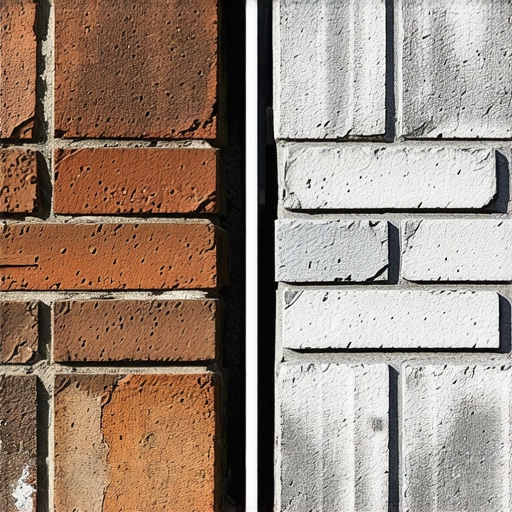
The Forensic Reality of the Modern Masonry Unit
I remember the first time I saw a major failure involving industrial byproduct units. The homeowner thought it was just a hairline crack, a bit of cosmetic dusting on their new garden wall. But when I put my scope inside that cavity, I saw the structural steel was rusted to dust and the units themselves were delaminating from the inside out. This wasn’t a case of bad mortar; it was a fundamental mismatch between the material science and the environment. You see, modern construction loves a ‘green’ alternative, but mother nature doesn’t give a damn about your carbon credits when the temperature drops to ten below and the hydrostatic pressure starts screaming against your foundation.
When we talk about the ‘tooth’ of a masonry unit, we are talking about the physical bond between the mortar—the mud—and the brick. Clay has been the gold standard for five thousand years for a reason. It is a product of fire, vitrified at temperatures exceeding 2,000 degrees Fahrenheit until the minerals fuse into a glass-like state that ignores most of what the atmosphere throws at it. Fly ash, on the other hand, is a different animal. It’s a chemical bond, often relying on the pozzolanic reaction of coal combustion byproducts. It’s clever engineering, but in the field, where freeze-thaw damage restoration becomes a daily reality, the chemistry of a factory floor often fails the test of the shovel and the slicker.
The Physics of the Pore: Why Clay Still Rules the North
In the harsh freeze-thaw cycles of the northern states, water is the ultimate predator. When water enters the pore structure of a masonry unit and freezes, it expands by approximately 9%. If that unit doesn’t have the internal strength to resist that pressure, or the breathability to let the vapor escape before it turns to ice, the face of the brick will pop off. We call this spalling. I’ve spent half my career on spalled concrete steps repair and cracked brick wall repair caused by this exact phenomenon.
“Water penetration is the single greatest threat to masonry durability. The ability of a unit to resist moisture absorption while maintaining vapor permeability is critical to the longevity of the assembly.” – BIA Technical Note 7
Clay bricks, particularly those rated Grade SW (Severe Weathering), have a pore structure that is naturally resistant to this internal trauma. The vitrification process creates a dense, crystalline matrix. Fly ash units, while often possessing high initial compressive strength, can have a more erratic capillary suction profile. If the fly ash isn’t perfectly graded, you get ‘honeycombing’ at a microscopic level. Once moisture gets trapped in those voids, the first hard frost acts like a thousand tiny wedges driving the unit apart from the center. This is why structural masonry inspection is so vital before you buy an older home—you need to know if you’re looking at a legacy clay wall or a mid-century experiment that’s about to give up the ghost.
The Chemistry of the Mud and the Butter
A master mason knows that the mortar must be the sacrificial lamb of the wall. If the mortar is harder than the brick, the brick will break. This is the cardinal sin of the ‘handyman special.’ I’ve seen guys slather Type S high-strength cement over soft, antique clay bricks. The result? The brick can’t expand or contract, so it shatters. When working with fly ash units, the chemistry gets even trickier. Fly ash is naturally pozzolanic, meaning it can continue to react with the lime in your mortar for years. This can lead to an unexpected hardening of the joint, stripping the wall of its ability to ‘breathe’ and move.
When I’m performing failing retaining wall repair, I’m looking for how the units have interacted with the soil. Clay is largely inert. It doesn’t care about the pH of the dirt. Fly ash units, depending on whether they used Class C or Class F ash, can sometimes react to sulfates in the groundwater. I’ve seen modular retaining walls made of inferior composite units that looked like they were melting because the ground chemistry was literally eating the binder that held the ash together. You don’t get that with a hard-fired clay paver or a dense structural block.
The High-Stakes World of Chimneys and Heat
Nothing tests a material like a chimney. You have extreme heat on the inside and freezing rain on the outside. It is the most violent environment a building material can endure. I’ve been called out for chimney cap replacement and chimney heat shield installation on hundreds of homes where the masonry was crumbling like a dry biscuit. Clay flue liners and firebricks are the only things I trust. They handle thermal shock. Fly ash units, because of their chemical binders, can sometimes undergo ‘de-hydration’ at high temperatures, losing their structural integrity. If you’re looking at stone balustrade restoration or a chimney stack, you want materials that were born in a kiln, not cured in a chemical press.
“The brick should be well-burnt, and the mortar should be of the best quality, so that the work may be firm and durable.” – Vitruvius, De Architectura
I’ve watched guys try to fix a sinking porch with foundation slab jacking, only to realize the weight of the masonry was too much for the underlying soil because the units had absorbed so much water weight over the years. Clay is predictable. Fly ash can be a wild card depending on the manufacturer’s ‘recipe’ that day. When you’re buttering a joint, you want to know exactly how much ‘suction’ that brick has. A dry clay brick will suck the moisture out of your mud instantly—you have to wet it down. Some fly ash units have almost zero initial rate of absorption, meaning the brick ‘floats’ on the mortar for twenty minutes, making it nearly impossible to keep a straight soldier course in the wind.
The Foreman’s Verdict: Do It Once, or Do It Twice
In my thirty years of carrying a hawk and trowel, I’ve learned that the cheapest material is the most expensive one you’ll ever buy. Fly ash masonry units have their place—they are excellent for interior partitions or in climates where the thermometer never touches the freezing mark. But if you are building a legacy, something that you want your grandkids to see, you go with clay. You go with the material that rings like a bell when you tap it with a hammer. If it thuds, it’s a dud.
Whether you are dealing with freeze-thaw damage restoration on a historic facade or you are looking at failing retaining wall repair in your backyard, remember the physics. Water wants in. Heat wants out. Gravity wants it all on the ground. A fired clay unit is a shield; a chemically bonded unit is a suggestion. Choose the shield. Don’t be the guy calling me in ten years for a forensic inspection because you wanted to save a nickel on the ‘green’ option. Masonry is the art of permanence. Anything less is just stacking rocks in the mud.