The Day the Facade Breathed: A Forensic Reality Check
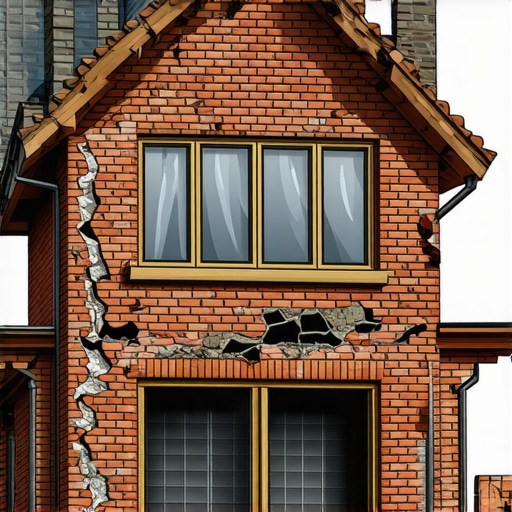
The homeowner called me out because she thought she had a simple cracked brick wall repair job on her hands. She pointed to a hairline fissure near the second-story window. But when I stepped back and looked down the line of the wall, I didn’t see a flat surface. I saw a belly. The brickwork was bowing outward, pregnant with the weight of its own detachment. I took my digital scope, slid it through a mortar joint that had lost its ‘tooth,’ and what I saw was a graveyard of orange dust. The structural steel ties, meant to bridge the gap between the masonry veneer and the wood framing, had completely oxidized. They weren’t just rusted; they were gone. The only thing holding 40,000 pounds of clay brick to that house was gravity and a prayer. This is the ‘shedding’ of a home—a silent, structural divorce that ends in a catastrophic pile of rubble on the sidewalk.
“Water penetration is the single greatest threat to masonry durability, leading to the corrosion of metal ties and the eventual loss of lateral stability.” – BIA Technical Note 7
1. The Horizontal ‘Belly’ and the Physics of Outward Displacement
When we talk about a house shedding its skin, the most terrifying sign is the outward bulge. In a properly constructed wall, the brick isn’t a load-bearing element for the roof; it is a rainscreen. It is tied to the structure using corrugated metal or wire ties. In older homes, especially those where historic brick salvage was used without updated moisture barriers, these ties sit in a damp cavity. In the North, the freeze-thaw cycle is the executioner. Water enters the cavity, cannot escape because the weep holes are clogged with ‘mud’ (excess mortar), and then it freezes. Water expands by 9% when it turns to ice. That expansion exerts thousands of pounds of pressure, pushing the brick away from the studs. Once the tie snaps or rusts through, the wall begins to ‘belly.’ If you see a shadow where the wall should be flush, you aren’t looking at a cosmetic issue; you are looking at a structural failure that requires immediate brick infill panel repair or full-scale stabilization.
2. Rust Jacking and the Death of the Soldier Course
The second sign is often found above windows and doors. This is where brick lintel replacement becomes the surgical necessity. The lintel is the steel angle iron that carries the weight of the bricks over an opening. When these steel members are exposed to moisture, they undergo a process called ‘rust jacking.’ As iron oxides form, they occupy up to ten times the volume of the original metal. This expansion lifts the soldier course—those vertical bricks standing like sentries above your windows—and cracks the mortar joints. I’ve seen lintels so swollen they’ve snapped the surrounding masonry like a dry twig. If you see ‘stair-step’ cracking radiating from the corners of your windows, the internal skeleton is failing. We don’t just ‘butter’ these cracks with more cement; we have to excavate the failing steel and restore the structural integrity before the header collapses into the living room.
“Metal accessories for masonry, including ties and anchors, must be protected by a coating of zinc or be made of stainless steel to prevent corrosive expansion.” – ASTM A153/A153M
3. The ‘Sandy’ Mortar and the Loss of Mechanical Bond
If you can scrape the mortar out of your joints with a fingernail, your house is shedding its binding agent. This is common in brick patio restoration and old facades where a ‘handyman’ used modern Portland cement to patch 19th-century lime mortar. In the masonry world, we have a law: the mortar must be softer than the brick. Old clay bricks are porous and ‘breathe.’ Modern cement is a hard, vapor-impermeable block. When the wall shifts, the hard cement doesn’t give; it crushes the face of the soft brick, a process called spalling. This is why flush pointing services must use Type O or Type K lime-based mortars for historic work. Without the right ‘suction’ during the brick patio restoration or wall repair, the new ‘mud’ will simply peel off in sheets, leaving the structural ties exposed to the elements. For those looking at digital twin masonry projects, we can now map these failures with thermal imaging to see exactly where the moisture is trapped behind the veneer.
The Solution: Beyond the Band-Aid
Fixing a shedding house isn’t about slapping on porous stone sealers and hoping for the best. It requires a deep understanding of the outdoor kitchen masonry build or the residential facade’s unique physics. We use helical stainless steel ties that are driven through the brick and into the backup material—whether it’s CMU, concrete, or wood—to re-establish that lateral connection. We then follow up with cracked brick wall repair that matches the original aggregate and color of the historic masonry. Don’t be fooled by tile grouts on masonry applications; they lack the compressive strength and breathability needed for exterior survival. Do it once, or you’ll be doing it twice when the wall is lying in your flower bed. Real masonry is about the chemistry of the bond and the physics of the load. If your house is shedding, it’s telling you the bond is broken. It’s time to listen before the silence is broken by a crash.