
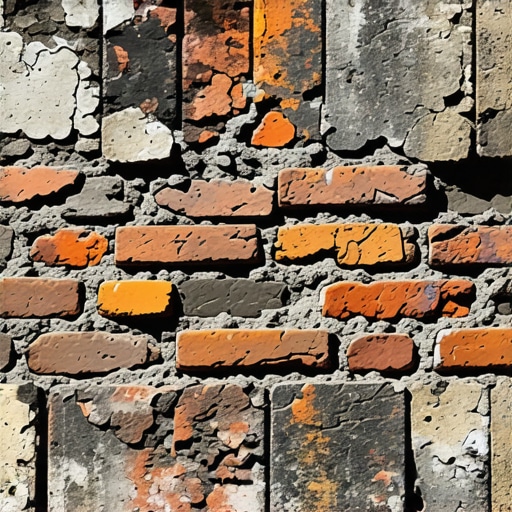
The Forensic Scene: The Skeleton Behind the Skin
The homeowner pointed to a thin gap where the brick met the soffit—maybe three-eighths of an inch. She thought it was just a hairline crack, a bit of settling, nothing a few tubes of caulk couldn’t hide. But as a third-gen mason, I know that ‘settling’ is the lie we tell ourselves to sleep at night. I didn’t reach for my trowel; I reached for my borescope. I drilled a quarter-inch hole into a head joint and slid the fiber-optic lens into the cavity. What I saw wasn’t just ‘age.’ It was a graveyard. The structural steel wall ties, meant to be the invisible tendons holding that 40-ton brick skin to the house, were rusted to orange dust. They didn’t even look like metal anymore; they looked like brittle, corrugated wafers. One good wind gust—what we call a lateral load—and that entire brick facade would have peeled off like sunburnt skin. This isn’t just a repair job; it is a forensic rescue mission.
The Physics of the Pull: Why Your Wall is Leaning
A brick veneer is a beautiful deception. It looks like a fortress, but it is actually a non-structural curtain. It carries its own weight vertically—the dead load—down to the foundation, but it cannot stand up against the wind on its own. It needs wall ties. In the old days, we used heavy-gauge galvanized steel. In the ‘cheap’ days, contractors used thin, flimsy corrugated strips that had the structural integrity of a soda can. When these ties fail, the wall begins to ‘bow’ or ‘belly.’ You might notice it first at the corners, near the brick quoin repair sites, where the geometry of the house changes. The chemistry here is brutal. When moisture enters the cavity—and it always enters the cavity—it reacts with the oxygen and the steel. This is the oxidation cycle. But here is the kicker: rust expands. As that steel tie corrodes, it can grow to ten times its original thickness. This ‘rust jacking’ actually pushes the brick away from the frame before the tie finally snaps.
“Corrosion of metal ties in masonry cavity walls can lead to a total loss of lateral stability, often without visible warning on the exterior face.” – BIA Technical Note 28B
The Moisture Trap: The Silent Killer of Masonry
Why do these ties rot? It usually comes down to a failure in masonry water damage repair protocols. Modern homes are built with a ‘drainage wall’ philosophy. We expect water to get behind the brick. That is why we have a cavity and weep holes. But if the original mason was sloppy with his mud, he likely dropped excess mortar down into the cavity. This is called ‘bridging.’ That pile of wet mortar sits against the metal ties, holding moisture against the steel for weeks after a rainstorm. It creates a micro-environment of permanent dampness. If you are seeing brick wall restoration needs, check your weeps. If they are plugged with dirt or, worse, if a ‘handyman’ caulked them shut because he thought they were ‘holes that shouldn’t be there,’ you are essentially drowning your wall ties in a vertical pond.
AI Masonry Assessment: The Modern Inspector’s Toolkit
We don’t guess anymore. With AI masonry assessment, we use thermal imaging and acoustic pulse technology to map the density of the wall. An infrared scan can show me ‘cold spots’ where moisture is trapped in the insulation or behind the veneer, signaling exactly where the wall ties are most likely to be compromised. It allows us to perform flush pointing services with surgical precision, targeting only the areas where the bond has failed. We can now identify if a wall is leaning by as little as 2 millimeters over a 10-foot span. If the lean is significant, we have to talk about foundation helical pier installation to stabilize the base before we even think about the brickwork. You can’t fix a leaning hat if the head is crooked.
The Restoration Reality: Fiber-Reinforced Mortars and Helical Ties
When we go in for a brick wall restoration, we aren’t just slapping on new mud. We use fiber-reinforced mortars that offer superior tensile strength and ‘bite’ compared to the brittle mixes of the 1970s. For the ties themselves, we use stainless steel helical anchors. We drill through the brick into the backup material—whether it is wood, CMU, or concrete—and ‘thread’ a new tie into place. This creates a mechanical connection that won’t rust out in our grandchildren’s lifetime. If the damage is extensive, we might look into mortarless masonry systems for specific architectural accents, or even green roofing masonry integration to manage water runoff better at the source.
“All fasteners and ties should be of highly corrosion-resistant materials, preferably stainless steel or hot-dip galvanized steel, to ensure the design life of the structure.” – ASTM A153/A153M Standards
The Micro-Zoom: The Chemistry of the Bond
Every time I butter a brick, I’m thinking about the ‘suction.’ If the brick is too dry, it sucks the water out of the mortar too fast—a ‘flash set’—and the bond never truly forms. This is ‘cold joint’ territory. If the brick is too wet, it ‘floats’ and the mud won’t hold. Getting that perfect ‘tooth’ in the mortar is what separates a Master Mason from a guy with a bucket. In outdoor masonry fountain restoration, this is even more critical because the pH of the water can eat away at the lime in the mortar. We use specific admixtures to ensure the slicker leaves a joint so tight that water beads off it like a duck’s back. Don’t let a ‘handyman special’ ruin your home’s envelope. If your veneer is pulling away, the clock is ticking. You are looking at a structural failure, not a cosmetic blemish. Treat the cause, not the crack. Do it once, do it right, and use the best materials science has to offer. Anything less is just waiting for the collapse.