
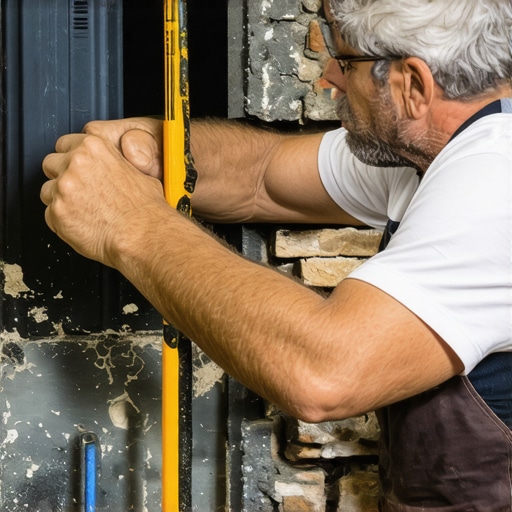
The Ghost in the Wall: A Forensic Discovery
The homeowner thought it was just a hairline crack, a minor blemish on a 1950s Georgian revival. But when I put my fiber-optic scope inside that cavity, the reality was grimmer than a cold November rain. I didn’t see steel; I saw a ghost. The original corrugated wall ties, those critical umbilical cords connecting the brick veneer to the structural frame, had rusted to a fine red powder. The outer wythe of brick was standing by habit and gravity alone, a 20-ton curtain of clay ready to peel away with the next high wind. This is the silent crisis of brick veneer detachment repair. Most folks look at their brickwork and see an invincible mountain. I see a dynamic, breathing system where the chemistry of the air and the physics of moisture are constantly at war with the metal holding it all together.
“Corrosion of metal ties in masonry cavity walls can lead to significant structural distress and potential collapse of the veneer wythe.” – BIA Technical Note 28B
The Micro-Physics of Oxidation and the Dew Point
To understand why your wall is failing, we have to talk about what happens in the dark. Within that two-inch air space between your drywall and your brick, there is a constant cycle of condensation. Brick is a sponge; it has high porosity and ‘suction.’ When the sun hits a damp wall, it drives moisture inward through capillary action. This moisture eventually hits the cooler cavity and condenses. If your wall ties are made of the cheap, mill-galvanized scrap common in mid-century builds, the zinc coating is gone in twenty years. Once the bare steel is exposed, the chemical oxidation process begins. The steel expands as it rusts—sometimes up to ten times its original thickness—which creates ‘rust jacking.’ This expansion is what causes those horizontal cracks that mirror your brickwork pointing styles. It is not just an aesthetic issue; it is the sound of the wall’s skeleton turning to dust.
Structural repointing is often the first thing people ask for, but you cannot fix a broken skeleton with a skin graft. If the ties are gone, you have to perform a surgical intervention. We use stainless steel helical ties now. These are driven through the brick and into the backup material—be it wood, block, or concrete—using a specialized tool that ensures they ‘bite’ into both surfaces without shattering the brick’s core. It’s about restoring the lateral load transfer. Without these ties, the wind load isn’t shared by the house; it’s borne entirely by a single layer of unreinforced masonry. [image_placeholder_1]
The Restoration Reality: Mortar Science over Convenience
When we get into crumbling mortar joint repair, I see the same mistake every time: some ‘handyman special’ has used high-strength Portland cement on a wall built with lime. It’s a death sentence for the brick. Old bricks are soft and breathable. If you slap a Type S mortar—a ‘hard mud’—into those joints, you’ve created a trap. The brick will expand with thermal heat, but the mortar won’t give. The result? The face of the brick pops off in a process called spalling. I’ve spent thirty years telling people that the mortar must be the ‘sacrificial’ element. It should be softer than the brick so that when the house breathes, the mortar takes the stress, not the clay.
“The selection of mortar for restoration must ensure the mortar is weaker than the masonry units to prevent sacrificial damage to the brick.” – ASTM C270 (Modified Context)
We mix our mud with a hawk and trowel, looking for that perfect ‘tooth.’ When we perform structural repointing, we aren’t just filling a hole. We are ‘buttering’ the joints to ensure a full bond that prevents water from sitting on the bed joint. If you use a slicker tool too early, you trap moisture inside. You have to wait for the mortar to be ‘thumb-print hard’ before you strike it. This compresses the aggregate and creates a weather-tight seal. This isn’t just masonry repair services; it’s masonry forensics.
Why Most ‘Fixes’ Fail: From Tile Grouts to Concrete Flatwork
I often see homeowners trying to use tile grouts on masonry or thin-set adhesives to fix loose bricks. It’s a joke. Grout is designed for non-porous environments with zero movement. Masonry moves. A long brick wall can expand and contract half an inch over a summer. If you don’t have control joints and the right ‘mud,’ the wall will find its own way to move, usually by cracking through the middle of your most expensive soldier course. Furthermore, the health of your wall depends on the ground it sits on. I’ve seen concrete flatwork services pour driveways right up against the weep holes of a brick house. When you plug those weeps, you turn your wall cavity into an aquarium. The moisture has nowhere to go but into your sill plate, leading to rot and an invitation to every termite in the county.
For those looking for an aesthetic refresh, metallic brick colors application has become popular, but you have to be careful. You can’t just paint a brick wall with latex and expect it to live. You need breathable silicate stains that bond chemically with the masonry. After the repair, masonry cleaning with the right proprietary acids—not just a power washer on high—is essential to remove the efflorescence, that white salty crust that’s the herald of moisture problems. If you have pavers nearby, don’t neglect masonry joint sand repair. If the sand is gone, water is saturating the base of your foundation, which leads to the very settlement that snaps those brittle, rusted ties in the first place.
The Forensic Conclusion: Do It Once or Do It Twice
You can ignore the ‘stair-step’ cracks and the slight bulge in your gable end. You can hire a guy with a bucket and a ladder to ‘smear some mud’ over the problem. But physics doesn’t care about your budget. The ‘lick-and-stick’ approach to masonry is why we have so many failing modern homes. Real masonry—the kind that lasts a hundred years—is about managing water and respecting the materials. Replacing hidden brick ties is a high-stakes game. It requires an inspector who knows how to read the ‘bloom’ of a crack and a craftsman who isn’t afraid of the dust. If you see your veneer leaning, don’t wait for the collapse. Address the brick veneer detachment repair now, or prepare to pick your house up off the lawn in ten years. Masonry isn’t just about what you see on the surface; it’s about the integrity of the hidden steel and the chemistry of the mud that holds it all together.
[image_placeholder_2]