
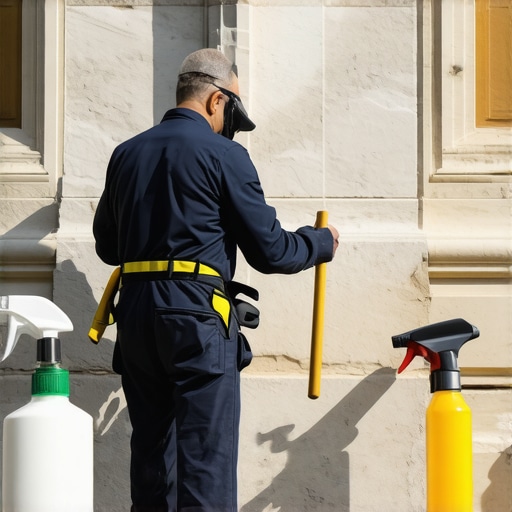
The Forensic Scene: The Death of a Limestone Balustrade
I was called to a job site last spring where a homeowner was in tears over a historic limestone balustrade restoration project. From twenty feet away, it looked like the stone had a skin disease. Up close, it was worse. A ‘handyman’ had used a 4,000 PSI pressure washer and a bucket of muriatic acid to ‘clean’ the soot off the stone. He didn’t just clean it; he lobotomized it. By the time I arrived, the protective patina—the fire-hardened skin that the stone had developed over eighty years—was gone. The stone was ‘fuzzy’ to the touch, a sign that the acidic reaction had dissolved the calcium carbonate binder, leaving the raw silt and sand behind. This is the reality of modern facade cleaning: most people think they are ‘beautifying’ a building when they are actually accelerating its return to the earth.
“Water penetration is the single greatest threat to masonry durability. Improper cleaning that increases surface porosity can lead to a 500% increase in water absorption rate.” – BIA Technical Note 20
The Physics of the ‘Tooth’ and Why Pressure is Your Enemy
When we talk about masonry repair services and facade cleaning, we have to talk about the ‘tooth’ of the stone. Every natural stone has a surface tension and a specific pore structure. When you blast it with high-pressure water, you aren’t just removing dirt; you are performing micro-demolition. This ‘honeycombing’ effect creates new pathways for water to enter. In a freeze-thaw climate, that water expands by 9% when it turns to ice. If you’ve just stripped the surface, you’ve basically invited the ice to tear the stone apart from the inside out. Before you even think about applying porous stone sealers, you have to understand the chemistry of what you’re removing. Is it biological growth like lichen and algae, or is it atmospheric soot? Using the wrong chemical is like trying to fix a watch with a sledgehammer. A stone balustrade restoration requires a gentle hand and an understanding of pH levels. If the stone is acidic (like granite), it can handle different cleaners than an alkaline stone (like limestone or marble).
The Micro-Zoom: The Chemistry of Carbon Crusts
In urban environments, stone facades develop what we call a carbon crust. This is a mix of gypsum, soot, and pollutants that chemically bonds to the stone. If you just ‘butter’ some soap on there and scrub, nothing happens. But if you hit it with too much pressure, the crust pulls a chunk of the stone off with it. The forensic way to handle this is through ‘nebulous’ misting. We set up tiny nozzles that spray a fog of water over the stone for 24 to 72 hours. This slowly softens the crust, breaking the ionic bond without damaging the substrate. It’s slow. It’s tedious. It’s the only way to do it right. Once that crust is soft, we use a natural bristle brush—never steel—to work the ‘mud’ off the surface. This prepares the wall for chimney structural repair or simple repointing without compromising the structural integrity of the unit itself.
“Cleaning methods should be the gentlest possible to achieve the desired result. Harsh chemical cleaners can leave residual salts that cause efflorescence and subflorescence.” – ASTM C67/C67M Standard Test Methods for Sampling and Testing Brick and Structural Clay Tile
The Science of Porosity and Sealing: Don’t Trap the Monster
Most people want to seal stone as soon as it’s clean. That’s a death sentence for the wall. A stone facade is a breathing organism. It needs to move moisture from the inside to the outside. If you apply a film-forming sealer—the kind that makes the stone look ‘wet’ or shiny—you are essentially wrapping your house in plastic wrap. Any moisture that gets behind the wall (and it will, through chimney flashing repair issues or foundation wall bowing repair cracks) gets trapped. When that moisture hits the back of the sealer, it can’t escape. It sits there, rot starts, and eventually, the face of the stone just ‘spalls’ or pops off. When I specify porous stone sealers, I’m looking for silanes or siloxanes. These are small-molecule penetrants. They don’t sit on top; they dive into the pores and line them with a hydrophobic coating while still allowing water vapor to pass through. It’s the difference between a raincoat and a Gore-Tex jacket.
The Critical Sequence: From Chimney to Foundation
You never clean a facade in isolation. You have to look at the whole system. If you have a chimney sweep and repair team on-site, they should be looking for failing mortar joints before the cleaning starts. If water gets behind the stone during the cleaning process because of a ‘soldier course’ with open joints, you’re just pumping water into the wall cavity. This leads to hidden mold and rusted wall ties. The same goes for the ground level. If you are dealing with retaining wall batter correction or a retaining wall geogrid installation, you need to ensure that the drainage is managed so that the cleaning runoff doesn’t saturate the soil and cause hydrostatic pressure against the foundation. A forensic inspector doesn’t just look at the dirt; they look at the path of the water. We check the ‘slicker’ work on the joints and ensure the ‘hawk’ was used to properly fill every void before a single drop of cleaner is applied.
The Hard Truth About Restoration
I’ve seen too many ‘pro’ crews come in with a ‘slicker’ tool and some bag-mix mortar, thinking they can fix a century-old wall. They don’t realize that old stone requires a ‘sacrificial’ mortar—one that is softer than the stone itself. If the mortar is harder than the stone (which most modern Portland cement is), the stone will be the thing that breaks when the building shifts. This is why masonry repair services must include a mortar analysis. We don’t just guess the mix; we look at the sand grain size and the lime content. Whether it’s chimney structural repair or fixing a bowing foundation, the materials must be compatible. Cleaning is the first step in this forensic journey. If you do it wrong, you’ve failed before you’ve even started. Do it once, do it right, or don’t do it at all. The stone has survived a hundred years without you; don’t let your ‘cleaning’ be the thing that finally kills it.