
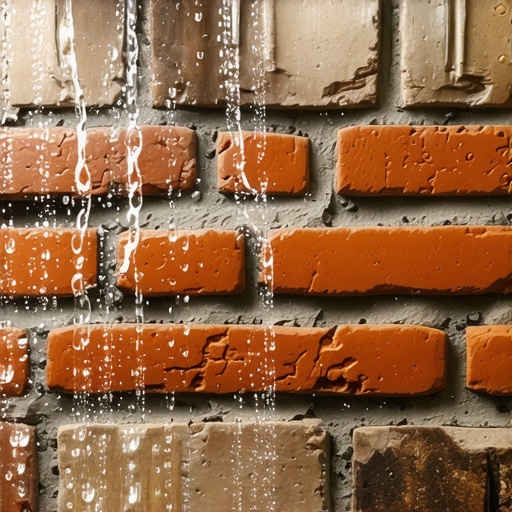
The Forensic Scene: When ‘Waterproof’ Becomes a Death Sentence
I recently walked onto a job site where the homeowner was frantic. They had a gorgeous 1920s Tudor-style home, but the interior plaster was bubbling and the basement smelled like a swamp. ‘I had it sealed last year,’ the owner told me, pointing to a shiny, plastic-looking coating on the exterior. I pulled out my structural masonry inspection scope and looked behind a single spalling brick. What I saw was a horror show: the underlying historic brick salvage was so saturated it had the consistency of wet cardboard. The structural steel lintels were rusted to half their original thickness. That ‘sealer’ wasn’t keeping water out; it was keeping the water in, turning the house into a slow-cooking pressure cooker. This is the reality of modern masonry failures—the fundamental misunderstanding of how a wall breathes.
“Water penetration is the single greatest threat to masonry durability.” – BIA Technical Note 7
The Physics of the Pore: Why Bricks Are Sponges
To understand how to keep a wall dry, you have to stop thinking of brick as a solid rock. It’s a series of interconnected capillary tubes. When rain hits a wall, it doesn’t just run off; it gets sucked in through capillary suction. In a healthy wall, this moisture eventually migrates back to the surface as vapor and evaporates. This is ‘breathability.’ When you apply a cheap ‘lick-and-stick’ stone veneer over brick without a drainage plane, or use a non-breathable sealant, you kill that migration. The water enters through hairline cracks in the mortar joints, gets trapped behind the impervious layer, and then the real damage begins. In our climate, the freeze-thaw cycle takes over. That trapped water expands by 9% when it turns to ice, blowing the face off your brickwork in a process we call spalling. I’ve seen 100-year-old bricks destroyed in two winters because someone used the wrong mud.
The Mud Matters: High-Performance Mortar Mixes vs. Historic Reality
I’ve watched ‘handymen’ mix up a batch of bag-mix Portland cement and slap it into a 19th-century wall. It’s a crime. Historic bricks were fired at lower temperatures, making them softer and more porous than modern units. If you use a hard, modern high-performance mortar mix—anything with a high Portland content like Type S—you’re creating a wall that is destined to fail. The mortar must be the ‘sacrificial lamb’ of the system. It should be softer than the brick so that when the wall moves or the water expands, the mortar yields, not the brick. For historic restoration, we use lime putty or Type O mortar. This allows for autogenous healing, where the lime actually migrates into small cracks and reseals them over time. This is the ‘Old World’ secret that keeps cathedrals standing while modern condos crumble in thirty years.
Full Repointing Services: The Right Way to Strike a Joint
If your mortar is crumbling or ‘honeycombing,’ you don’t need a bucket of sealant; you need full repointing services. This isn’t just ‘tuck pointing services’—which is often misused as a term for cosmetic fixes—but a structural deep-dive. We grind out the old, failing joints to a depth of at least two times the width of the joint. We then ‘butter’ the joints in lifts, packing the mud tight with a slicker tool. The goal is to ensure there are no voids or cold joints where water can pool. When we’re done, we use a jointer to strike the joint, compressing the surface to create a ‘skin’ that sheds water naturally. It’s about the ‘tooth’ of the mortar grabbing the brick, creating a monolithic barrier that still lets vapor through.
“The property of water vapor transmission is essential for masonry walls to allow internal moisture to escape.” – ASTM C270 Standard Specification for Mortar for Unit Masonry
The Chimney Structural Repair Nightmare
Chimneys are the most vulnerable part of any masonry structure. They are hit by wind, rain, and thermal shock from both sides. Often, I see a chimney structural repair where someone just slapped a crown of concrete on top. Within five years, it cracks, water gets into the flue, and the whole stack starts to lean. A real mason uses a concrete pump masonry mixes for the core if needed, but the exterior must be finished with a proper overhanging wash and a drip edge. Without that drip edge, water just rolls down the side of the chimney, soaking into every soldier course and header. If you see white powder on your chimney, that’s efflorescence—the salt being pushed out by migrating water. It’s your chimney’s way of screaming for help.
Modern Failures: Stone Veneer and Foundation Woes
I have a particular loathing for stone veneer over brick. It’s a trend that creates a massive moisture trap. People want the ‘look’ of stone without the cost, so they glue thin slices of rock to their structural brick. This creates a double-vapor barrier that leads to rapid foundation rot. If you must have a new look, consider mortarless masonry systems that incorporate a built-in air gap. This ‘rainscreen’ principle allows water to drain down the back of the veneer and exit through weep holes at the bottom. Without drainage, you’re just building a vertical pond. For foundations, the same rules apply. Hydrostatic pressure from saturated soil will find its way through any hairline crack. You don’t just patch the crack with epoxy; you fix the drainage. Gutters, grading, and proper damp-proofing are the only ways to keep your basement from becoming a grotto.
The Master Mason’s Final Word
Don’t be fooled by ‘miracle’ sprays or ‘waterproof’ paints. Masonry is a living, breathing system of clay and lime. If you treat it like plastic, it will fail you. Whether you’re looking at historic brick salvage for a restoration project or pouring a new slab, remember the masonry hierarchy: water must be managed, not just blocked. Respect the suction of the brick, the chemistry of the lime, and the physics of the freeze-thaw cycle. If your mason doesn’t talk about vapor transmission or the ‘tooth’ of the mortar, find one who does. Do it once, or do it twice—the choice is usually written in the cracks of your walls.